New MacBook Pro with Retina Display
A Retina display with 5.1 million pixels. An all-flash architecture. Quad-core Intel Core i7 processors. In a design that’s just 0.71 inch thin and 4.46 pounds. It’s not just the most advanced notebook Apple have ever made, it’s the most advanced Mac they’ve ever made.
Retina Display
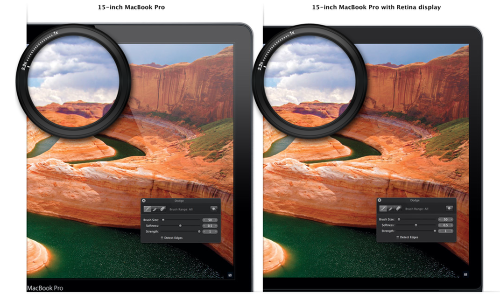
When you pack over 5 million pixels into a 15.4-inch display, the results are positively stunning. The pixel density is so high, your eyes can’t discern individual pixels. Images take on a new level of realism and text is pin sharp. And with a 2880-by-1800 resolution, you can see more of your high-resolution images onscreen with pixel-for-pixel accuracy. So your best ideas can become your best work.
The new Retina display reduces glare while maintaining incredible color and quality. In fact, it has a 29 percent higher contrast ratio than a standard MacBook Pro display. Blacks are blacker. Whites are whiter. And everything in between is rich and vibrant. IPS technology gives you a wide, 178-degree view of everything on the screen, so you’ll see the difference at practically any angle.
All-flash Storage

When your goal is to build the high-performance notebook of the future, you begin at its foundation. For this MacBook Pro, that foundation was flash. Because when you build a notebook around an all-flash architecture, not only is everything more durable, reliable, and battery efficient — everything is fast. Really, really fast.
There’s a reason they call it “flash.”
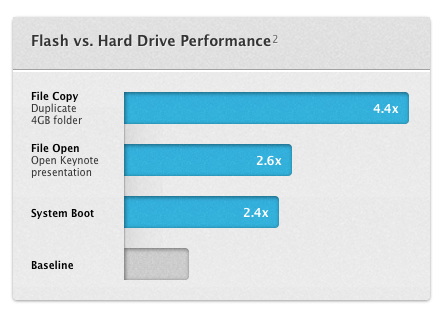
You’ll notice a difference in whatever you do — starting up takes seconds, apps launch quickly, even navigating the desktop feels incredibly fluid and responsive. It’s all thanks to flash storage, which gives you up to four times the performance of a traditional hard drive.1 When you use apps like Final Cut Pro or Aperture, you can perform even the most demanding tasks right from your internal storage. And since the all-new MacBook Pro comes with up to 768GB of flash storage, you can keep all your important files with you, including large video and photo libraries. Flash doesn’t have any moving parts, which makes it superdurable and quiet. It also has the ability to stay in standby mode for up to a month. Whether it’s been 1 day or 30, this all-flash MacBook Pro will spring to life, right where you left off.
Long-lasting Battery
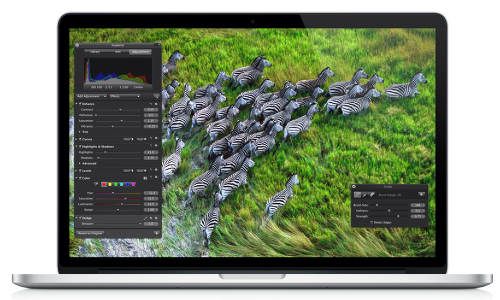
The all-new MacBook Pro has more than just processing power. It has an incredible amount of battery power, too. So you can do more than ever — all on a single charge.
A 7-hour battery life is impressive for any notebook. But for a high-performance notebook with an ultra-high-resolution display, top-of-the-line processors and graphics, and a superslim design, it’s absolutely remarkable. The built-in 95-watt-hour battery gives you up to 1000 full charge and discharge cycles and up to 30 days of instant-on standby time.3 Which means you can put your MacBook Pro to sleep, and it’ll come back on instantly — after a day, a week, or even a month. With Power Nap coming this summer in OS X Mountain Lion, your MacBook Pro can continue to receive new email and calendar invitations while it’s asleep. And when it’s connected to a power source, it can download software updates and make backups with Time Machine. So the next time you open your notebook, everything’s right there waiting for you.
The New Mobile Powerhouse.

This notebook has the power to do amazing things. Third-generation Intel Core i7 Ivy Bridge processors with a state-of-the-art 22-nanometer single-die microarchitecture provide the fastest quad-core performance ever in a notebook. Hyper-Threading technology allows two threads to run simultaneously on each core. And with speeds up to 2.7GHz, 6MB of shared L3 cache, and Turbo Boost speeds up to 3.7GHz, these processors are great for running professional applications like Aperture and Final Cut Pro. They also support up to 16GB of superfast 1600MHz memory. Which means the all-new MacBook Pro is ready to take on whatever you can dream up.
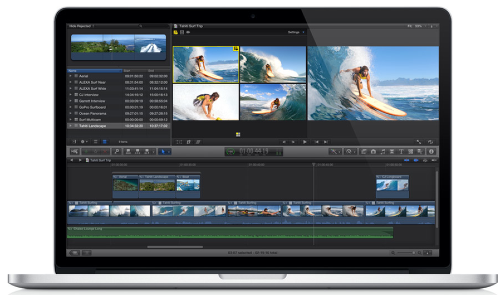
The all-new MacBook Pro has a phenomenal display — and a GPU to match. Based on a next-generation Kepler architecture with 1GB of dedicated video memory, the NVIDIA GeForce GT 650M graphics processor provides up to 60 percent faster graphics performance than any notebook we’ve ever made.4 And it delivers enough power to drive the amazing 5-million-pixel Retina display as well as two external displays. All while making the most graphics-intensive tasks — like rendering HD video and editing RAW photography — fast, fluid, and incredibly lifelike.

Joanne Carter
Joanne Carter is a British photography journalist, editor, curator, and the founder of *TheAppWhisperer.com*, one of the world’s leading platforms dedicated to mobile photography and art. Since its launch in 2009, TheAppWhisperer has become an international hub for artists of all levels to discover, learn, exhibit, and engage with contemporary photographic practice.Built on principles of inclusivity, accessibility, and artistic excellence, Joanne has spent almost two decades championing mobile photography as a serious artistic medium. Through interviews, critical essays, exhibitions, competitions, and education, she has helped shape and document the evolution of mobile art on a global scale.Her work has taken her internationally, lecturing on photography and mobile art at institutions and events including the Museum of Art in Seoul, South Korea, alongside appearances in the UK and Europe. She has served as a juror for international photography and mobile art awards across Portugal, Canada, the United States, South Korea, Italy, and the UK.Joanne is also the founder of *TheAppWhispererPrintSales.com*, one of the first online galleries dedicated exclusively to collectible mobile art, connecting artists with collectors across Europe, the United States, and Asia.Before founding TheAppWhisperer, Joanne worked extensively in print journalism and photographic publishing, including roles at a paparazzi photo agency and as deputy editor of a leading photography magazine. Her freelance journalism, criticism, and commentary have been published widely in both the UK and the US, with bylines in *The Times*, *The Sunday Times*, *The Guardian*, *Popular Photography*, *NikonPro*, *DPReview*, *Which?*, *Vogue Italia*, *LensCulture*, the *BBC*, and more recently, the *Financial Times*, where her published letters on photography continue to contribute to wider conversations around the medium.Alongside her editorial and curatorial work, Joanne’s own photographic practice has been exhibited internationally across the UK, Europe, South Korea, and the United States. Her work increasingly explores themes of grief, loss, death, memory, and the body.Her current research interests centre on grief, death, and poverty, with forthcoming postgraduate study leading towards doctoral research in these areas.Joanne is currently developing new long-form writing and photographic projects and is available for commissions, editorial projects, speaking engagements, and collaborations.Contact: joannetheappwhisperer@gmail.com)