
Photo Book Review – Sleepers by Sophie Calle
It is a rare thing these days to hold a book that doesn’t simply tell a story but becomes one in your hands. Sophie Calle’s The Sleepers, now newly published in English by Siglio Press, is exactly such an object—a book that begs not only to be read but to be held. To press your palm against its quilted, pillowy cover is to be reminded that this is no ordinary text. It is soft, like the cheek of someone you love; it gives under your fingers, like a mattress that remembers the shape of your rest. The cover is padded, yes—physically—but emotionally, too, it cushions you for the quiet interior journey that lies ahead.
This is not my first encounter with Calle, whose work I’ve long admired for its unapologetic blend of vulnerability and voyeurism. But The Sleepers struck something different in me. Maybe it’s because it touches on something so profoundly universal, so achingly human: the act of sleep, and the exquisite solitude—or shared intimacy—it offers.
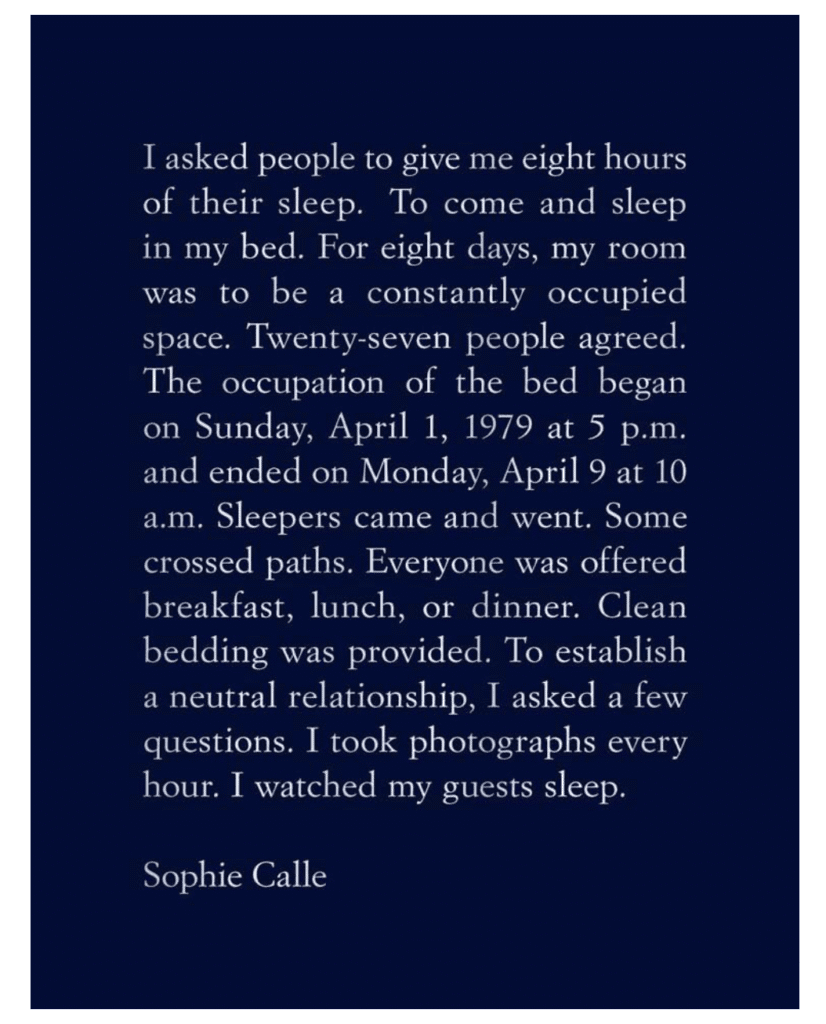
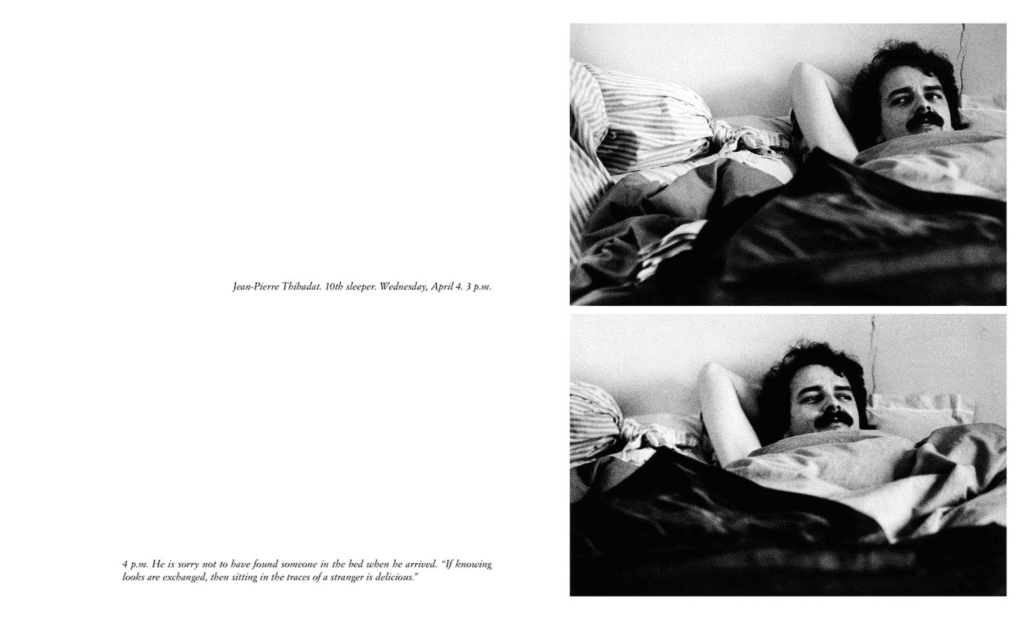
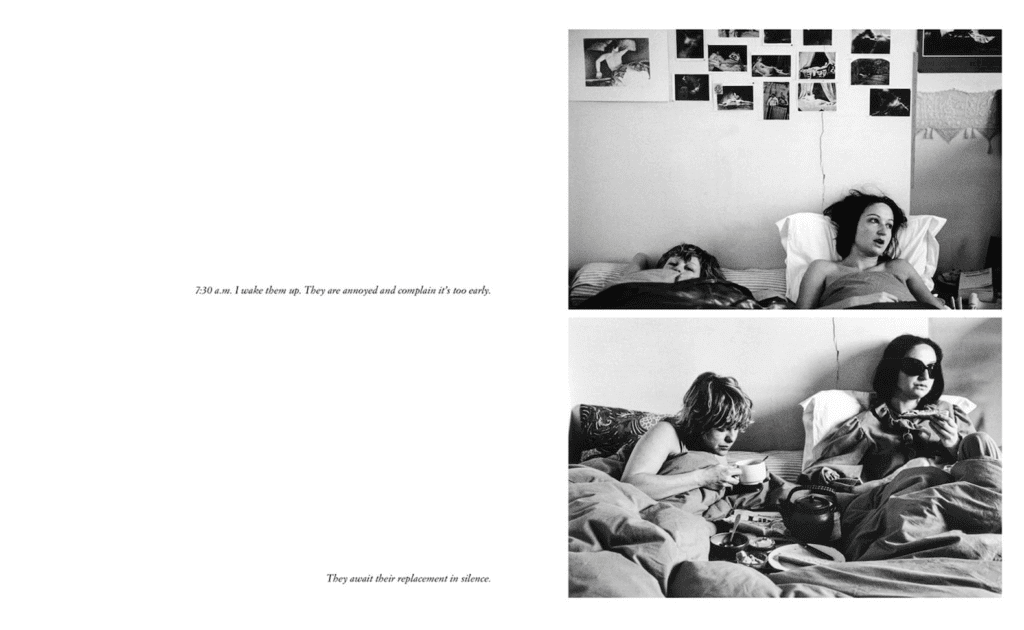
Back in 1979, Calle invited twenty-eight people (friends, lovers, strangers) to sleep in her bed in rotating shifts for eight days. Some stayed a night. Others, just a few hours. She did not sleep herself but remained ever-present—documenting, photographing, watching, writing. She became the quiet sentinel of her bed. The result is this book: part diary, part dream journal, part photographic essay, and entirely a study of trust, in exposure, and the poetry of the ordinary.
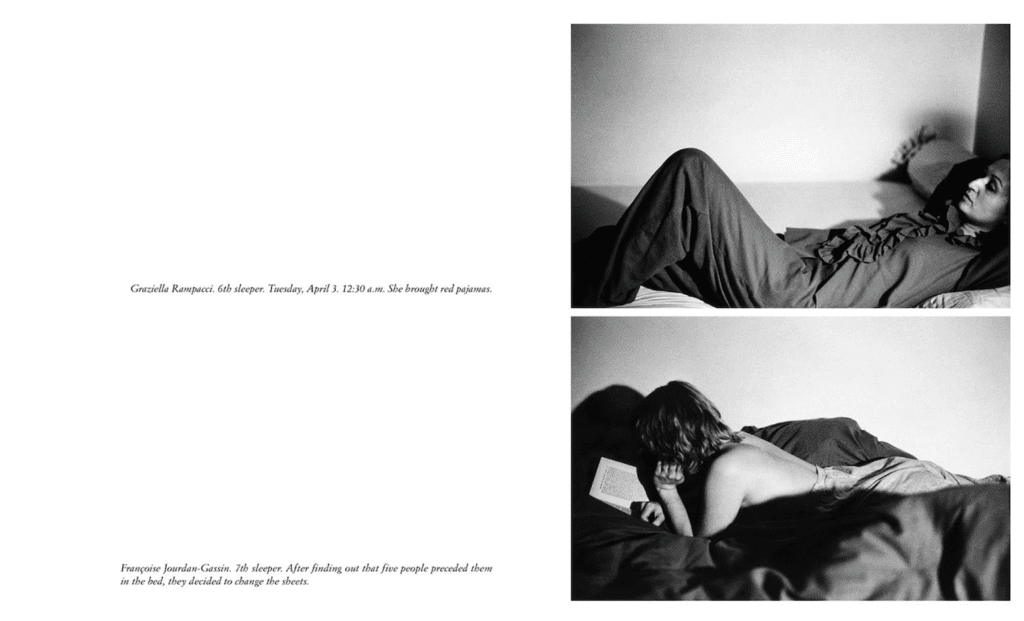
Each “sleeper” is given a little space of their own in the book. Calle records their arrival, their habits, and their moods. She photographs them as they lie in bed—some curled tightly into themselves, others sprawled out as if fully at ease. Some look like children, lost in the serenity of deep sleep; others seem restless, even vulnerable. What is striking is how each portrait feels both deeply personal and utterly universal. You don’t just see the person lying in bed—you recognise them. You know what it feels like to lie like that. You know that position of the hand, the twist of the shoulder, the way the duvet folds around the hips.
But the book is more than just a catalogue of sleepers. It is, in essence, an exploration of absence and presence. Calle is there, always watching, always writing. But she is never the subject. Her absence—her refusal to insert herself beyond the occasional note—feels paradoxically like a constant presence. She is the eye that sees but is not seen. She is the reader before us. And in that way, we, too, are made complicit.
There’s a beautiful discomfort to it all. As you flip through the pages, with their careful notes and quiet, black-and-white photographs, you begin to feel like you’re snooping. Like you’ve stumbled upon someone’s secret diary. And perhaps, in a way, you have. Calle invites us to inhabit the same space she created in 1979: a space where sleep was made public, where the private act of rest was offered up as material for art. And it’s impossible not to feel slightly guilty for enjoying it as much as you do.
The design of the book only enhances this sensation. That padded cover—the tactile allure of it—echoes the vulnerability within. It feels like a comfort object, a talisman. And when you open it, the spine reveals itself in that Swiss binding: exposed, but deliberate. A book that shows its bones. The metaphor writes itself.
There’s something particularly British, I think, about the way I approached this book. I picked it up at dusk, a cup of tea going lukewarm on the armrest beside me, the rain tracing half-hearted lines down the windowpane. The house was quiet. And I read it slowly, almost reverently, as if each page were a whispered confession. It felt like peering into the lives of ghosts—not spectral, exactly, but distant. Like people you once knew in dreams.
And what struck me most was the contrast between the banality of the project and the emotional resonance it carries. Calle didn’t do anything grandiose. She asked people to sleep. That’s all. No performance. No drama. Just bodies, resting. And yet it tells us more about human connection, about loneliness, about the need to be witnessed, than most novels I’ve read this year.
There’s also a strange eroticism that pulses just beneath the surface—not in a salacious way, but in the deeply intimate sense of sharing a bed. Even if you’re not touching, to lie beside someone is to surrender something. To sleep in someone’s bed is, in a way, to inhabit their absence. Calle captures that beautifully. You can almost hear the quiet rustle of fabric, the sighs, the creak of springs shifting under the weight of a body trying to find peace.
The English translation does justice to the original, maintaining that soft-spoken tone that Calle’s work often carries. The entries are brief, sometimes almost clinical, but laden with suggestion. A note that “she pulled the covers up to her chin and did not speak for an hour” says volumes. A simple observation like “he hummed to himself before falling asleep” becomes an entire character study.
What stays with me, long after closing the book, is not a single image or phrase, but a feeling. A kind of melancholic warmth. A tenderness for people I’ve never met. A renewed awareness of the strangeness and beauty of sleep—the way we all let go of ourselves, for a few hours each day, and hope to be safe. And perhaps, if we’re lucky, seen.
I also found myself reflecting on my bed, my habits, and the way I sleep when no one’s watching. Would I have done it, I wondered? Would I have accepted Calle’s invitation in 1979 to come sleep in a stranger’s bed, to be photographed, to be observed? I don’t know. But the very fact that I asked myself the question proves the power of the book. It draws you in, not just to observe others, but to consider your self—the private self, the one that only exists in sleep.
There’s something deeply poetic about Calle’s decision not to sleep during the project. For eight days, she remained awake—keeping vigil, recording, witnessing. And perhaps that’s what art is, in the end: the act of staying awake while the world dreams. The book doesn’t offer conclusions. It doesn’t analyse or explain. It simply presents. And in doing so, it becomes something much more than the sum of its parts.
The Sleepers is not a book you “read” in the traditional sense. It’s a book you experience. You move through it slowly. You sit with it. You let it seep into your skin. It is a quiet masterpiece—strange, gentle, haunting.
In a culture obsessed with productivity and performance, Sophie Calle reminds us of the radical beauty of rest. Of stillness. Of watching. Of being watched. This book is a love letter to all those moments that happen in the dark, behind closed eyes, beneath blankets. And with its soft, padded cover and ghostlike pages, it invites you to lie down beside it and dream.
Please support us
TheAppWhisperer has always had a dual mission: to promote the most talented mobile artists of the day and to support ambitious, interested viewers worldwide. As the years pass, TheAppWhisperer has gained readers and viewers and has found new venues for that exchange.
All this work thrives with the support of our community.
Please consider donating to TheAppWhisperer as this New Year commences. Your support helps protect our independence, and we can keep delivering open, global promotion of mobile artists. Every contribution, however big or small, is valuable for our future.

Joanne Carter
Joanne Carter is a British photographer, photography journalist, editor and curator and the founder and editorial director of TheAppWhisperer.com, an independent international photography publication established in 2009.Her journalism, criticism and commentary have appeared in The Times, The Sunday Times, The Guardian, Financial Times, BBC, Vogue Italia, LensCulture, Popular Photography, Android Magazine, NikonPro, DPReview, Which Digital Camera and Which Camera. She has lectured internationally on photography and mobile art, served as a juror for international photography awards, and exhibited her own photographic work across the UK, Europe, South Korea and the United States.Alongside her editorial work, Joanne's photographic and postgraduate research explores death, grief, memory, representation and social inequality through contemporary photography, participatory practice and visual research methods, with the longer-term aim of developing this work through doctoral research.Through TheAppWhisperer, she continues to publish independent photography journalism spanning contemporary photographic practice, mobile imaging, photographic apps, computational photography and emerging imaging technologies.Joanne is available for editorial commissions, photography projects, judging, curatorial work, speaking engagements, consultancy and selected collaborations.