Book Review – Sophie Calle’s Take Care of Yourself
Book Review – Sophie Calle’s Take Care of Yourself
Sophie Calle’s Take Care of Yourself is a stunning conceptual art project that turns a moment of personal pain into a profound collective exploration of human emotion, language, and resilience. The book was born out of a breakup email Calle received signed off with the seemingly innocuous yet distancing phrase, Take care of yourself. What might have remained a private moment of heartbreak instead became a deeply collaborative work, as Calle invited 107 women to interpret the email through the lenses of their professions. This process transformed the breakup into a layered and communal investigation of how language shapes emotional experience.
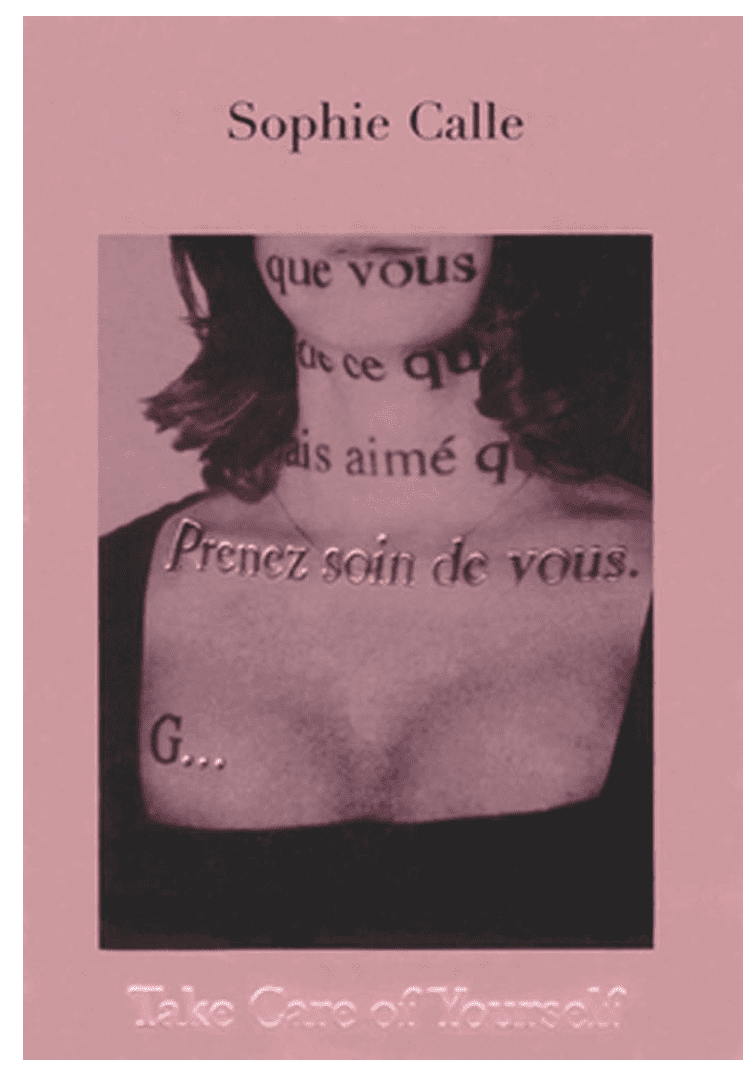
The book’s design is as striking as its concept. Presented as a substantial hardback, its cover is a vivid pink—a choice that speaks volumes about the themes it contains. The colour is simultaneously soft and bold, capturing the interplay of vulnerability and strength that runs through the project. The sturdy binding and high-quality production reflect the permanence of this ephemeral moment being turned into lasting art. Inside, semi-gloss pages bring richness to the visual elements, enhancing photographs, written analyses, and other creative responses. The layout is eclectic and engaging, varying between dense text and full-page imagery, echoing the diversity of perspectives offered by Calle’s collaborators.
At the heart of the book is the breakup letter, a clinical and detached piece of writing that is anything but neutral in its emotional impact. Calle’s contributors, from dancers and artists to linguists, psychologists, and more, each bring their own tools to dissect and reinterpret its content. A grammarian picks apart its structure and punctuation, while a psychoanalyst unpacks its emotional implications. A comedian finds humour in its contradictions, and a dancer embodies its themes through movement. These responses range from the playful to the poignant, demonstrating how language can be understood—and felt—on countless levels.
The pink cover offers a hint of the project’s exploration of femininity and collective resilience. This colour, traditionally associated with softness or romance, becomes a bold frame for a narrative of strength, transformation, and shared interpretation. Calle’s decision to place herself at the centre of the project while also stepping back—allowing others to take the lead in interpreting her pain—is a powerful artistic choice. It challenges notions of privacy and control, asking what it means to share personal trauma with others and whether such sharing can help reclaim power from a deeply hurtful moment.
The structure of the book is intentionally fragmented, reflecting the chaotic, non-linear process of emotional healing. While some may find this lack of cohesion challenging, it mirrors the repetitive and cyclical nature of heartbreak. The book encourages readers to engage with its content in their own way, flipping between responses and returning to the email as a touchstone. This approach allows the work to resonate differently depending on the reader’s perspective, much like how Calle’s collaborators each brought their unique insights to the project.
Physically, the book feels luxurious and weighty, inviting readers to linger. The semi-gloss paper enhances the tactile experience, and the range of colours and styles within its pages makes it visually arresting. Whether it’s the starkness of the letter itself or the vibrant contributions of Calle’s collaborators, the book captures attention and demands reflection. Its design is a reminder that the physical presentation of a book can be an essential part of its message.
Take Care of Yourself also explores the intersection of art and life, one of Calle’s signature themes. By turning her breakup into a public project, she raises questions about the boundaries of intimacy and the commodification of personal experience. Is this project a cathartic exercise, a way to distance herself from pain, or an intentional provocation about the role of art in processing human emotions? The book does not offer easy answers, instead inviting readers to grapple with these questions themselves.
In its entirety, Take Care of Yourself is not merely a study of heartbreak—it is a meditation on how we interpret, process, and ultimately transform difficult experiences. The voices of the 107 women offer a tapestry of perspectives, creating a sense of solidarity and collective understanding. The book becomes more than just an object or a project; it is a living, breathing exploration of human emotion and resilience.
In conclusion, Sophie Calle’s Take Care of Yourself is an extraordinary achievement. Its bold pink cover, high production quality, and deeply personal yet universal content make it a book that lingers in the mind long after it is closed. By turning private pain into public art, Calle has created a work that speaks to the power of collective interpretation, the complexity of language, and the enduring strength of the human spirit. I hope you find a copy in your local bookshop too!
Please support us
TheAppWhisperer has always had a dual mission: to promote the most talented mobile artists of the day and to support ambitious, interested viewers worldwide. As the years pass, TheAppWhisperer has gained readers and viewers and has found new venues for that exchange.
All this work thrives with the support of our community.
Please consider donating to TheAppWhisperer as this New Year commences. Your support helps protect our independence, and we can keep delivering open, global promotion of mobile artists. Every contribution, however big or small, is valuable for our future.

Joanne Carter
Joanne Carter is a British photography journalist, editor, curator, and the founder of *TheAppWhisperer.com*, one of the world’s leading platforms dedicated to mobile photography and art. Since its launch in 2009, TheAppWhisperer has become an international hub for artists of all levels to discover, learn, exhibit, and engage with contemporary photographic practice.Built on principles of inclusivity, accessibility, and artistic excellence, Joanne has spent almost two decades championing mobile photography as a serious artistic medium. Through interviews, critical essays, exhibitions, competitions, and education, she has helped shape and document the evolution of mobile art on a global scale.Her work has taken her internationally, lecturing on photography and mobile art at institutions and events including the Museum of Art in Seoul, South Korea, alongside appearances in the UK and Europe. She has served as a juror for international photography and mobile art awards across Portugal, Canada, the United States, South Korea, Italy, and the UK.Joanne is also the founder of *TheAppWhispererPrintSales.com*, one of the first online galleries dedicated exclusively to collectible mobile art, connecting artists with collectors across Europe, the United States, and Asia.Before founding TheAppWhisperer, Joanne worked extensively in print journalism and photographic publishing, including roles at a paparazzi photo agency and as deputy editor of a leading photography magazine. Her freelance journalism, criticism, and commentary have been published widely in both the UK and the US, with bylines in *The Times*, *The Sunday Times*, *The Guardian*, *Popular Photography*, *NikonPro*, *DPReview*, *Which?*, *Vogue Italia*, *LensCulture*, the *BBC*, and more recently, the *Financial Times*, where her published letters on photography continue to contribute to wider conversations around the medium.Alongside her editorial and curatorial work, Joanne’s own photographic practice has been exhibited internationally across the UK, Europe, South Korea, and the United States. Her work increasingly explores themes of grief, loss, death, memory, and the body.Her current research interests centre on grief, death, and poverty, with forthcoming postgraduate study leading towards doctoral research in these areas.Joanne is currently developing new long-form writing and photographic projects and is available for commissions, editorial projects, speaking engagements, and collaborations.Contact: joannetheappwhisperer@gmail.com)