
Best Camera Apps for iPhone 18 Pro (2026): 8 Top Picks
Best Camera Apps for iPhone 18 Pro in 2026: The Complete Guide to Manual Photography, RAW Capture and Professional Video
By Joanne Carter | TheAppWhisperer | October 2026
The iPhone 18 Pro marks an important development in mobile photography, but its most interesting advancement may not be the quality of the photographs it can produce. It is the degree of control it offers the photographer. With its variable-aperture main camera, increasingly sophisticated RAW capture and a growing ecosystem of professional applications, Apple’s flagship smartphone continues to move into territory traditionally occupied by dedicated photographic equipment.
Yet a fundamental distinction remains between having an advanced camera and exercising meaningful creative control over it. Apple’s native Camera app has become far more sophisticated, offering greater control over capture. Nevertheless, third-party applications remain particularly valuable for photographers seeking alternative RAW processing, specialist bracketing techniques, more detailed manual adjustments or distinctive approaches to image rendering. The choice is no longer simply between automatic and manual photography, but between different ways of exercising creative control.
Third-party camera applications have consequently become increasingly important. Developers such as Lux Optics, Reeflex, Blackmagic Design, Cocologics and Moment have created tools that treat the smartphone as a serious photographic instrument rather than merely a convenient way to record everyday experiences.
The iPhone 18 Pro has opened another opportunity to explore mobile photography’s creative possibilities. Some apps offer more detailed control over supported camera hardware, while others focus on reducing computational processing to capture natural-looking RAW photos or record video through workflows familiar to professional cinematographers. Applications such as Reeflex Pro Camera also show the growing sophistication of specialist mobile photography, bringing techniques like focus bracketing, exposure bracketing, and in-app focus stacking into a more accessible photographic environment.
These developments are particularly relevant to photographers working across disciplines such as street photography, documentary practice, landscape, architecture, macro photography and fine art. The ability to choose not only how an image is exposed, but also how focus, tonal information, and computational processing are managed, creates opportunities for more deliberate, individual approaches to image-making.
In this extensive guide, TheAppWhisperer examines eight particularly relevant applications, from Halide Mark III and Reeflex Pro Camera to ProCamera, Moment Pro Camera II, Blackmagic Camera, Final Cut Camera, Kino and Adobe Lightroom. We explore their different approaches to image-making and consider which are most appropriate for photographers, visual artists, documentary practitioners and filmmakers.
The emphasis is not simply on which application offers the most features. It is on how those features affect the experience of making photographs and the creative decisions available to the person behind the camera. An application that offers greater technical control is not automatically the best choice; its value ultimately depends on whether that control serves the photographer’s intentions.
Editorial note: This guide draws upon developer documentation, published application specifications and independently reported updates available in October 2026. It is a researched comparison, not a controlled, hands-on laboratory test of all eight applications on the iPhone 18 Pro. Features, compatibility and available camera controls may change with software updates.
At a Glance: The Best iPhone 18 Pro Camera Apps
| Camera App | Best For | Standout Features |
|---|---|---|
| Halide Mark III | Creative photography and RAW capture | Manual controls, alternative image processing, focus tools |
| Reeflex Pro Camera | Macro, focus stacking and advanced photography | Variable aperture, focus bracketing, exposure bracketing, in-app focus stacking |
| ProCamera | All-round professional photography | Manual exposure, RAW capture, advanced shooting controls |
| Moment Pro Camera II | Creative manual photography | Exposure controls, focus adjustment, professional capture tools |
| Blackmagic Camera | Professional filmmaking | Manual video controls, monitoring tools, professional recording workflows |
| Final Cut Camera | Video production and multicamera recording | Manual video controls, integration with Final Cut Pro |
| Kino | Cinematic everyday video | Film-inspired colour presets, intuitive video controls |
| Adobe Lightroom | RAW photography and editing | Camera capture, RAW processing, colour grading and editing tools |
These eight applications do not all compete directly. Halide, Reeflex Pro Camera, ProCamera and Moment Pro Camera II are primarily designed for still photographers, although their approaches and capabilities differ considerably. Halide emphasises manual control and photographic rendering, while Reeflex stands out with specialist features including focus bracketing, exposure bracketing, and in-app focus stacking. ProCamera offers a versatile professional shooting environment, while Moment appeals to photographers who want accessible manual controls and creative flexibility. Blackmagic Camera, Final Cut Camera, and Kino focus on moving images, while Adobe Lightroom is especially valuable as part of a broader photographic editing and image-development workflow.
For many serious photographers, the most effective approach involves more than one application. A dedicated camera app can offer greater control during capture, while a separate editing environment lets you interpret and refine the resulting image carefully. Specialist apps like Reeflex also show how mobile photography increasingly incorporates techniques traditionally associated with dedicated cameras and desktop processing. Ultimately, the strongest workflow isn’t built around a single application, but around a considered combination of tools that supports the photographer’s creative intentions.
Why the iPhone 18 Pro Changes the Conversation
One of the iPhone 18 Pro’s most significant developments is its variable-aperture Fusion Main camera. According to Apple’s September 2026 documentation, the 48-megapixel camera supports physical aperture adjustments between f/1.48 and f/4.
This matters because aperture has traditionally been one of the principal expressive controls for photographers using interchangeable-lens cameras. Changing the aperture affects how much light reaches the sensor and, along with focal length, subject distance, and sensor size, influences depth of field.
Previous iPhones have simulated shallow depth of field through computational portrait photography. These effects can be impressive, but they are not equivalent to physically changing the aperture of the lens.
With the iPhone 18 Pro, photographers can exercise a degree of optical control previously unavailable on Apple smartphones.
The difference becomes especially interesting when photographing close subjects, objects with detailed textures or scenes containing several distinct planes of focus. A wider aperture allows more light to reach the sensor and can help separate a nearby subject from its surroundings. A narrower aperture lets in less light and can increase depth of field under appropriate conditions.
Nevertheless, expectations should remain realistic. The iPhone’s comparatively small sensor means that aperture changes will not necessarily produce the dramatic background separation associated with full-frame cameras and fast portrait lenses. The effect depends heavily on subject distance, focal length and the particular photographic situation.
The greater significance lies in the photographer’s ability to consciously choose the image’s optical characteristics rather than accept a fixed aperture or rely entirely on software-generated effects.
Apple’s Final Cut Camera app now supports aperture-priority, shutter-priority, and manual modes for video capture on the iPhone 18 Pro. Third-party developers have also introduced more detailed aperture adjustments, demonstrating how quickly the wider application ecosystem is responding to the new hardware.
For photographers who regard exposure and optical rendering as expressive choices rather than purely technical considerations, this is a meaningful development.
Official reference: Apple – Final Cut Camera and iPhone 18 Pro variable aperture
1. Halide Mark III – Best for Manual Photography and Natural RAW Images
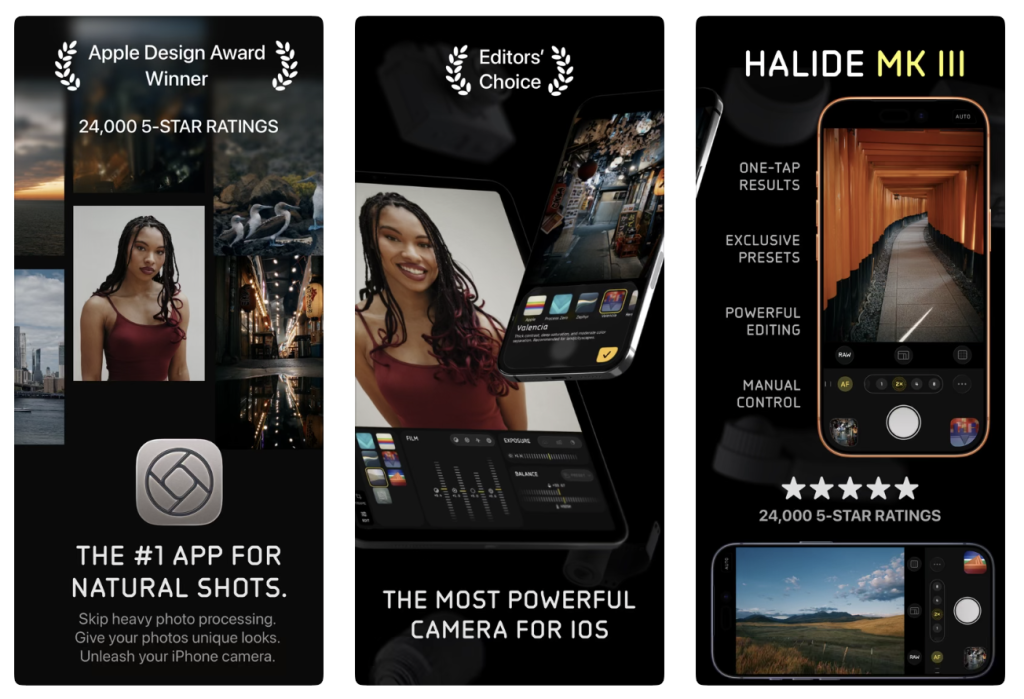
Developer: Lux Optics
Best for: Photographers who want control over capture, processing and photographic appearance.
Availability: iPhone
Price: Free download with paid features and purchase options.
Download: Halide Mark III on the UK App Store
Halide has long occupied a distinctive position within mobile photography. Rather than focusing exclusively on making smartphone photos look more technically polished, its developers have repeatedly questioned how much computational processing should shape the final image. That distinction matters because contemporary smartphone photographs rarely record a single exposure. They may be assembled from multiple frames, then sharpened, noise-reduced, tonally adjusted, and otherwise altered before the photographer sees the result. These processes are often beneficial, especially in difficult lighting conditions. However, they can also produce images that feel overly sharpened, unnaturally bright, or aesthetically disconnected from the original scene’s atmosphere. Halide offers an alternative approach.
Process Zero and the Question of Photographic Authenticity
One of Halide’s most interesting features is Process Zero, an image-rendering approach designed to reduce the influence of computational photography and produce a more natural-looking result. Rather than maximising detail and brightness through extensive processing, Process Zero prioritises a rendering that retains more of the original capture’s character. Photographers interested in subtle tonal transitions, shadow detail, atmospheric light, or natural textures may find this particularly appealing.
However, reduced processing should not automatically be confused with superior image quality. Computational techniques can improve dynamic range, manage noise, and preserve detail where a more minimally processed image may struggle. The relevant question is therefore not whether computational photography is inherently good or bad, but whether the photographer wants the application to make those decisions automatically.
Halide makes that choice more explicit.
Halide Mark III and Creative Looks
Halide Mark III introduced a broader creative system built around photographic Looks, developed with colourist Cullen Kelly. These are intended to influence how photographs are rendered during the capture workflow, rather than functioning solely as conventional filters added afterwards. The distinction matters because a photographic aesthetic isn’t simply about applying a colour preset. Contrast, highlight behaviour, tonal separation, and colour relationships all contribute to an image’s character. Halide’s approach encourages photographers to consider these decisions before pressing the shutter. For some, this creates a more deliberate, satisfying photographic process. Others may prefer the flexibility of recording a neutral RAW file and deciding on aesthetics later.
Both approaches are valid, and Halide’s appeal lies partly in providing space for different working methods.
Variable Aperture on the iPhone 18 Pro
Halide’s October 2026 update matters most to iPhone 18 Pro owners because it adds detailed control over the new variable-aperture system. While Apple’s native interface offers a limited selection of aperture settings, Halide provides more continuous adjustment across the supported range from f/1.48 to f/4. This makes the app particularly interesting for photographers who want to experiment with the optical effects of changing aperture rather than choose from a small set of predetermined options.
The practical differences between closely spaced settings may be subtle, especially when photographing distant subjects. Nevertheless, the ability to control the lens more precisely represents a welcome development for photographers accustomed to manual camera operation.
Who Should Choose Halide?
Halide suits photographers who work with RAW files, prefer a less aggressively processed look, or want to make deliberate decisions about exposure and focus. It is also worth considering for fine-art and documentary photographers who see the image’s visual characteristics as part of its meaning. Its greatest strength isn’t that it automatically produces better photos than Apple’s Camera app. It provides a different relationship between the photographer, the camera, and the resulting image.
For further reading, see TheAppWhisperer’s Best Camera Apps to Reduce iPhone Processing (2026) and 10 iPhone Camera Apps That Put the Photographer Back in Control.
Verdict: Halide Mark III is one of the strongest choices for photographers who want a more intentional still-photography experience, particularly when RAW capture, manual settings and restrained processing are priorities.
2. Reeflex Pro Camera – Advanced Manual Photography, Variable Aperture and Focus Stacking
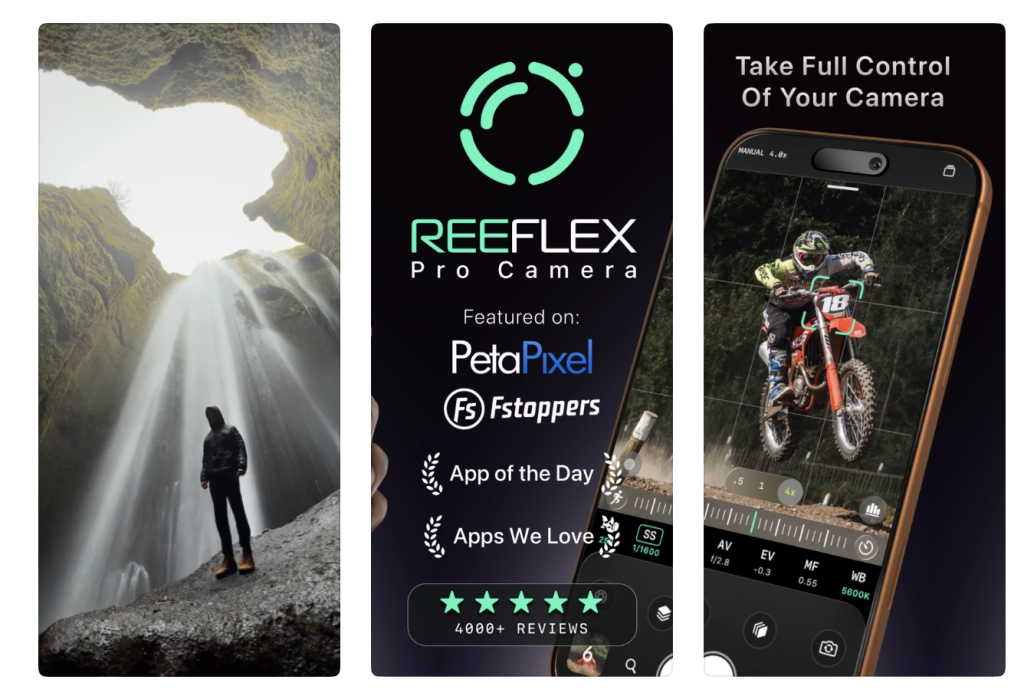
Developer: Reeflex
Availability: iPhone, subject to the iOS and device requirements listed in the App Store.
Pricing: Check the current App Store listing for download pricing, subscriptions and any in-app purchases.
Best for: Macro photography, focus stacking, exposure bracketing, still life, architectural details and advanced manual photography.
Official App Store: Reeflex Pro Camera
Developer website: Reeflex Pro Camera
Best for: Macro photography, focus stacking, exposure bracketing, architectural photography, landscapes and advanced manual control.
Reeflex Pro Camera is one of the most compelling specialist photography applications to consider for the iPhone 18 Pro in 2026. With extensive manual controls and sophisticated photographic techniques, it offers photographers a compelling alternative to established apps like Halide and ProCamera.
Reeflex stands out for its emphasis on giving photographers direct control over the photographic process. Rather than relying entirely on Apple’s automatic computational processing, the app provides tools to manage exposure, focus, and image capture with greater precision. Its accessible interface keeps essential controls within reach, letting photographers focus on composition and timing.
Variable Aperture Control on iPhone 18 Pro
One of Reeflex’s most significant recent developments is its support for the iPhone 18 Pro and iPhone 18 Pro Max’s variable-aperture system. Version 3.6, released in September 2026, introduced dedicated aperture controls, letting photographers adjust the physical aperture directly in the app.
This differs from computational Portrait mode, which simulates background blur in software. Adjusting the physical aperture changes the light entering the camera and affects the optical characteristics of the resulting photograph.
For photographers working with close-up subjects, still life, architectural details, and carefully composed landscapes, this added control offers another way to influence the image at the point of capture.
Focus Bracketing and In-App Focus Stacking
Perhaps Reeflex’s most distinctive feature is its integration of focus bracketing and focus stacking.
Focus bracketing involves capturing a sequence of photographs at different focus distances, each with a different area of the subject in sharp focus. These images can subsequently be combined to produce a final photograph with greater apparent depth of field.
Reeflex makes this process particularly convenient by letting photographers combine focus-bracketed images directly in the app, without necessarily transferring them to desktop editing software.
This is especially valuable for macro photography, where extremely shallow depth of field can make it difficult to keep the entire subject sharp. You can photograph a flower, intricate object, or detailed texture at multiple focus distances and combine them into a single image.
The technique can also help with landscape, product, and still-life photography, though success depends on subject stability, accurate alignment, and consistent lighting.
Exposure Bracketing and RAW Photography
Reeflex also offers exposure bracketing, letting photographers capture multiple frames at different exposure values. This helps in challenging lighting conditions, especially when photographing architectural interiors, dramatic landscapes, or scenes with bright highlights and deep shadows.
Alongside these specialist features, the app supports manual adjustments to shutter speed, ISO, focus, and white balance, plus RAW capture on compatible devices.
For photographers who prefer to make deliberate decisions about exposure and image interpretation, these controls provide a more considered alternative to fully automatic smartphone photography.
Professional Controls Without an Overcomplicated Interface
Reeflex’s key strength is its accessible interface. Its manual settings stay close at hand, reducing the need to navigate numerous menus while photographing.
This matters especially in changing light, with moving subjects, or when you need quick adjustments.
The combination of comprehensive controls, specialist bracketing tools, and in-app image processing makes Reeflex appealing to photographers who want a dedicated camera’s flexibility while keeping an iPhone’s convenience.
How Does Reeflex Compare with Halide and ProCamera?
Halide remains particularly interesting for its manual capture approach and alternative computational rendering, while ProCamera offers a broad professional shooting environment for many situations.
Reeflex stands out for its focus-bracketing capabilities, in-app focus stacking, and dedicated aperture controls on supported hardware.
For photographers specialising in macro photography, still life, detailed architectural subjects or technically demanding compositions, these features may make Reeflex especially attractive.
No single application will suit every photographer. However, Reeflex’s technical capabilities and practical usability make it one of the most interesting camera apps for the iPhone 18 Pro.
TheAppWhisperer Verdict
Reeflex Pro Camera deserves a prominent place among our recommended iPhone 18 Pro photography applications for 2026. Its variable-aperture controls, separate focus and exposure bracketing, in-app focus stacking, and comprehensive manual settings offer genuine creative possibilities beyond conventional smartphone capture.
Its focus-stacking workflow is particularly noteworthy, letting photographers explore extended depth of field without needing a separate desktop application.
For macro, landscape, still-life, and architectural photographers, Reeflex is a serious contender and well worth exploring.
Key strengths: Variable-aperture control on supported iPhone 18 Pro models, focus bracketing, exposure bracketing, in-app focus stacking, RAW photography and accessible manual controls.
Considerations: Certain capabilities depend on compatible iPhone hardware. Focus stacking and other multi-frame techniques work best with stable subjects and careful camera positioning.
3. Blackmagic Camera – Best Free App for Professional Video
Developer: Blackmagic Design
Best for: Filmmakers, documentary practitioners and photographers working with moving images.
Availability: iPhone and supported Android devices
Price: Free.
Download: Blackmagic Camera on the UK App Store
Official website: Blackmagic Design – Blackmagic Camera
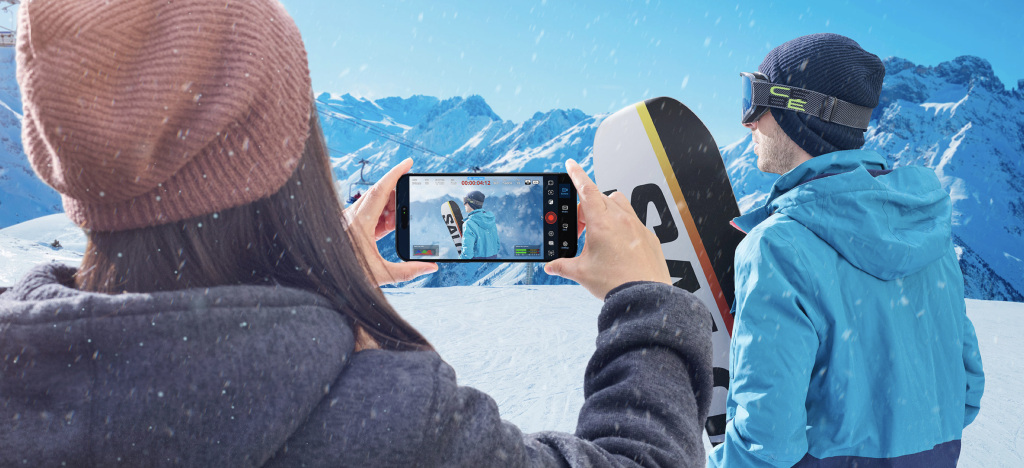
Blackmagic Camera approaches the smartphone from a professional cinematography perspective. Its interface draws on the conventions of dedicated digital cinema cameras, giving immediate access to settings often hidden or automated in consumer video apps. Exposure, shutter angle, frame rate, white balance, focus and recording format are treated as essential creative controls rather than secondary options. This makes Blackmagic Camera particularly attractive to photographers beginning to work with moving images and looking to develop a more technically informed approach to filmmaking.
Professional Controls Without the Price Barrier
The application’s most remarkable feature is that its extensive capture controls are available at no purchase price. For independent filmmakers, students and documentary practitioners, this significantly lowers the financial barrier to experimenting with professional recording techniques.
Blackmagic Camera provides control over frame rate, shutter angle, ISO, white balance, focus and supported recording formats. It also offers monitoring tools and workflow options intended for more demanding production environments.
The interface may seem complicated at first, especially for photographers unfamiliar with cinematography terminology. However, the underlying principles are relatively straightforward.
Frame rate determines how many individual images the camera records each second. Shutter angle affects each exposure’s duration and, therefore, how motion blur appears. White balance affects colour consistency, while ISO and exposure settings help determine how the camera responds to different lighting conditions. Once you understand these relationships, the application becomes much easier to navigate.
What Does a 180-Degree Shutter Mean?
Traditional still cameras generally describe exposure duration using shutter speed. Cinematography often uses shutter angle, a convention inherited from rotating mechanical shutters in film cameras. A 180-degree shutter corresponds to an exposure duration of approximately half the interval between successive frames. At 25 frames per second, this produces a shutter speed of approximately 1/50 second. At 30 frames per second, it corresponds to approximately 1/60 second. These settings generally produce familiar, natural-looking motion blur, although different shutter angles can be used deliberately to create sharper or more fluid movement.
For photographers moving into video, understanding this relationship is more useful than simply copying recommended settings without knowing what they accomplish.
Variable Aperture and the iPhone 18 Pro
The iPhone 18 Pro’s variable-aperture camera adds another dimension to Blackmagic Camera’s manual workflow. Recent updates have expanded third-party applications’ ability to select aperture settings across the new hardware’s supported range.
For filmmakers, this creates opportunities to make more deliberate exposure and depth-of-field decisions, particularly when balancing available light, shutter angle and ISO.
However, changing aperture during a shot can alter exposure and potentially affect the footage’s visual continuity. For controlled productions, it is generally preferable to establish exposure settings before recording unless the change is an intentional creative effect.
Colour, Log Recording and Post-Production
Blackmagic Camera is especially valuable when used as part of a wider editing and colour-grading workflow. Log recording, where supported by the device and selected recording format, preserves a flatter tonal representation intended to provide flexibility during post-production.
The initial image may appear relatively low in contrast and saturation, but this does not indicate poor quality. It is a starting point for later colour correction and grading.
A Look-Up Table, commonly known as a LUT, can preview how Log footage might look after a particular colour transformation. Distinguish between a monitoring LUT and a look permanently incorporated into recorded footage. The available behaviour depends on the application settings and workflow.
For documentary practitioners, managing colour consistently across scenes can be particularly useful. It can also help filmmakers integrate smartphone footage with material captured using dedicated cinema cameras.
Blackmagic Camera for Documentary and Fine-Art Practice
The application is not limited to commercial video production. Photographers developing moving-image installations, visual research projects or experimental documentary work may find its manual controls equally valuable.
A static sequence, a carefully observed landscape or a prolonged study of a particular environment can benefit from consistent exposure and controlled focus just as much as a conventional film production. The application provides the technical framework without prescribing its aesthetic direction.
TheAppWhisperer has already published a detailed technical resource, Blackmagic Camera App Settings Explained (2026): Every Setting, Simplified, which examines the principal controls in accessible language.
Readers may also find Best Video Settings for Blackmagic Camera App (2026) useful when establishing a starting configuration.
Verdict: Blackmagic Camera is an exceptional free option for iPhone filmmakers who want professional recording controls, technical flexibility and a workflow that can extend into serious post-production.
4. Final Cut Camera – Best for Apple’s Professional Video Ecosystem
Developer: Apple
Best for: iPhone filmmakers using Final Cut Pro and photographers exploring professional video.
Availability: iPhone
Price: Free.
Download: Final Cut Camera on the UK App Store
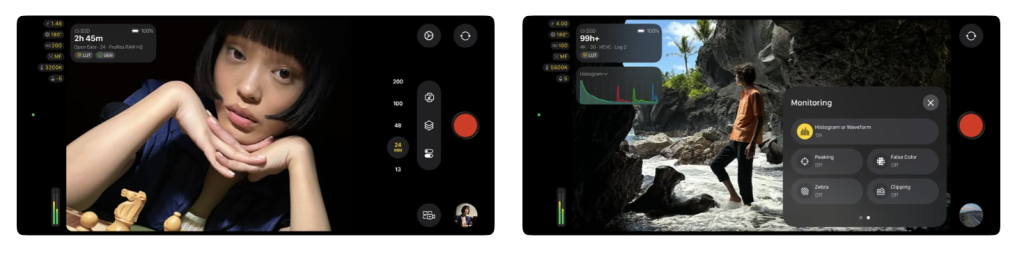
Apple’s Final Cut Camera has become a serious alternative to specialist third-party video apps. Its September 2026 update, version 2.4, is particularly significant because it adds dedicated support for the iPhone 18 Pro’s variable-aperture camera, along with redesigned controls and expanded professional monitoring capabilities.
The application occupies an interesting position within Apple’s ecosystem. It aims to make professional recording features accessible without sacrificing the simplicity Apple’s software is known for.
Aperture Priority, Shutter Priority and Manual Exposure
The iPhone 18 Pro’s introduction of aperture control lets Final Cut Camera support exposure modes familiar to photographers using dedicated cameras. In aperture-priority mode, the photographer selects an aperture while the camera manages other exposure parameters within the available operating range. In shutter-priority mode, the user specifies the desired shutter behaviour, and the application adjusts other parameters where supported. Manual mode provides more direct control over the relationship between aperture, shutter and exposure. These modes matter because they accommodate different experience levels and photographic intentions.
A filmmaker recording a rapidly changing scene may prefer some automatic assistance, while someone producing a carefully lit sequence may wish to control every relevant parameter.
Exposure Monitoring and Focus Assistance
Final Cut Camera 2.4 also introduces improved monitoring features, including false colour, clipping indicators, focus peaking and professional video scopes on supported devices. False colour visually represents exposure levels, making it easier to spot underexposed or overexposed areas. Clipping indicators highlight regions where detail may be lost, while focus peaking helps you identify areas of apparent sharpness. The RGB Parade separates red, green, and blue signal information, letting users assess colour balance and exposure more precisely.
These tools are especially useful when recording Log footage, where the flatter preview can make exposure decisions harder.
Cinematic Effects and Post-Production Flexibility
Apple has also expanded the relationship between captured video and subsequent editing. On supported iPhone 18 Pro workflows, Cinematic-style depth effects can be applied to compatible footage, including certain ProRes and Apple Log recordings, with adjustments made later in Final Cut Pro.
This creates an important distinction between optical depth of field, determined during capture, and computational depth effects that can be modified afterwards. Both approaches offer creative possibilities, but you shouldn’t confuse them. The optical image depends on the camera and lens’s physical characteristics, while computational effects rely on software interpretation of subject separation and scene depth.
Which Is Better: Final Cut Camera or Blackmagic Camera?
The choice depends primarily on workflow.
Final Cut Camera is especially attractive to users already in Apple’s editing ecosystem who value straightforward integration between capture and post-production.
Blackmagic Camera may appeal more strongly to filmmakers who prefer its cinema-camera interface, monitoring options and integration with Blackmagic’s broader production environment.
Neither application should be considered universally superior. Both offer substantial creative control, and the best choice depends on the project’s demands.
Verdict: Final Cut Camera is one of the most compelling free applications for iPhone 18 Pro video recording, particularly for creators who want sophisticated manual controls without leaving Apple’s professional software ecosystem.
5. ProCamera – Best All-Round Camera App for Serious Photographers
Developer: Cocologics
Best for: Everyday photography, manual capture, RAW files and photographers wanting one versatile application.
Availability: iPhone
Price: Paid, with additional purchase options depending on features.
Official website: ProCamera
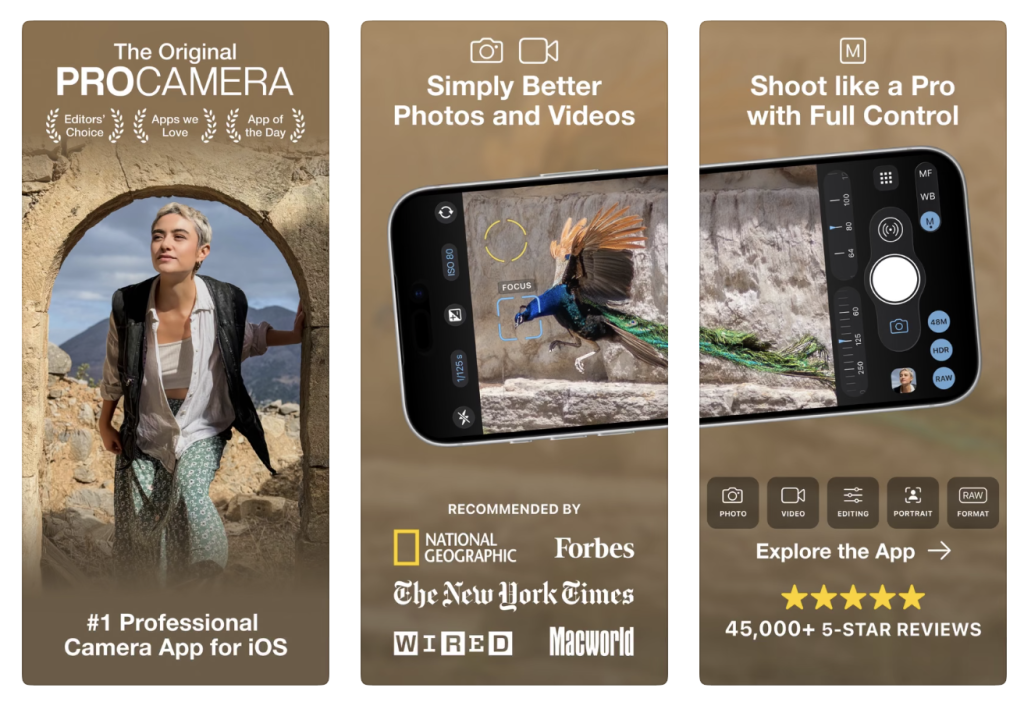
ProCamera is one of the longest-established specialist camera applications available for iPhone. Its continued development illustrates how third-party software has evolved alongside successive generations of smartphone camera hardware.
Unlike apps that focus on a particular photographic aesthetic, ProCamera offers a broad range of tools to suit many situations.
It combines manual exposure and focus controls with RAW capture, specialised shooting modes and features designed to help photographers work more confidently in challenging conditions.
A Practical Approach to Manual Photography
One of ProCamera’s principal strengths is its balance between accessibility and technical depth. Photographers can use the app for straightforward everyday shots without diving into every setting. However, more experienced users can control exposure, focus, white balance, and supported capture formats when a situation demands greater precision.
This flexibility makes ProCamera particularly suitable for photographers who do not want to switch applications every time their subject or working conditions change.
Street photography, architecture, travel, portraiture and documentary photography all present different technical challenges.
An application that adapts to these situations without imposing a single visual style can be extremely useful.
RAW Capture and Editing Flexibility
RAW photography remains a key reason to use a dedicated camera app. A RAW file retains image data that offers greater editing flexibility, particularly when adjusting white balance, highlights, shadows, and colour.
However, RAW files are not automatically better than processed images. They generally require more post-production attention, and their advantages depend on the original exposure quality and the processing applied afterwards.
For photographers who prefer to make their own tonal and colour decisions, this additional flexibility can be valuable.
ProCamera and Variable Aperture
ProCamera continues to offer an extensive range of manual photographic controls, including exposure, focus, white balance and RAW capture on compatible iPhone models. Support for newer hardware-specific features, including physical variable-aperture adjustment, depends on the app version and the capabilities Apple makes available through its camera APIs.
For photographers seeking a versatile, general-purpose camera application, ProCamera’s established manual controls remain valuable. However, confirm specific iPhone 18 Pro aperture functionality in the developer’s latest release notes rather than assuming it based on device compatibility.
Who Is ProCamera Best Suited To?
ProCamera is a strong choice for photographers who want a dependable, general-purpose app with substantial manual control. It is particularly relevant to users who value technical flexibility but do not necessarily want the more explicitly aesthetic approach offered by Halide.
TheAppWhisperer previously included ProCamera in its Best Mobile Photography Apps (2026 Edition), which provides a broader introduction to contemporary mobile photographic tools.
Verdict: ProCamera remains one of the strongest all-round choices for iPhone photographers who want manual control, RAW capture, and a flexible app for varied situations.
6. Moment Pro Camera II – Best for Manual Exposure and Hybrid Creators
Developer: Moment
Best for: Manual photography, creative video and photographers using Moment’s wider equipment ecosystem.
Availability: iPhone
Price: £9.99 on the UK App Store at the time of research.
Download: Moment Pro Camera II on the UK App Store
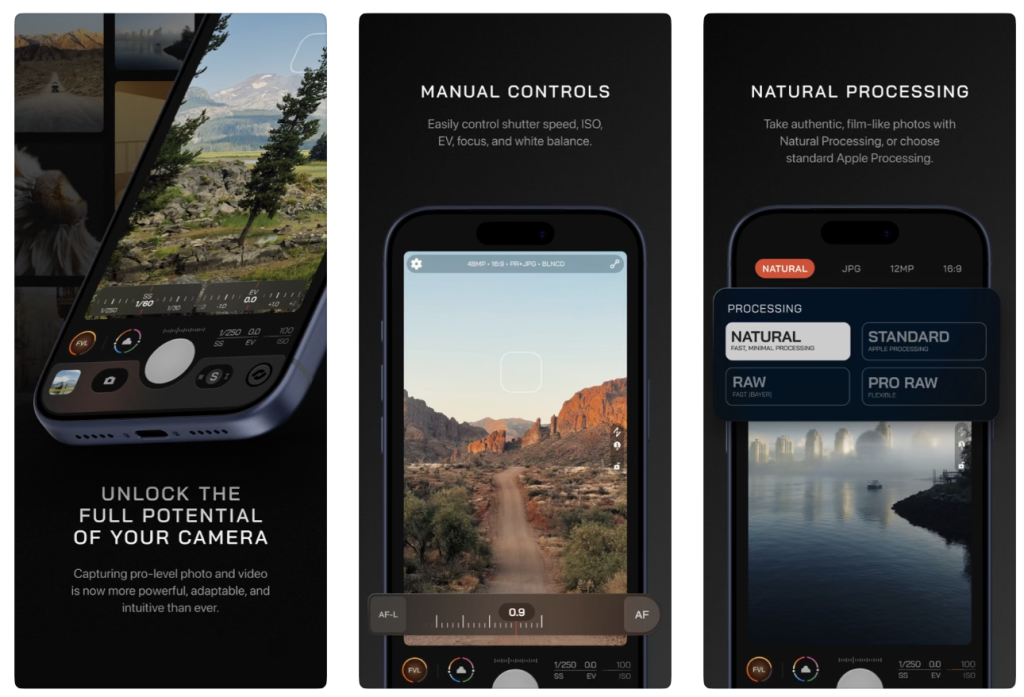
Moment Pro Camera II represents a substantial redevelopment of Moment’s original camera application. Its design emphasises manual exposure, flexible shooting modes, and an interface that adapts to different creative requirements.
For photographers used to dedicated camera controls, this approach appeals because it makes familiar exposure relationships more accessible on a smartphone.
Exposure Control and Shooting Modes
Moment Pro Camera II offers several exposure approaches, including manual operation and priority-based modes. This lets photographers decide how much control they want to keep and how much they want to delegate to the camera. For example, a photographer shooting a relatively static subject may choose manual exposure to keep frames consistent. Someone photographing rapidly changing light may prefer a priority mode that lets the app respond automatically while preserving control over a key parameter.
Moment also offers tools like focus peaking, exposure aids, and lens controls to help users assess an image’s technical characteristics before recording.
Variable Aperture and the iPhone 18 Pro
The iPhone 18 Pro makes Moment Pro Camera II especially interesting because the app supports more detailed aperture selection than Apple’s standard interface.
Its updated controls let photographers choose from ten aperture positions across the supported range, in approximately one-third-stop increments. For users familiar with traditional photographic exposure systems, this approach feels closer to operating a dedicated camera.
Nevertheless, the practical visual difference between neighbouring aperture settings may be modest. The most useful changes will likely appear when photographing close subjects, balancing available light, or making controlled comparisons under consistent conditions.
Creative Looks and Natural Rendering
Moment Pro Camera II also includes creative rendering options that give photographers more control over how their images look. The distinction between a naturally rendered photograph and a computationally enhanced one is increasingly important in mobile photography. Some photographers prefer the polished appearance produced by modern image-processing systems. Others want a quieter interpretation of colour, texture and contrast.
Moment offers options to accommodate different preferences, though results depend on the selected capture mode and lighting conditions.
The Importance of Interface Design
A camera application is not simply a collection of technical capabilities. Its interface can affect how quickly and confidently a photographer responds to a scene. Moment’s configurable controls and quick-access features aim to reduce the distance between recognising a photographic opportunity and taking the shot. This matters especially in street and documentary photography, where an overly complicated interface can disrupt observation.
Verdict: Moment Pro Camera II is a strong option for photographers who want traditional exposure controls, detailed aperture adjustments, and an app that supports both still photography and creative filmmaking.
7. Adobe Lightroom – Best for Editing and the Complete Photographic Workflow
Developer: Adobe
Best for: RAW editing, colour correction, image organisation and consistent photographic workflows.
Availability: iPhone and other supported platforms
Price: Free download with paid features and subscriptions.
Download: Adobe Lightroom on the UK App Store
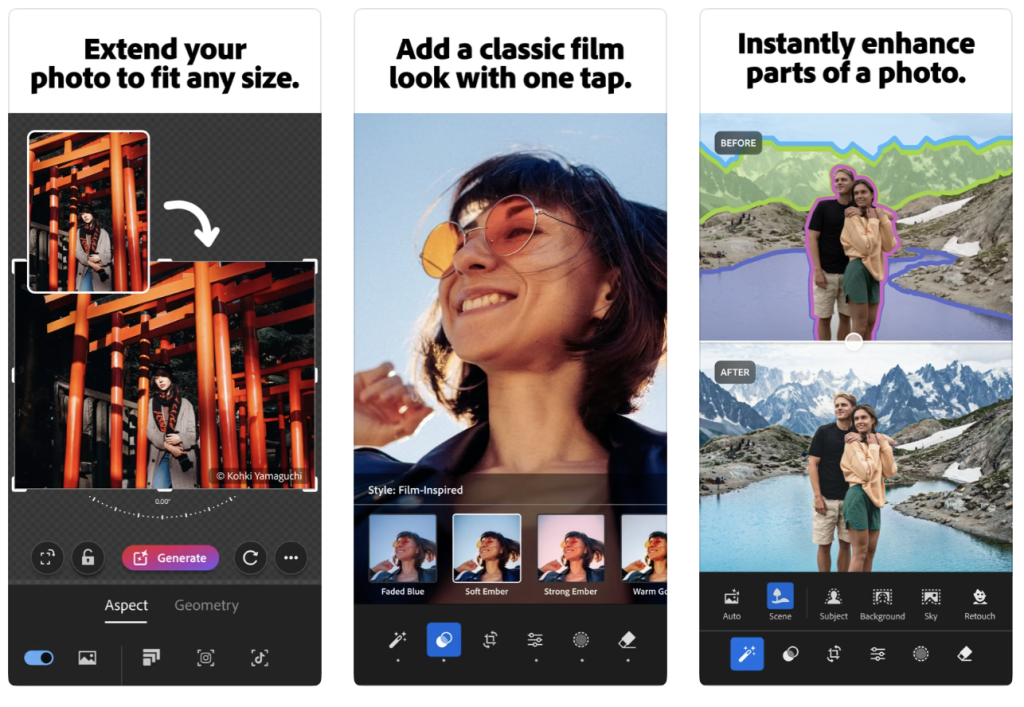
Adobe Lightroom occupies a slightly different position within this comparison. Although Lightroom offers mobile capture capabilities, its main strength lies in what happens after you take the photo. Rather than replacing specialist manual camera apps such as Halide, ProCamera, or Moment, Lightroom provides a sophisticated environment for developing, organising, and interpreting photographs. Its extensive editing capabilities, including Generative Expand, selective AI adjustments, and film-inspired colour treatments, let photographers refine, reinterpret, and, in some cases, substantially transform their images. This distinction matters for photographers who see image-making as a process that extends beyond the moment of exposure, while remaining mindful of questions of photographic authenticity, documentary integrity, and the ethical implications of computational image manipulation.
Why Editing Is Part of Photography
A photograph does not necessarily reach its final form when the shutter is released. Exposure decisions, colour balance, tonal relationships, and cropping can all shape how an image communicates its subject.
These decisions have always formed part of photographic practice, whether through darkroom printing, film development or contemporary digital processing. Lightroom provides tools to make these adjustments in a relatively controlled, repeatable way.
For photographers working with RAW files captured in Halide, ProCamera or Moment, Lightroom can serve as a central editing environment.
Working with RAW Files
RAW files generally offer more latitude to adjust certain image characteristics than heavily compressed formats. Lightroom lets photographers refine exposure, recover available highlight and shadow information, adjust white balance, and manage colour relationships. However, editing flexibility should not be mistaken for an ability to recover information that was never captured. Severely clipped highlights, excessive motion blur or missed focus cannot always be corrected convincingly in post-production. The strongest workflow therefore combines careful capture with thoughtful editing.
Colour Consistency Across a Series
For documentary photographers and visual artists, consistency across a group of images can be as important as an individual photograph’s appearance. A photographic series may contain images made at different times, under different lighting conditions and with different cameras. Lightroom’s editing and organisational tools can help establish a coherent visual language while allowing individual photographs to retain their distinctive characteristics. This is especially valuable when preparing exhibitions, portfolios, editorial submissions or extended documentary projects.
AI and Photographic Intention
Adobe has introduced a growing range of AI-assisted editing tools, including automated adjustments and generative features. These can be useful in appropriate circumstances, but photographers should consider their implications carefully. Removing an unwanted object from a commercial image is not necessarily equivalent to removing an element from a documentary photograph presented as evidence of a real event. The ethical significance depends on context, disclosure and the claims being made about the image.
For photographers concerned with documentary integrity, Lightroom’s conventional tonal and colour tools may be more appropriate than generative alterations.
TheAppWhisperer’s Best Camera Apps Without AI Processing explores the wider movement towards more restrained computational intervention.
Verdict: Lightroom is best regarded as an essential companion to a dedicated capture application rather than a universal replacement for one. Its strengths lie in RAW development, colour management, and creating a coherent photographic workflow.
8. Kino – Best for Film-Inspired Video and Creative Colour
Developer: Lux Optics
Best for: Creative filmmakers, visual artists and photographers interested in cinematic colour.
Availability: iPhone
Price: Paid.
Download: Kino on the UK App Store
Kino approaches smartphone filmmaking differently from Blackmagic Camera and Final Cut Camera. Rather than focusing on technical breadth or integration with a professional editing ecosystem, Kino emphasises the visual character of recorded footage.
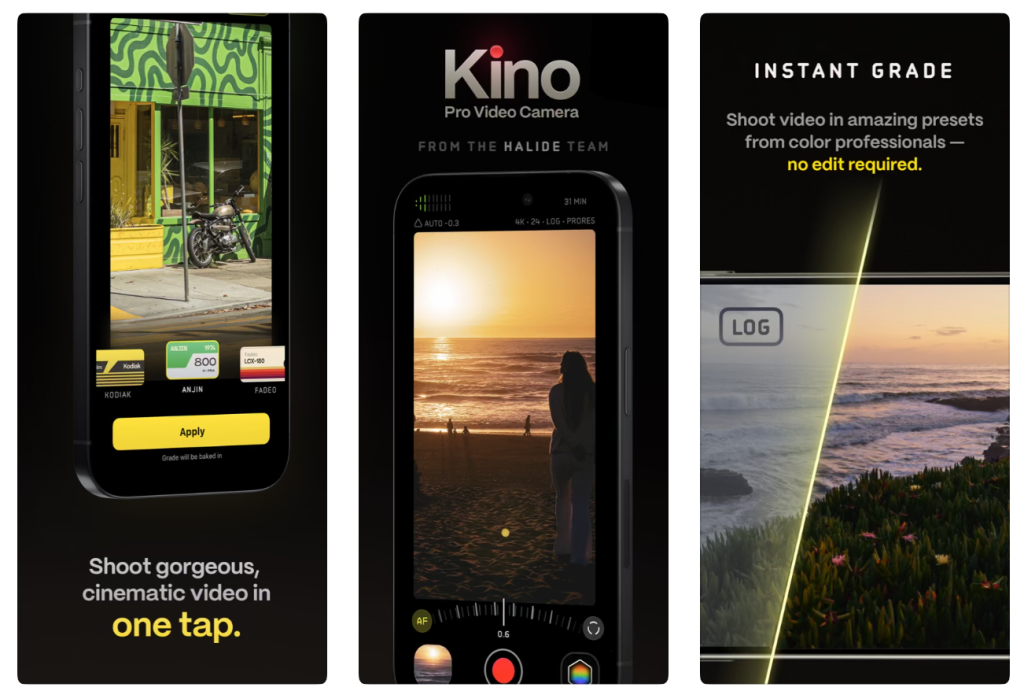
Developed by the team behind Halide, it combines manual video controls with film-inspired colour treatments and an interface designed to make creative recording relatively approachable.
The Appeal of Film-Inspired Video
The visual characteristics associated with analogue film continue to influence contemporary digital photography and cinematography. Colour response, contrast, highlight behaviour and tonal transitions all contribute to what viewers may perceive as a cinematic appearance. However, no single film look exists. Different film stocks, development processes, lighting conditions and printing techniques produce markedly different results.
Kino’s creative colour options provide starting points for developing a particular aesthetic, but the resulting footage still depends on composition, exposure, movement, and the quality of the original scene.
Manual Control and Creative Simplicity
Kino includes professional-style controls that give users more influence over video capture than the native Camera app. Its appeal lies partly in presenting these capabilities within a workflow oriented toward the finished look of the footage.
For photographers beginning to experiment with moving images, this may feel more approachable than an application designed around the conventions of a professional cinema camera. The ability to select a visual treatment during capture can also encourage greater consistency between shots. However, recording footage with a strongly established aesthetic may reduce flexibility later, depending on how the selected look is applied and the recording format used.
Photographers should therefore consider whether they want to commit to a particular appearance during capture or retain the widest possible range of options for post-production.
Kino for Experimental Moving Images
Kino may particularly attract photographers exploring the relationship between still and moving images. Short observational sequences, atmospheric studies, visual diaries and experimental documentary work can all benefit from carefully considered colour and controlled movement. In these contexts, the most important question is not whether the footage resembles a commercial film production.
It is whether the visual treatment supports the intended meaning and emotional character of the work.
Verdict: Kino is a compelling creative option for photographers and filmmakers who value film-inspired colour and a relatively direct approach to producing distinctive video footage.
Understanding RAW, Apple ProRAW and Computational Photography
Smartphone photography terminology can be confusing, especially because different apps use similar terms for processes that aren’t identical.
A conventional RAW file generally preserves sensor-derived image information for editing software to interpret later.
Apple ProRAW combines RAW-format flexibility with elements of Apple’s computational imaging pipeline. It should not be understood as an entirely unprocessed sensor recording.
By comparison, a JPEG or HEIF image generally contains a more fully rendered interpretation of the scene, with colour, contrast, sharpening, and other processing already applied.
None of these formats is inherently the correct choice for every photographer.
In a rapidly changing documentary situation, the convenience and reliability of a processed image may outweigh RAW’s added editing flexibility.
For a carefully composed landscape, still life, or fine-art photograph, a RAW workflow may give greater control over the final look.
The important distinction is between technical possibility and photographic intention.
Photographers should choose a format that supports their work, rather than assuming the most technically demanding option must produce the most meaningful image.
For more discussion of these questions, read TheAppWhisperer’s Best Camera Apps to Reduce iPhone Processing and 10 iPhone Camera Apps That Put the Photographer Back in Control.
Which Camera App Should You Choose for Different Types of Photography?
Street Photography
Street photography demands a balance of speed, discretion and control. A technically sophisticated app is of limited value if its interface makes the photographer miss a fleeting moment.
Halide and ProCamera are both worth considering for photographers who want manual control without sacrificing street photography’s spontaneity.
Moment Pro Camera II may also appeal to photographers who prefer a configurable interface and quick access to frequently used settings. Reeflex Pro Camera offers another option for photographers who value direct control over exposure and focus, though its more specialised bracketing tools generally suit deliberate compositions better than rapidly unfolding street scenes.
TheAppWhisperer explores this subject in greater depth in Best Camera Apps for Street Photography (2026): The Complete Guide.
Documentary Photography
Documentary photography often involves unpredictable lighting, rapidly changing situations and ethical decisions about how subjects are represented.
A camera application should support observation rather than interfere with it. Halide’s restrained processing options may appeal to photographers seeking a less stylised look, while ProCamera and Reeflex offer manual controls for photographers who want to make more deliberate exposure and focus decisions.
For documentary video, Blackmagic Camera and Final Cut Camera offer controls that can help maintain consistency between shots and support more demanding production workflows.
Landscape and Architectural Photography
Landscape and architectural photographers often work with subjects where composition, tonal range and detail are especially important.
RAW capture offers flexibility in high-contrast scenes, while manual exposure and focus controls help maintain consistency.
The iPhone 18 Pro’s variable aperture adds an optical control, though its practical effect depends on subject distance and the camera’s physical characteristics.
Halide, ProCamera and Moment Pro Camera II are all relevant choices for this kind of work. Reeflex Pro Camera is particularly interesting for photographers who want to explore focus bracketing, in-app focus stacking and exposure bracketing. These techniques can be valuable when photographing intricate architectural details, close-up textures, or landscapes that require careful management of focus and tonal range.
Macro and Still-Life Photography
Macro and still-life photography are areas where specialist camera applications can make a particularly noticeable difference. At close focusing distances, depth of field becomes extremely shallow, making it difficult to render every part of a subject sharply within a single exposure.
Reeflex Pro Camera is especially relevant here because of its focus-bracketing and in-app focus-stacking capabilities. By capturing multiple photographs at different focus distances and combining them, photographers can create images with an extended apparent depth of field.
This approach is particularly useful for flowers, small objects, intricate surfaces, product photography and carefully constructed still-life compositions.
Stable subjects, consistent lighting and a secure camera position remain important, as movement between exposures can affect the final result. Still, exploring these techniques directly on an iPhone offers considerable creative possibilities.
Fine-Art and Experimental Photography
For artists, the most technically accurate representation of a scene isn’t necessarily the most appropriate. Softness, grain, restricted tonal range, unusual colour relationships and deliberate imperfections can all form part of a photographic language.
Halide’s creative Looks, Moment’s rendering options and Kino’s film-inspired video treatments offer different ways to explore these possibilities.
Reeflex introduces another approach through focus stacking, exposure bracketing and manual capture. These tools need not be used exclusively to produce technically flawless photographs; they can also become part of a more experimental investigation into photographic detail, perception and the relationship between multiple exposures.
Photographers seeking more distinctive approaches to mobile imaging may also enjoy TheAppWhisperer’s 10 iPhone Camera Apps for Distinctive Photo Styles in 2026, available in the site’s iOS Apps archive.
Professional Video and Filmmaking
For serious video production, Blackmagic Camera and Final Cut Camera are the strongest starting points in this selection.
Both offer manual controls and professional recording features, although their interfaces and workflows differ.
Blackmagic Camera appeals particularly to users familiar with digital cinema equipment and DaVinci Resolve, while Final Cut Camera is a natural fit for creators working within Apple’s software ecosystem.
Kino provides a more visually oriented alternative for filmmakers who prioritise creative colour and a straightforward recording experience.
How to Get Better Photographs with the iPhone 18 Pro
Choosing the right application is only one part of producing stronger photographs. A sophisticated camera app cannot compensate for every weakness in composition, timing or observation.
The most effective improvements often come from understanding a few fundamental photographic principles and applying them consistently.
Control Exposure Deliberately
Automatic exposure systems attempt to produce technically acceptable images across a wide variety of situations. However, the camera’s interpretation of an acceptable exposure may not correspond to the photographer’s intention.
A dark interior may be brightened too much, while a luminous sky may lose subtle distinctions in the highlights. Manual exposure and exposure compensation allow photographers to preserve the atmosphere they observed.
Applications such as Halide, ProCamera, Moment, and Reeflex let photographers approach exposure more deliberately, while Reeflex’s exposure-bracketing tools offer additional options for scenes with challenging tonal differences.
Pay Attention to the Quality of Light
The direction, colour and intensity of light often influence a photograph’s emotional character more than the choice of camera application.
Soft, overcast light can reveal subtle textures and tonal transitions, while direct sunlight may produce strong contrast and sharply defined shadows.
Rather than attempting to correct every difficult lighting situation computationally, consider whether the light itself contributes something meaningful to the image.
Understand the Limits of Aperture Control
Variable aperture can be a useful creative tool, but it shouldn’t be treated as a guarantee of dramatic background blur. Where supported by the device and camera application, experiment with different aperture settings and subject distances, comparing the results carefully.
Close subjects may reveal differences more clearly than distant landscapes, though the precise effect depends on the camera’s optical characteristics.
Experiment with Focus Bracketing and Focus Stacking
One of the most interesting ways to expand mobile photography’s creative possibilities is to explore focus bracketing.
Rather than relying on a single point of focus, this technique involves photographing a subject at several focus distances. You can then combine the resulting images to increase the apparent depth of field.
Reeflex Pro Camera makes this technique particularly accessible through its in-app focus-stacking workflow.
For photographers interested in macro, still-life, or detailed architectural photography, experimenting with focus stacking can help you understand how focus affects an image’s construction.
Avoid Unnecessary Digital Zoom
Digital zoom can help when no alternative is available, but it may crop or computationally enlarge the image instead of using a different optical focal length.
Where practical, select an appropriate physical camera and compose with an understanding of its characteristics.
Moving closer to a subject can sometimes produce a stronger image, although it also changes perspective and the relationship between foreground and background.
Establish a Consistent Editing Workflow
A coherent photographic series benefits from a consistent approach to colour, contrast and tonal range. This doesn’t mean every photograph should look identical. Rather, the editing process should support the relationship between images and avoid introducing visual inconsistencies that distract from the work.
Lightroom can be particularly valuable for developing and maintaining this consistency.
Frequently Asked Questions
What is the best camera app for iPhone 18 Pro in 2026?
For photographers focused on still images, Halide Mark III is a strong choice because of its manual controls, RAW support and natural image rendering. Reeflex Pro Camera is particularly appealing for macro photography, focus stacking and exposure bracketing, while ProCamera is an excellent alternative for users who want a versatile, all-round application. For professional video, Blackmagic Camera and Final Cut Camera stand out.
Which iPhone 18 Pro camera app has the most manual control?
The answer depends on whether you prioritise still photography or video. Halide Mark III offers detailed still-photography controls, while Reeflex Pro Camera combines manual settings with specialist focus and exposure bracketing. Moment Pro Camera II and ProCamera also provide extensive photographic controls. Blackmagic Camera and Final Cut Camera offer sophisticated manual video settings.
Can third-party camera apps control the iPhone 18 Pro’s aperture?
A third-party application can offer physical aperture control only where the iPhone hardware and Apple’s camera APIs support it. The availability and precision of those controls also depend on how each developer implements them. Photographers should consult the latest release notes for Halide, Reeflex, ProCamera, Moment and other applications before assuming that particular aperture adjustments are supported.
Is Halide better than Apple’s Camera app?
Halide offers more deliberate control over capture and rendering, which appeals to experienced photographers. Apple’s Camera app remains highly effective for everyday photography, especially when speed, convenience and computational assistance are priorities. Neither is universally better for every situation.
Is Blackmagic Camera really free?
Yes. Blackmagic Camera is free and offers extensive professional-style video controls. Broader production workflows may require separate hardware, storage or software, but the camera app itself is free.
What is the best free professional video app for iPhone 18 Pro?
Blackmagic Camera and Final Cut Camera are both excellent free options. Blackmagic Camera suits users who prefer a cinema-camera interface, while Final Cut Camera appeals to creators working with Apple’s professional video tools.
Does shooting RAW always improve iPhone photography?
No. RAW adds editing flexibility, but it doesn’t automatically produce a more aesthetically successful photograph. Exposure, focus, light, composition and processing all influence the result. In some situations, a carefully processed HEIF or JPEG may be more practical and visually satisfying.
Can the iPhone 18 Pro replace a professional camera?
The iPhone 18 Pro can serve as a serious photographic tool and may be entirely appropriate for some professional assignments. However, dedicated cameras still offer advantages in sensor size, lens selection, ergonomics, specialised accessories and specific low-light or action-photography needs. The right equipment depends on the project, not the photographer’s professional status.
Which app is best for natural-looking photographs without excessive AI processing?
Halide Mark III is particularly relevant because of Process Zero and its emphasis on restrained image rendering. Moment Pro Camera II also offers options for photographers who want a less heavily processed look. The results will depend on the selected settings, lighting conditions and subsequent editing.
Which app is best for macro photography and focus stacking?
Reeflex Pro Camera is a particularly interesting choice for macro photography because it combines manual focusing with focus bracketing and in-app focus stacking. These features let photographers capture different parts of a close-up subject in focus and combine them into an image with greater apparent depth of field.
Which app is best for black-and-white photography?
Halide, ProCamera and Lightroom can all support a monochrome workflow, though they approach it differently. A dedicated capture app gives you control over exposure and tonal information, while Lightroom can develop the final black-and-white interpretation.
For additional options, see TheAppWhisperer’s Best Black and White Photography Apps for iPhone (2026).
Final Thoughts: The Best Camera App Is the One That Supports Your Photographic Intentions
As smartphone camera technology evolves, it raises an interesting question about the relationship between technical capability and creative authorship.
Modern smartphones can perform extraordinary amounts of processing in fractions of a second. They can combine exposures, interpret scenes, reduce noise, reconstruct detail and produce technically impressive photographs under circumstances that once posed considerable difficulties. Yet photographic sophistication does not necessarily require eliminating uncertainty, imperfection or individual decision-making.
For many photographers, an image’s value lies partly in the choices made during its creation. Exposure, timing, focus, colour and the treatment of light are not simply technical problems waiting for software to solve them. They are components of photographic expression.
Developments in manual capture and specialist techniques such as focus stacking matter because they offer photographers additional ways to shape an image rather than accepting a single automated interpretation.
Applications such as Halide Mark III, Reeflex Pro Camera, ProCamera and Moment Pro Camera II offer different approaches to this process. Reeflex is particularly noteworthy for extending the possibilities of focus and exposure bracketing, while Blackmagic Camera, Final Cut Camera and Kino provide distinct approaches to moving-image production. Lightroom remains an important part of the photographic workflow through its editing and image-development tools.
Ultimately, the best camera application is not necessarily the one with the longest list of features. It is the one that supports the photographer’s intentions, encourages experimentation, and lets technology serve the image rather than dictate it.
Which Camera App Has Earned a Place on Your iPhone?
Do you prefer Halide’s approach to manual photography, Reeflex’s focus-stacking capabilities, ProCamera’s versatility or Moment’s creative controls? Perhaps Blackmagic Camera, Final Cut Camera, Kino or Lightroom plays a more important role in your photographic practice.
At TheAppWhisperer, we’re especially interested in how photographers use these apps beyond their technical specs. Which features genuinely influence your work? Have you discovered an app that offers something distinctive, or one you think deserves more recognition?
Tell us which camera app you use most, what makes it indispensable and whether there are others we should be exploring.
Share your experiences in the comments below. Your contributions help shape our continuing independent coverage of mobile photography.
About the Author
Joanne Carter BA (Hons), ARPS is an award-winning British photographer, photography journalist, editor and curator, and the founder and editorial director of TheAppWhisperer.com, an independent international photography publication established in 2009.
She holds a First Class Honours degree in Photography and is an Associate of the Royal Photographic Society (ARPS), reflecting her commitment to photographic excellence, critical enquiry and contemporary visual practice.
Her journalism, criticism and editorial work have appeared in The Times, The Sunday Times, The Guardian, Financial Times, BBC, Vogue Italia, LensCulture, Popular Photography and NikonPro, among other international publications.
Through TheAppWhisperer, she brings together academic knowledge, professional photographic expertise and more than 17 years of specialist editorial experience to examine contemporary photography, mobile imaging, computational photography, photographic applications and emerging imaging technologies.
Explore more photography guides at TheAppWhisperer.com.

Joanne Carter
Joanne Carter BA (Hons), ARPS is a British photographer, photography journalist, editor and curator, and the founder and editorial director of TheAppWhisperer.com, an independent international photography publication established in 2009.She holds a First Class Honours degree in Photography and is an Associate of the Royal Photographic Society (ARPS).Her journalism, criticism and editorial work have appeared in The Times, The Sunday Times, The Guardian, Financial Times, BBC, Vogue Italia, LensCulture, Popular Photography and NikonPro, among other international publications.Through TheAppWhisperer, she brings together academic knowledge, professional photographic expertise and more than 17 years of specialist editorial experience to examine contemporary photography, mobile imaging, computational photography, photographic applications and emerging imaging technologies.