Alessia Glaviano – Vogue Italia’s Senior Photo Editor – Exclusive Interview with Joanne Carter
‘In the age of social networks it’s becoming harder for an image to stand out and become iconic’. Alessia Giaviano Photo Editor of Vogue Italia talks with Joanne Carter at TheAppWhisperer.com. ‘I agree with Fred Richin (Photography and Imaging at New York University‘s Tisch School of the Arts and co-director of the NYU/Magnum Foundation Photography and Human Rights educational program) when he says that ‘in the era of the image, the image loses power’.
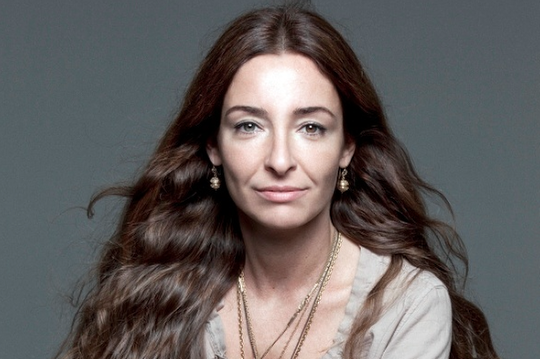
We are delighted to publish this interview with Alessia Glaviano Senior Photo Editor for Vogue Italia and L’Uomo Vogue. Born in Palermo, Italy, she is now based in Milan, having lived and worked for many years in New York City. Glaviano has a degree in economics from Bocconi University in Milan, and has always been passionate about photography, partially thanks to her father, the renowned fashion photographer Marco Glaviano.
After graduating, she moved to New York to a job at at Pier 59 Studios, where she had the opportunity to work for many international fashion photographers. Five years later, she moved back to Milan, where she began her career as a photo editor for Vogue Italia.
Today, in addition to her positions at Vogue Italia and L’Uomo Vogue, Glaviano is also responsible for Photovogue, and the news channels for the Vogue Italia website, Vogue.it, where she curates the video-interview series Vogue Masters, featuring such acclaimed photographers as Bruce Weber, David LaChapelle, and Josef Koudelka, among others.
I interviewed Alessia discussing the impact mobile photography and social networks has had on her both professionally and personally and how mobile photography might feature within Vogue today…

For some photo editors and photographers alike, the idea of Instagram offering a universal language to the world, in pictures, does not go far enough. Social networks allows us to project whatever image we choose onto the people we’re connected to. Images that we take of ourselves and of others form a central role in the way we perform for others in the online space. But how these images are interpreted from our original intention can be very different. Giaviano explains, ‘Images are intrinsically ambiguous and we read them with our own personal cultural background, so they are necessarily interpreted in very different ways’. Not dissimilar to written language, where you can find as many diverse genres as poetry, essays, novels, articles and even shopping lists’.
‘We cannot assume that images are all the same, there are those made by professional image makers, the vernacular images, the informative one, the artistic, the ads etc. What we really lack right now is a visual education: you cannot take for granted that people are naturally able to read all the layers of an image. We teach people to read and to write and to define their literary taste and understanding, but we don’t teach them how to approach an image in a critical way’.
Alessia Glaviano
But what of Instagram, how is it changing the media landscape? As TheNational recently reported, ‘The explosion of social media is perhaps the greatest revolution in fashion since Mary Quant’s mini skirt, transforming the industry’s branding and fan base. It’s been incredible, absolutely incredible. Social media has made such a difference,” said Lubov Azria, the chief creative officer of the fashion house BCBG Max Azria Group. “It used to be where the editors would come in, whether they liked the collection or not, they would have a certain point of view, and that’s what everyone saw,” said Azria. “Now with social media, we have a voice. We have a way to express what we feel, why we feel certain things. It’s incredible.”
Giaviano goes on to say, ‘social networks are completely transforming the editorial landscape in a mulitpolar universe, where individuals are the publishers of themselves and if they are able to communicate in an effective way, they will manage to have a personal following and this will give their messages more strength and relevance. Of course, the downside to this is that populism and the ‘likes logic’ can sometimes lower the quality level of the virtual discussion, but nevertheless, I think that this empowering of the individual is a positive achievement’.
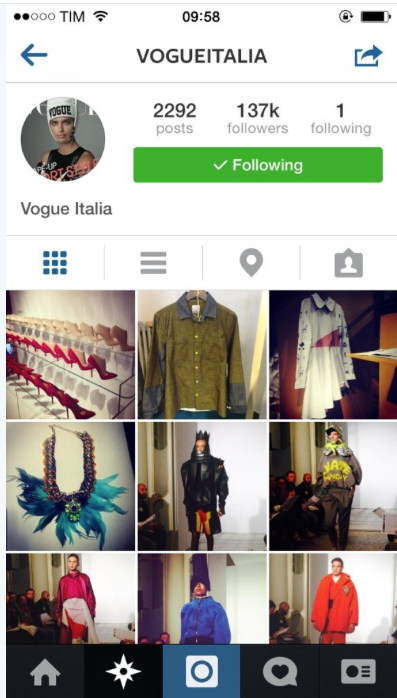
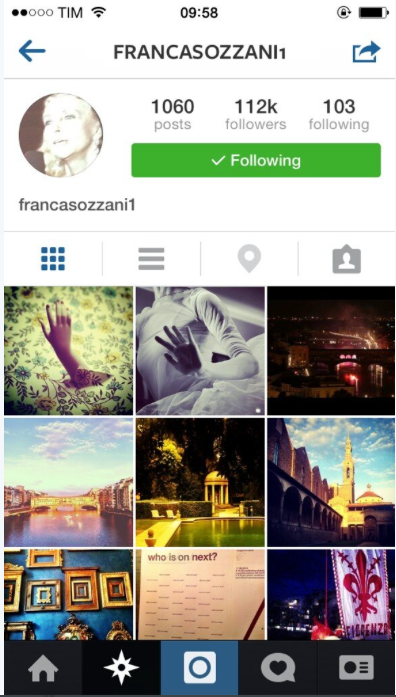
Vogue Italia have incorporated mobile photography both in their communication strategy (they have a Vogue Italias account (link) and Franca Sozzani, the Editor-in-Chief, has a personal one (link). In the editorial strategy, Franca Sozzani and Sara Maino, the Senior Fashion Editor, often publish their live ‘snapshot impressions’ of fashion shows. They also occasionally publish mobile photography in PhotoVogue (expect to see more here via theappwhisperer, soon, thank you so much Alessia x).
PhotoVogue
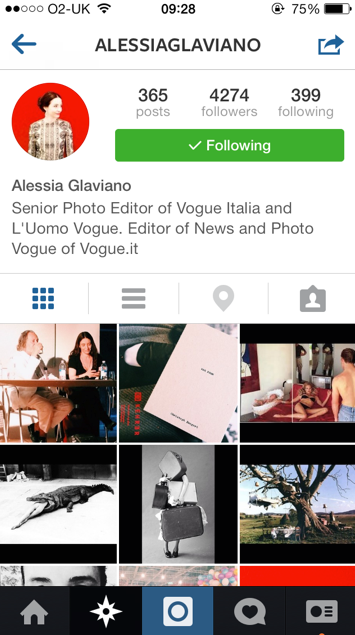
Alessia Glaviano Instagram Feed (@AlessiaGlaviano)
VogueItalia Instagram Feed (@VogueItalia)
FrancaSozzani1 Instagram Feed (@FrancaSozzani1)

Joanne Carter
Joanne Carter is a British photography journalist, editor, curator, and the founder of *TheAppWhisperer.com*, one of the world’s leading platforms dedicated to mobile photography and art. Since its launch in 2009, TheAppWhisperer has become an international hub for artists of all levels to discover, learn, exhibit, and engage with contemporary photographic practice.Built on principles of inclusivity, accessibility, and artistic excellence, Joanne has spent almost two decades championing mobile photography as a serious artistic medium. Through interviews, critical essays, exhibitions, competitions, and education, she has helped shape and document the evolution of mobile art on a global scale.Her work has taken her internationally, lecturing on photography and mobile art at institutions and events including the Museum of Art in Seoul, South Korea, alongside appearances in the UK and Europe. She has served as a juror for international photography and mobile art awards across Portugal, Canada, the United States, South Korea, Italy, and the UK.Joanne is also the founder of *TheAppWhispererPrintSales.com*, one of the first online galleries dedicated exclusively to collectible mobile art, connecting artists with collectors across Europe, the United States, and Asia.Before founding TheAppWhisperer, Joanne worked extensively in print journalism and photographic publishing, including roles at a paparazzi photo agency and as deputy editor of a leading photography magazine. Her freelance journalism, criticism, and commentary have been published widely in both the UK and the US, with bylines in *The Times*, *The Sunday Times*, *The Guardian*, *Popular Photography*, *NikonPro*, *DPReview*, *Which?*, *Vogue Italia*, *LensCulture*, the *BBC*, and more recently, the *Financial Times*, where her published letters on photography continue to contribute to wider conversations around the medium.Alongside her editorial and curatorial work, Joanne’s own photographic practice has been exhibited internationally across the UK, Europe, South Korea, and the United States. Her work increasingly explores themes of grief, loss, death, memory, and the body.Her current research interests centre on grief, death, and poverty, with forthcoming postgraduate study leading towards doctoral research in these areas.Joanne is currently developing new long-form writing and photographic projects and is available for commissions, editorial projects, speaking engagements, and collaborations.Contact: joannetheappwhisperer@gmail.com)
One Comment
Maryjane Sarvis
Many interesting points. Several topics I’d like to go into depth with someone so knowledgeable about this field and how fast it changes. Great interview and would love to hear more!