Got Your iPhone 4 Yet?
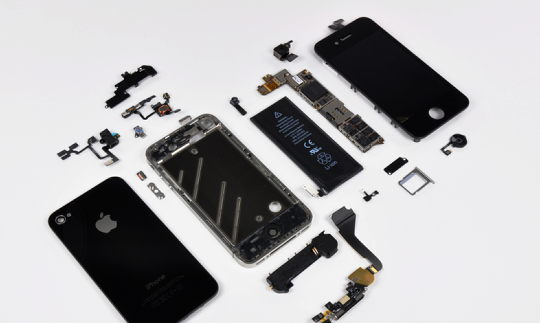
Well, if you haven’t been lucky enough to get your hands on one yet today, take a look at one being dismantled instead – you knew it was going to be good but did you expect it to look this good? iFixit.com wasted no time in getting hold of one and tearing it down, take a look at this…
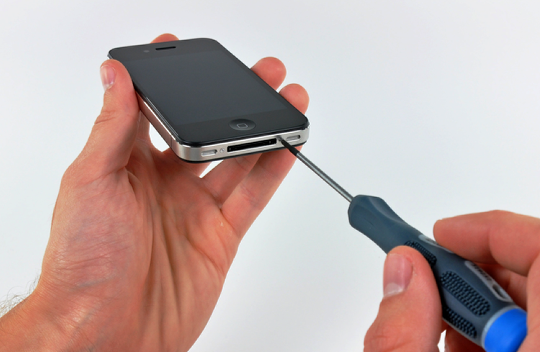
Like the iPhone 3G and 3GS, there are two silver Phillips #00 screws at the bottom of the phone. In a departure from the design of the 3G and 3GS, removing the screws releases the rear case, not the front glass. This design makes replacing the rear panel trivial, but unfortunately means that replacing the front glass will likely be rather challenging.
Look at that battery
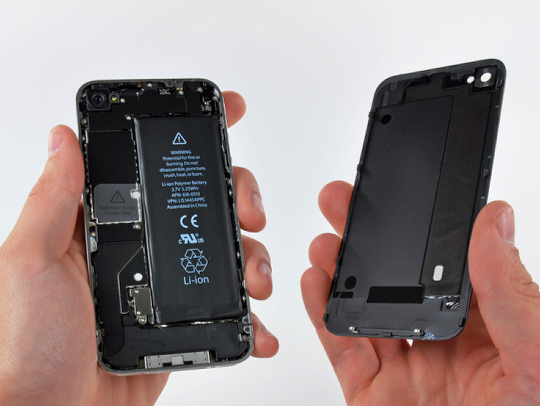
Removing rear panel gives us a pretty good look at the iPhone 4’s innards. Holy battery! The inside of this thing is dominated by its juice-provider. It’s pretty apparent that real estate was very limited inside the iPhone 4’s 115.2 x 58.6 x 9.3 mm footprint. You can also see the antenna’s pressure contact on the inner face of the rear panel.
Removing The Battery
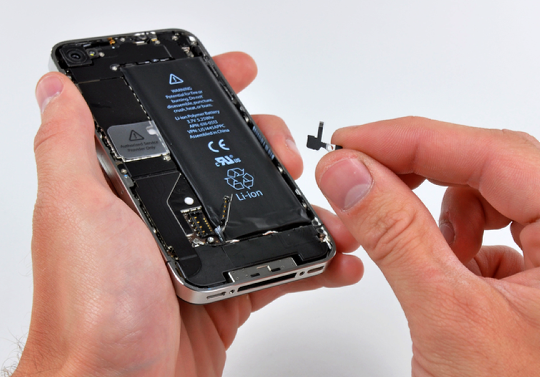
Luckily, the battery can be easily removed once the back panel assembly is out of the way. The 3.7V 1420 mAh Li-Polymer battery allows for up to 7 hours of talk time on 3G or up to 14 hours on 2G. The battery connector is different than the one in the 3G and 3GS. Fortunately, the battery is not soldered to the logic board. The plastic pull tab for the battery says "Authorized Service Provider Only."
EMI Shield
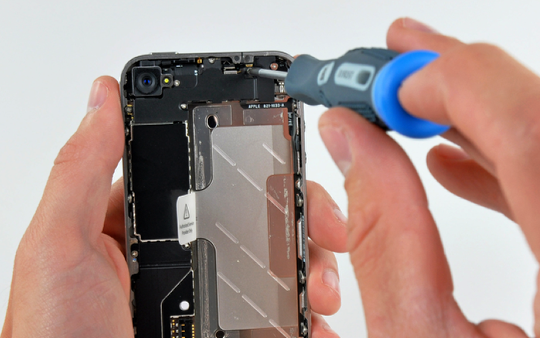
No EMI shield will stand between us and the innards of this iPhone 4! The EMI shield comes off after four screws are removed to reveal lots of important connectors.
512 MB RAM
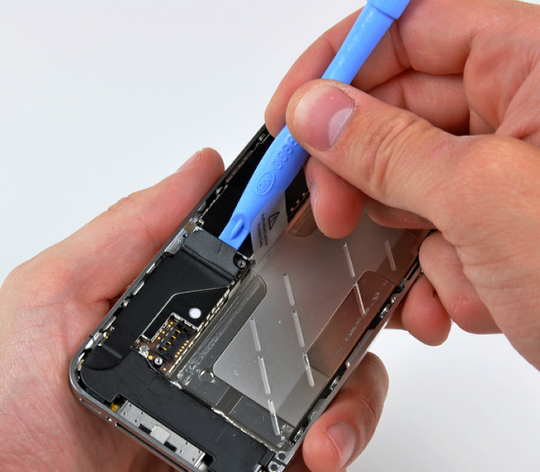
The logic board is heavily embedded under wires and EMI shields. While we’re not too busy, let’s talk RAM. Unlike the iPhone 3GS and iPad, who are both equipped with 256 MB, the iPhone 4 has a whopping 512 MB! The increase in RAM allows for a larger amount of cached data allowing for a smoother and faster user experience.
Vibrator
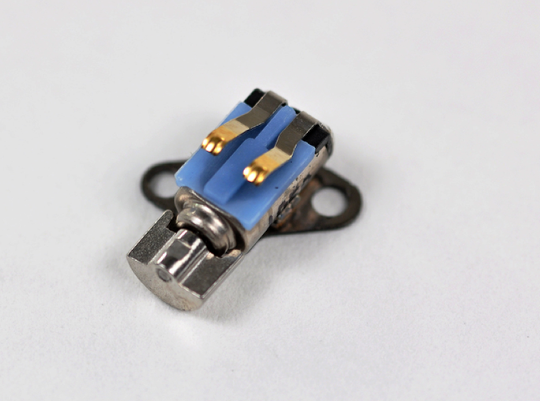
Hiding in the corner is the iPhone 4’s vibrator motor, which…well…vibrates.
Hot Stuff
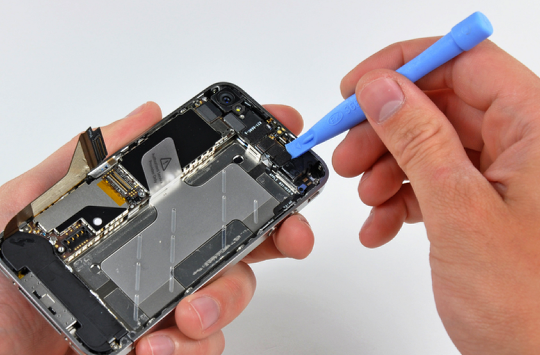
Removing one of the many connectors on the logic board. In our brief usage, we did notice that the phone is considerably warmer on the right side. This makes sense, as the logic board is located entirely along the right side of the phone.
5 MP Camera
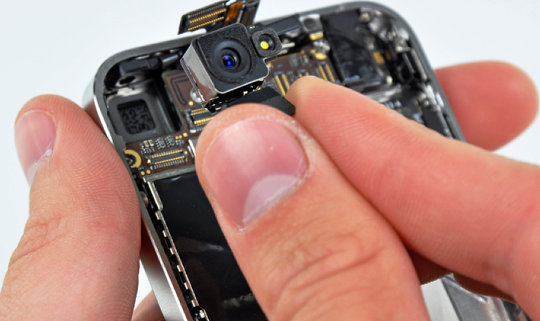
Behold a beauty in the iPhone 4: a rear-facing 5 MP camera with 720p video at 30 FPS, tap to focus feature, and LED flash. This is a huge upgrade from the 3.2 MP camera found in the iPhone 3GS.
Improved Audio
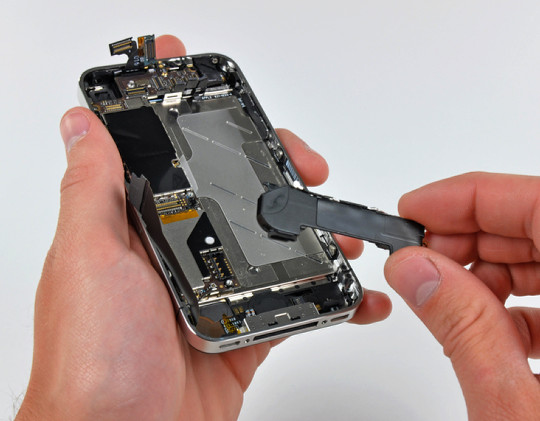
Removing the lower antenna/speaker enclosure from the bottom of the phone. The improved audio chamber aids in clarifying sounds leaving the iPhone, including calls via speakerphone as well as music played through the speaker inside this housing. Apple hasn’t made taking the iPhone 4 apart very hard so far: no 5-point Torx bits or fragile clips to be seen.
Logical
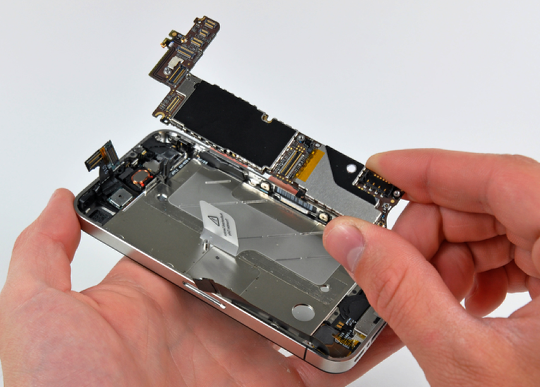
Removing the logic board. The unusual shape and small size of the logic board shows just how costly real estate is inside this powerhouse of a phone.
Genius
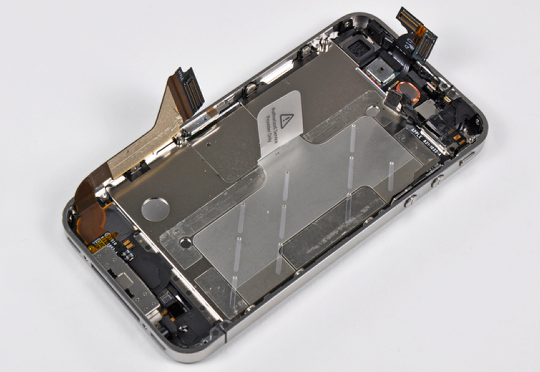
In what can only be described as a work of genius, Apple has integrated the UMTS, GSM, GPS, Wi-Fi, and Bluetooth antennas into the stainless steel inner frame. The dual purpose stainless steel inner frame/antenna assembly addresses possibly the two biggest flaws concerning previous iterations of the iPhone: continuous dropped calls and lack of reception. Apple has gone a step further and tuned the phone to utilize whichever network band is less congested or has the least interference for the best signal quality, regardless of the actual signal strength. Early reports suggest this feature, while buggy in its early stages, will greatly improve the phone’s reliability on AT&T’s fragile network.
Gyroscope
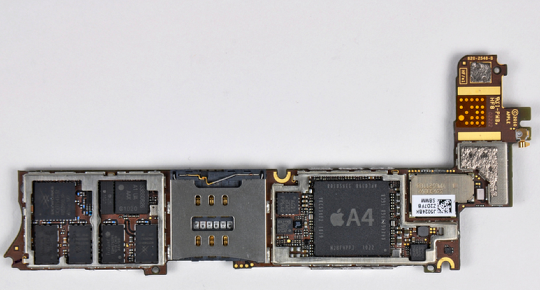
With the EMI shields off, we can get a look at what makes this beast roar. Lurking deep within the phone, the A4 processor, manufactured by Samsung, is the centralized unit that provides the iPhone 4 with the much needed computing power.
Replacing the Samsung S5PC100 ARM A8 600 MHz CPU used in the 3GS, the new iPhone uses the 1 GHz ARM Cortex A8 core, much like its bigger sibling, the iPad. The new Samsung Wave S8500 smartphone uses the same Cortex A8 core!
Just to the left of the A4 package, the AGD1 is the new 3 axis gyroscope that we believe is designed and manufactured by ST Micro for Apple. The package marks on this device do not appear to be the currently available commercial part, L3G4200D. The commercial version of this gyroscope is yet to be released — Apple got first dibs on dibs on it.
Top of logic board
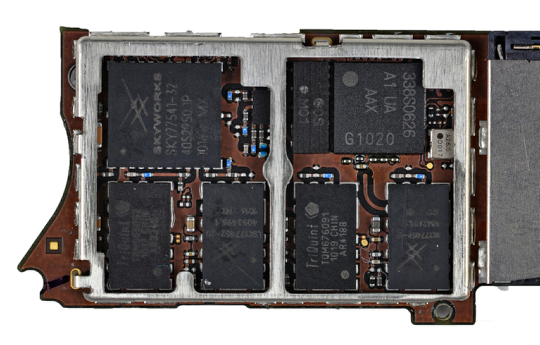
Skyworks SKY77542 Tx–Rx iPAC™ FEM for Dual-Band GSM/GPRS: 880–915 MHz and 1710–1785 MHz bands.
Skyworks SKY77541 GSM/GRPS Front End Module
STMicro STM33DH 3-axis accelerometer
TriQuint TQM676091
338S0626
On the back
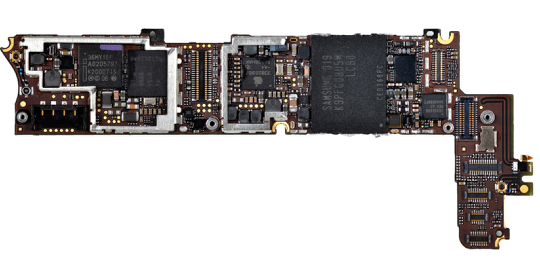
Samsung K9PFG08 flash memory
Cirrus Logic 338S0589 audio codec (Apple branded). This is the same part as in the iPad.
AKM8975 – newest magnetic sensor that promises to improve the performance over the prior generation.
Texas Instruments 343S0499 Touch Screen Controller
36MY1EE Numonyx NOR and mobile DDRR and mobile DDR
Wi-Fi
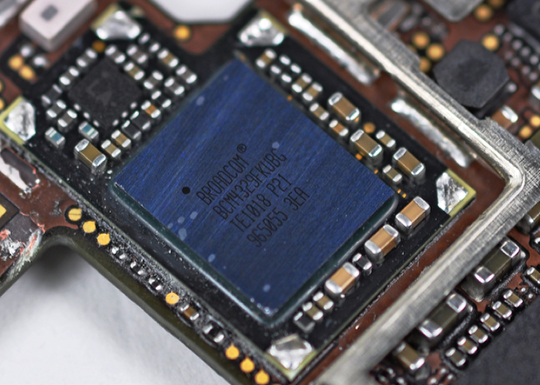
Wi-Fi, Bluetooth, and GPS are all provided by Broadcom and located beneath EMI shields on the front side of the board.
Broadcom BCM4329FKUBG 802.11n with Bluetooth 2.1 + EDR and FM receiver.
Broadcom BCM4750IUB8 single-chip GPS receiver.
Second Microphone
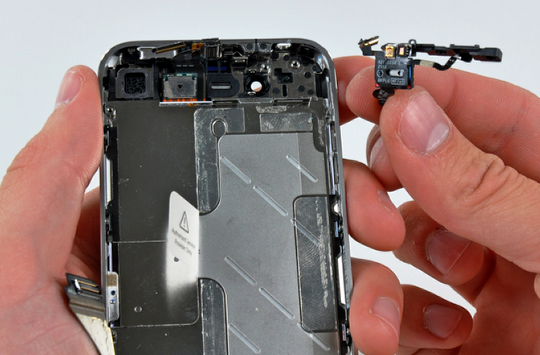
Up next we find the second microphone, which is used to cut out ambient noise and improve sound quality when talking on the phone.
Front-Facing Camera
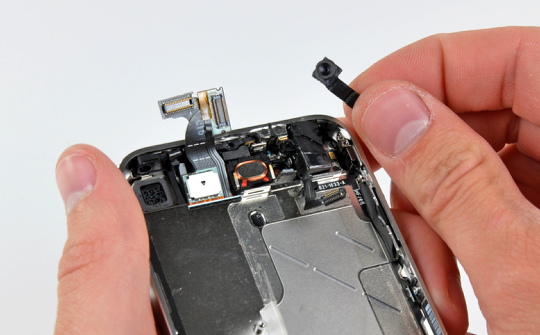
The front-facing VGA camera. While the 5 megapixel camera on the rear of the iPhone 4 is ideal for video recording, the smaller camera on the front optimizes use of Apple’s FaceTime for mobile-to-mobile video calls.
Front Panel
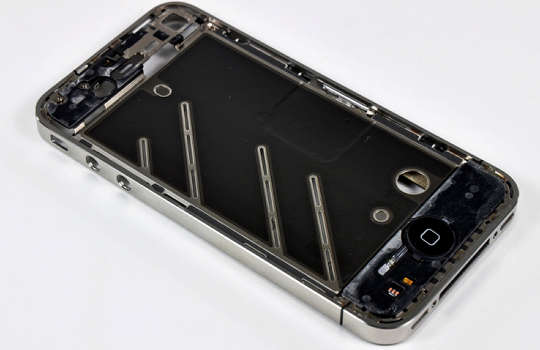
The front panel comes off without too much additional trouble. The stainless steel body left behind is quite a marvel of gadget engineering.
Gorilla Glass
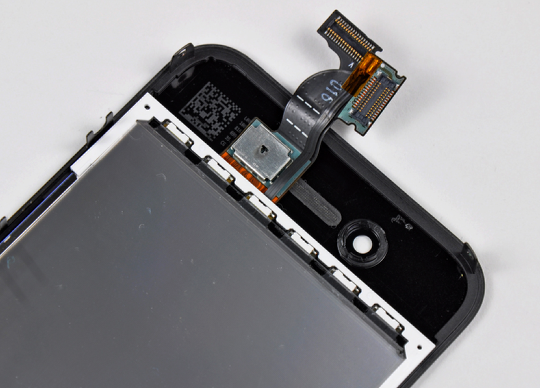
The front glass panel of the iPhone is constructed of Corning Gorilla Glass, a chemically strengthened alkali-aluminosilicate thin sheet glass that is reported to be 20 times stiffer and 30 times harder than plastic. Gorilla Glass holds many advantages as the iPhone 4’s front panel including its high resistance to wear and increased strength from an ion-exchange chemical strengthening process. LED Backlight for the LCD. Unfortunately, the LCD panel is very securely glued to the glass and digitizer. It appears that if you break the glass, you’ll have to replace the glass, digitizer, and LCD as a single assembly.
Home Button
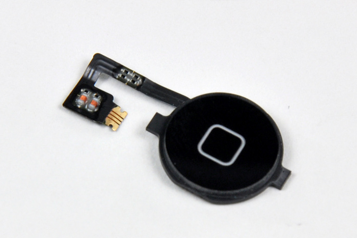
Surprisingly, the electronic home button switch is attached directly to the home button itself.
30-pin Dock Connector
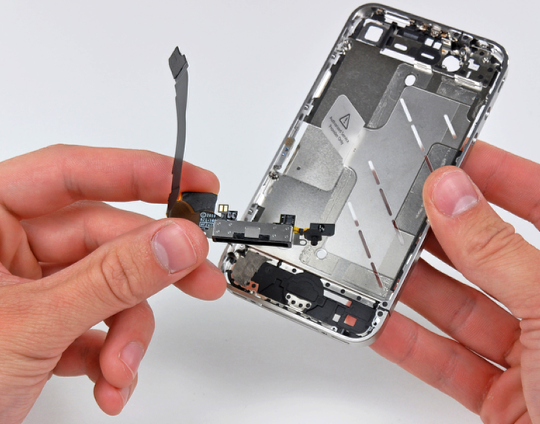
The 30-pin dock connector is where we would usually expect it to be: at the bottom of the iPhone. The primary microphone is also found at the bottom of the phone.
Dual Microphones
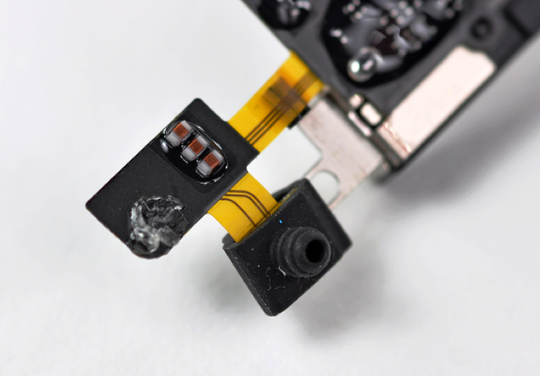
Apple is following in the footsteps of the Nexus One by using dual microphones to help improve audio quality and suppress background noise. Interestingly, the two microphones are positioned at the two far ends of the phone. The microphone at the top of the iPhone is most likely utilized for capturing background noise to be analyzed by internal circuitry and used to cancel any noise put into the main microphone other than the user’s voice.

Joanne Carter
Joanne Carter is a British photographer, photography journalist, editor and curator and the founder and editorial director of TheAppWhisperer.com, an independent international photography publication established in 2009.Her journalism, criticism and commentary have appeared in The Times, The Sunday Times, The Guardian, Financial Times, BBC, Vogue Italia, LensCulture, Popular Photography, Android Magazine, NikonPro, DPReview, Which Digital Camera and Which Camera. She has lectured internationally on photography and mobile art, served as a juror for international photography awards, and exhibited her own photographic work across the UK, Europe, South Korea and the United States.Alongside her editorial work, Joanne's photographic and postgraduate research explores death, grief, memory, representation and social inequality through contemporary photography, participatory practice and visual research methods, with the longer-term aim of developing this work through doctoral research.Through TheAppWhisperer, she continues to publish independent photography journalism spanning contemporary photographic practice, mobile imaging, photographic apps, computational photography and emerging imaging technologies.Joanne is available for editorial commissions, photography projects, judging, curatorial work, speaking engagements, consultancy and selected collaborations.