
Creating Mobile Images Using Plant Matter… Anthotypes For Mobile Photography
As you know, we are looking at as many ways to expand mobile photography into the many realms of ‘traditional/typical’ photography as possible. We have a close working relationship with the team at Impossible as you would have seen with the number and quality of articles we have published, if not see here – and we have a blossoming relationship with the team at PhotoJoJo.
We were interested in the following article relating to analog post-processing that they published last year, it’s the perfect time (in many places of the world) to delve into anthotypes and create a photo print with your captured mobile images and whatever else you can find, spinach, daises, wine, strawberries, onions and many other plants are all light sensitive.
It’s a case of once captured, leaving them in the sun long enough for your own plant prints. There is the issue of print longevity and that plays at odds with photography, recording and capturing but you can of course, scan your images. Take a look at this article featured on PhotoJoJo and let us know your thoughts and we’d love to see your creations, we are considering setting up a Flickr group, purely for these.
Reproduced with kind permission from the team at PhotoJoJo.
WHAT’S AN ANTHOTYPE?
The concept behind Sir John Herschel‘s anthotypes goes like this. Grind up plant matter and paint the juices onto paper. Plop a positive film on top and allow nature to execute its handy work.
You can use all kinds of petals, leaves and berries for this process.
Here are just a few to choose from: Note that the final color may not be the color of the original plant!
Spinach: 4-5 hours, light green (This is what we used.) Daisy: 1 week, sepia Red Wine: 1 week, burgundy Pansy: 2 weeks, purple Onion: 3-4 weeks, orange Beetroot: 4-6 weeks, fuchsia
There is one catch. Anthotypes will fade if left out on display. You can slow down the exposure a couple of different ways.
Artist Binh Dahn encases his work in resin. Rosemary Horn exhibits her anthotypes but covers them so that viewers have to lift a flap to view the print. This protects her work but also makes you think about the fragility of nature.
INGREDIENTS:
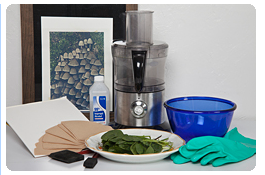
- Newspaper
- Rubber gloves
- Grubby clothes
- Petals, berries or leaves
- Blender or mortar and pestle
- Denatured alcohol (found at hardware stores)
- Container for mixing
- Coffee filter or cheesecloth
- Foam brush
- Hefty watercolor paper (300gsm suggested)
- Contact print frame
- A positive image on transparency film
- OR items to produce a photogram
- The Sun
STEP 1: TRANSFORM THE PLANT INTO EMULSION
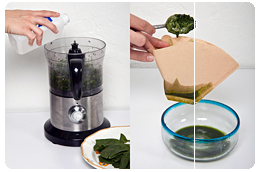
Once you discover the plant that suits your fancy, it’s time to blend it up. In the case of spinach, use only the leaves and you will receive a darker pigment.
Splash some denatured alcohol in the mix. Alcohol is an ideal diluter because it helps extract the chlorophyll from the plants. Blend until it looks juicy.
Strain your mixture through a coffee filter or cheesecloth into a bowl. Drip, drip, drip.
STEP 2: COAT YOUR PAPER
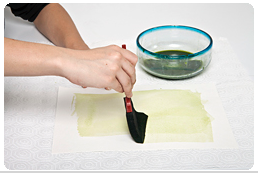
Brushes with hair shed all over your paper, so you may try a foam brush.
Dampen your brush with water, so it doesn’t suck up all the plant goop. Dip it in your juice and coat your paper any funky way you like. Make sure you get it evenly spread out.
Since the sun bleaches the light areas of your positive, begin with as saturated a color as possible. This may require several applications.
Dry in a dark place to avoid premature exposing.
STEP 3: FRAME IT
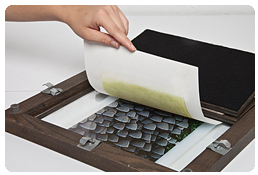
Grab your positive film and arrange it on top of your dry piece of coated paper. Place it into your contact print frame and close it up tight.
You can also use a regular frame as long as the positive stays in place. Contact print frames are really the way to go if you can get a hold of one. They have a hinged back that lets you check the exposure without accidentally moving the positive.
You can snag a reasonably priced contact print frame at B & H Photo.
STEP 4: GIVE IT TO THE SUN
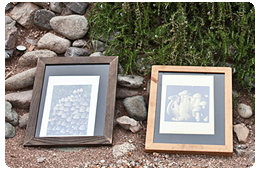
Find a place in your yard that has the brightest sun and leave your soon to be anthotypes there to cook. Check on them periodically to make sure they are not being blocked by shadows.
Now it’s time to wait. The length of your exposure depends on the weather conditions, so if it’s an overcast day, give it more time.
STEP 5: FINAL RESULT!
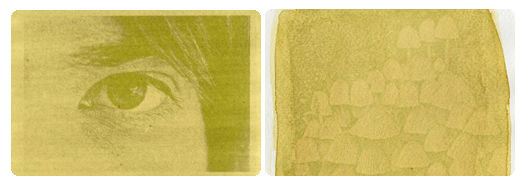
Admire your print!
Anthotypes are low contrast, but instead produce a subtle and delicate looking print.
From here, you’ll want to store it away from the sun. You might want to scan your anthotype. That way, even if it fades, you’ll be able preserve what it looked like forever.
TAKE IT FURTHER
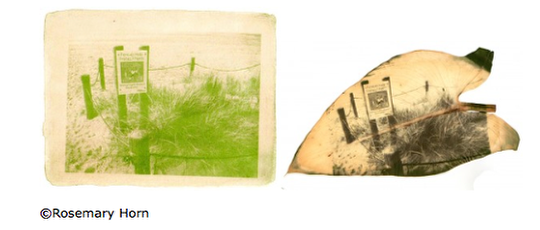
1.) Expose your petals while you pedal, like artist Rosemary Horn. She attaches anthotypes and chlorophyll prints to her bike!
2.) Recommended Reading: Anthotypes by Malin Fabbri. The plant index is especially helpful with tips on which plants to use.
3.) Make a fancy food centerpiece. Place a stencil or positive directly onto fruit and put it in the sun!

Joanne Carter
Joanne Carter is a British photographer, photography journalist, editor and curator and the founder and editorial director of TheAppWhisperer.com, an independent international photography publication established in 2009.Her journalism, criticism and commentary have appeared in The Times, The Sunday Times, The Guardian, Financial Times, BBC, Vogue Italia, LensCulture, Popular Photography, Android Magazine, NikonPro, DPReview, Which Digital Camera and Which Camera. She has lectured internationally on photography and mobile art, served as a juror for international photography awards, and exhibited her own photographic work across the UK, Europe, South Korea and the United States.Alongside her editorial work, Joanne's photographic and postgraduate research explores death, grief, memory, representation and social inequality through contemporary photography, participatory practice and visual research methods, with the longer-term aim of developing this work through doctoral research.Through TheAppWhisperer, she continues to publish independent photography journalism spanning contemporary photographic practice, mobile imaging, photographic apps, computational photography and emerging imaging technologies.Joanne is available for editorial commissions, photography projects, judging, curatorial work, speaking engagements, consultancy and selected collaborations.
One Comment
slp
Awesome!