Apple brings Everyone Can Code to schools serving blind and deaf students nationwide
This is something or one of the many things I love about Apple, how they team up with leading educators for blind and deaf communities to bring accessible coding to their schools. Personally, having moderate to severe hearing loss, from birth and living with bilateral digital hearing aids (which I love by the way), I know that this is so important! Beginning this autumn, schools supporting students with vision, hearing or other assistive needs will start teaching the Everyone Can Code curricula for Swift, Apple’s powerful and intuitive programming language.
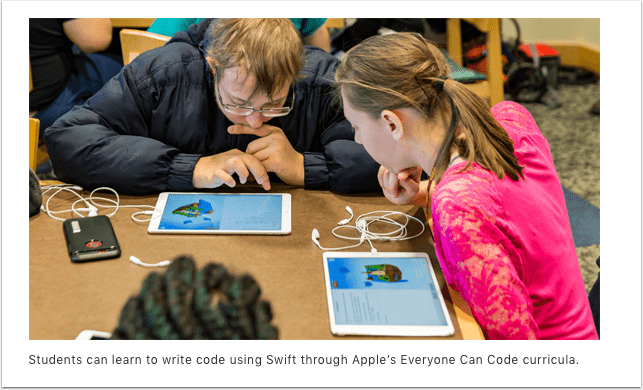
Apple created the comprehensive Everyone Can Code curricula so students from kindergarten to college and beyond can learn and write code using Swift. With teacher guides and lessons, students learn the basics on iPad with Swift Playgrounds which lets you use real code to solve puzzles and control characters with just a tap, to App Development with Swift to help aspiring app developers build their first iOS apps.
“Apple’s mission is to make products as accessible as possible,” said Tim Cook, Apple’s CEO. “We created Everyone Can Code because we believe all students deserve an opportunity to learn the language of technology. We hope to bring Everyone Can Code to even more schools around the world serving students with disabilities.”
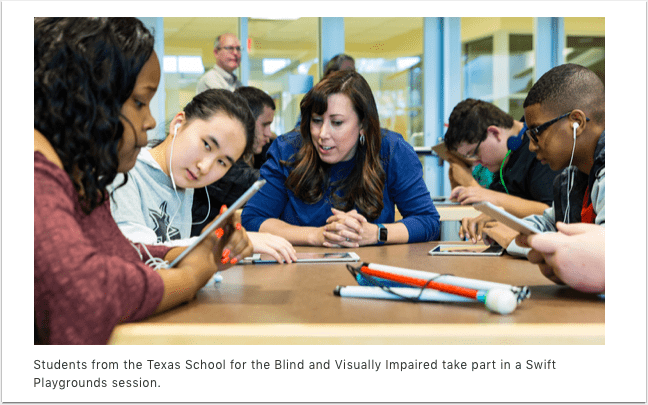
The schools will tailor lessons using Apple’s groundbreaking accessibility technology, which has changed the lives of millions of people with vision, hearing, physical motor, cognitive or other assistive needs. Apple collaborated with engineers, educators, and programmers from various accessibility communities to make Everyone Can Code as accessible as possible and will work in close coordination with schools to augment the curricula as needed. This will include providing additional tools and resources such as tactile maps to enhance the understanding of coding environments for non-visual learners.
Initial list of participating schools:
- California School for the Blind (Fremont, CA)
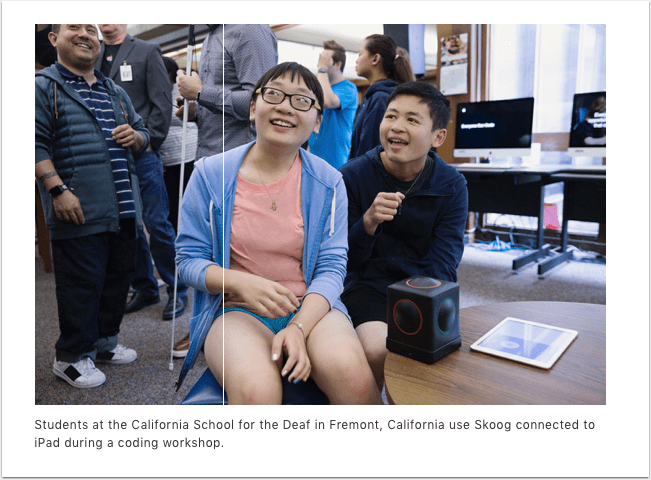
- California School for the Deaf (Fremont, CA)
- District 75/Citywide Programs, New York City Department of Education (New York, NY)
- Florida School for the Deaf and the Blind (St. Augustine, FL)
- Hadley Institute for the Blind and Visually Impaired (Winnetka, IL)
- Perkins School for the Blind (Watertown, MA)
- Texas School for the Blind and Visually Impaired (Austin, TX)
- Texas School for the Deaf (Austin, TX)
“Our students were tremendously excited at our first Everyone Can Code session earlier this year,” said Bill Daugherty, superintendent at the Texas School for the Blind and Visually Impaired in Austin. “There are more than 10,400 students with visual impairments in Texas, and the development of this curricula is going to be a big step in opening up coding opportunities for our students and those across the nation.”
California School for the Deaf superintendent Clark Brooke said, “We’re thrilled to kick off the partnership with Apple. This program is a great way to bring to life the ideas and imagination of our Deaf students through coding, while also building a foundation for future careers in software development and technology.”
Julie Tye, president and CEO of the Hadley Institute for the Blind and Visually Impaired added, “As the largest educator within the visually impaired community, Hadley knows firsthand how important Apple’s technology is in making daily living easier and more enjoyable. Now, partnering with Apple, we are excited to help even more people learn how to code. Whether for fun or future employment, learning the language of technology can offer tremendous opportunity to everyone.”
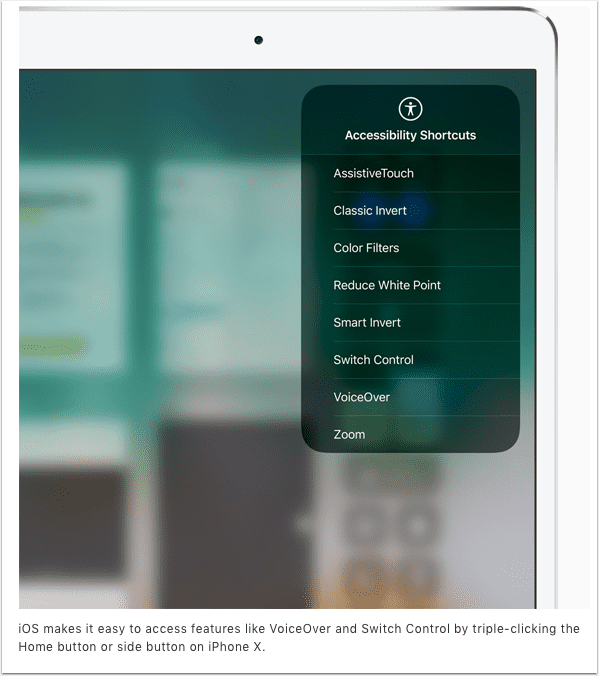
The Everyone Can Code curricula is compatible with VoiceOver, the most advanced screen-reading technology for people who are blind or low vision. VoiceOver is a gesture-based screen reader that describes nearly everything happening on your screen, and is the most popular screen-reading technology of any mobile technology platform1. With VoiceOver integration, Swift Playgrounds can take students step-by-step through learning Swift, all without needing to see the screen.
Accessibility features for people who are deaf or hard of hearing include FaceTime for capturing every gesture and facial expression, Type to Siri, closed captions, LED Flash for Alerts, Mono Audio and Made for iPhone hearing aids.
iPad and Everyone Can Code can also be used by students with physical motor limitations through Apple’s built in Switch Control, which enables switches, joysticks and other adaptive devices to control what is on your screen.
While You’re Here
We have a small favour to ask. More people than ever are reading TheAppWhisperer.com and we could not be more excited about that. We bring you ad-free journalism every day, so you don’t have to close windows and be distracted with advertisements. We specialise in mobile photography and mobile art and we value all of our readers, writers, contributors and viewers but we do have costs and we do need to ask for your help. We at TheAppWhisperer spend many hours each day, each week and each month to bring you this high quality level of journalism. We do it because we are passionate about it and because we want others to be as passionate too.
If everyone who reads our website, who likes it, helps to support it, our future would be so much more secure. Please help us by offering a contribution or supporting us with a monthly donation of your choosing. Please will you help us?
[seamless-donations]

Joanne Carter
Joanne Carter is a British photography journalist, editor, curator, and the founder of *TheAppWhisperer.com*, one of the world’s leading platforms dedicated to mobile photography and art. Since its launch in 2009, TheAppWhisperer has become an international hub for artists of all levels to discover, learn, exhibit, and engage with contemporary photographic practice.Built on principles of inclusivity, accessibility, and artistic excellence, Joanne has spent almost two decades championing mobile photography as a serious artistic medium. Through interviews, critical essays, exhibitions, competitions, and education, she has helped shape and document the evolution of mobile art on a global scale.Her work has taken her internationally, lecturing on photography and mobile art at institutions and events including the Museum of Art in Seoul, South Korea, alongside appearances in the UK and Europe. She has served as a juror for international photography and mobile art awards across Portugal, Canada, the United States, South Korea, Italy, and the UK.Joanne is also the founder of *TheAppWhispererPrintSales.com*, one of the first online galleries dedicated exclusively to collectible mobile art, connecting artists with collectors across Europe, the United States, and Asia.Before founding TheAppWhisperer, Joanne worked extensively in print journalism and photographic publishing, including roles at a paparazzi photo agency and as deputy editor of a leading photography magazine. Her freelance journalism, criticism, and commentary have been published widely in both the UK and the US, with bylines in *The Times*, *The Sunday Times*, *The Guardian*, *Popular Photography*, *NikonPro*, *DPReview*, *Which?*, *Vogue Italia*, *LensCulture*, the *BBC*, and more recently, the *Financial Times*, where her published letters on photography continue to contribute to wider conversations around the medium.Alongside her editorial and curatorial work, Joanne’s own photographic practice has been exhibited internationally across the UK, Europe, South Korea, and the United States. Her work increasingly explores themes of grief, loss, death, memory, and the body.Her current research interests centre on grief, death, and poverty, with forthcoming postgraduate study leading towards doctoral research in these areas.Joanne is currently developing new long-form writing and photographic projects and is available for commissions, editorial projects, speaking engagements, and collaborations.Contact: joannetheappwhisperer@gmail.com)