Apple unleashes M5, the next big leap in AI performance for Apple silicon
Apple unleashes M5, the next big leap in AI performance for Apple silicon
M5 delivers over 4x the peak GPU compute performance for AI compared to M4, featuring a next-generation GPU with a Neural Accelerator in each core, a more powerful CPU, a faster Neural Engine, and higher unified memory bandwidth
Apple has announced M5, delivering the next big leap in AI performance and advances to nearly every aspect of the chip. Built using third-generation 3-nanometer technology, M5 introduces a next-generation 10-core GPU architecture with a Neural Accelerator in each core, enabling GPU-based AI workloads to run dramatically faster, with over 4x the peak GPU compute performance compared to M4.1 The GPU also offers enhanced graphics capabilities and third-generation ray tracing that combined deliver a graphics performance that is up to 45 percent higher than M4.1 M5 features the world’s fastest performance core, with up to a 10-core CPU made up of six efficiency cores and up to four performance cores.2 Together, they deliver up to 15 percent faster multithreaded performance over M4.1M5 also features an improved 16-core Neural Engine, a powerful media engine, and a nearly 30 percent increase in unified memory bandwidth to 153GB/s.1 M5 brings its industry-leading power-efficient performance to the new 14-inch MacBook Pro, iPad Pro, and Apple Vision Pro, allowing each device to excel in its own way. All are available for pre-order today.
“M5 ushers in the next big leap in AI performance for Apple silicon,” said Johny Srouji, Apple’s senior vice president of Hardware Technologies. “With the introduction of Neural Accelerators in the GPU, M5 delivers a huge boost to AI workloads. Combined with a big increase in graphics performance, the world’s fastest CPU core, a faster Neural Engine, and even higher unified memory bandwidth, M5 brings far more performance and capabilities to MacBook Pro, iPad Pro, and Apple Vision Pro.”
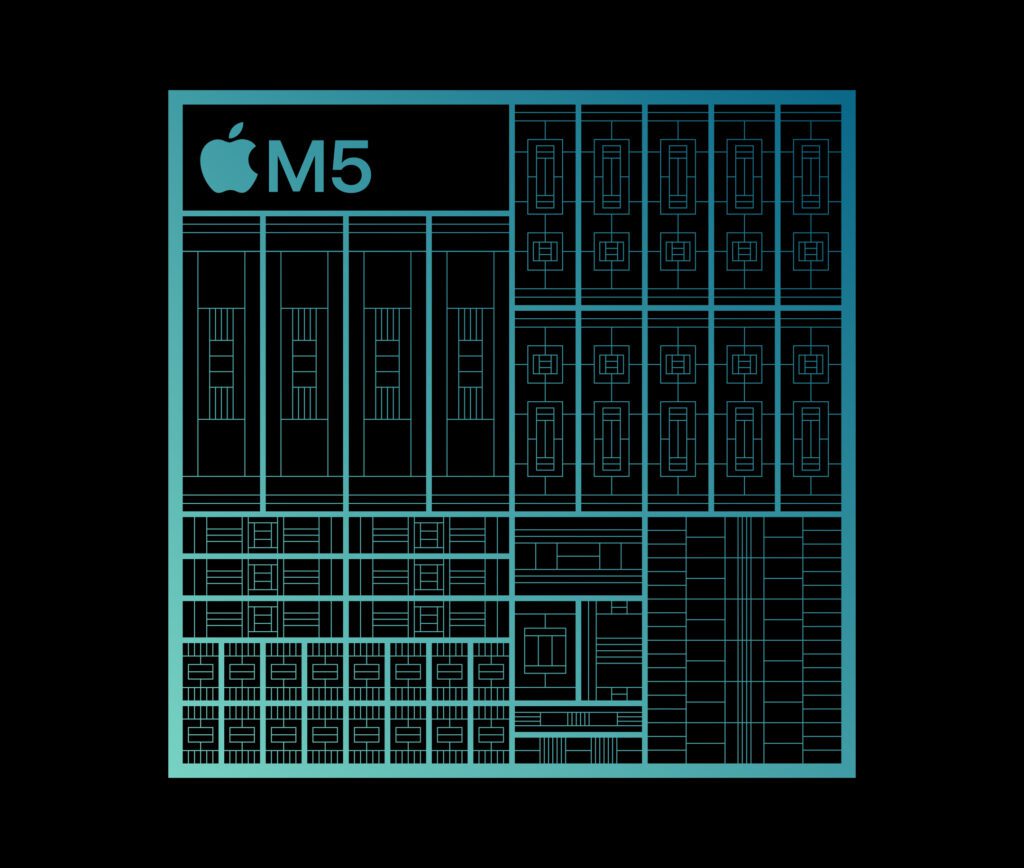
A Next-Generation GPU Architecture Optimised for AI and Graphics
With the next-generation GPU architecture in M5, every compute block of the chip is optimised for AI. The 10-core GPU features a dedicated Neural Accelerator in each core, delivering over 4x peak GPU compute compared to M4, and over 6x peak GPU compute for AI performance compared to M1.1 And now with M5, the new 14-inch MacBook Pro and iPad Pro benefit from dramatically accelerated processing for AI-driven workflows, such as running diffusion models in apps like Draw Things, or running large language models locally using platforms like webAI.
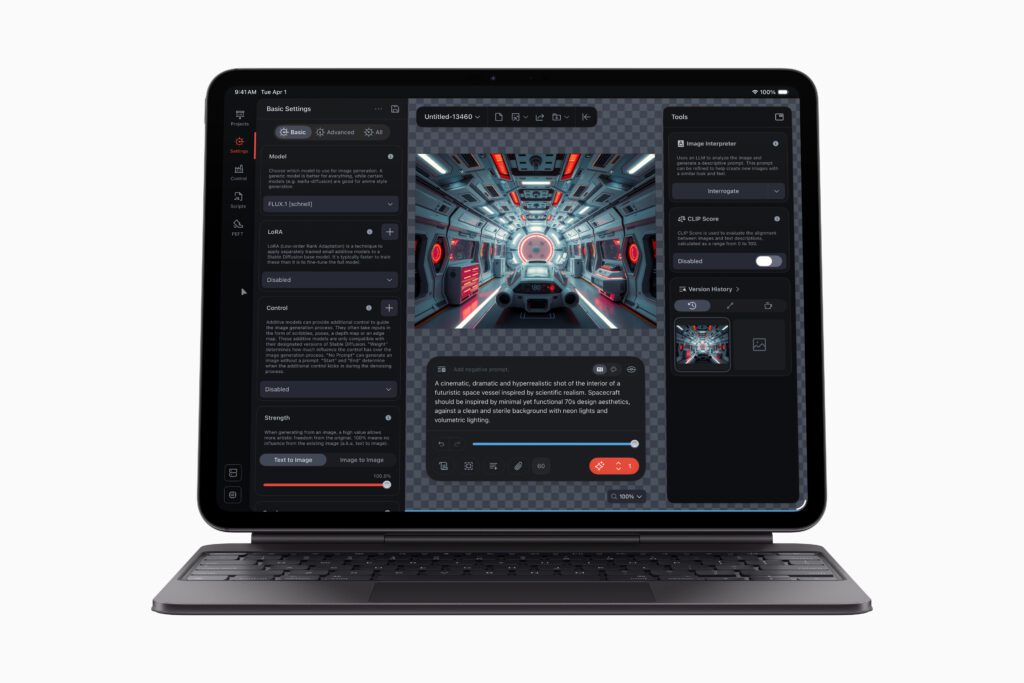
The next-generation GPU and enhanced shader cores in M5 also deliver increased graphics performance, achieving up to 30 percent faster performance compared to M4 and up to 2.5x faster performance than M1.1 M5 also includes Apple’s third-generation ray-tracing engine, providing up to a 45 percent graphics uplift in apps using ray tracing.1 Combined with rearchitected second-generation dynamic caching, the GPU provides smoother gameplay, more realistic visuals in 3D applications, and faster rendering times for complex graphics projects and other visually intensive applications. With M5, Apple Vision Pro renders 10 percent more pixels with the micro-OLED displays, and refresh rates increase up to 120Hz, resulting in crisper details, more fluid display performance, and reduced motion blur.

The GPU architecture is engineered for seamless integration with Apple’s software frameworks. Applications using built-in Apple frameworks and APIs — like Core ML, Metal Performance Shaders, and Metal 4 — can automatically see immediate increases in performance. Developers can also build solutions for their apps by directly programming the Neural Accelerators using Tensor APIs in Metal 4.
A Faster Neural Engine to Power Intelligent Features
The faster 16-core Neural Engine delivers powerful AI performance with incredible energy efficiency, complementing the Neural Accelerators in the CPU and GPU to make M5 fully optimised for AI workloads. For example, AI-powered features on Apple Vision Pro — like the ability to transform 2D photos into spatial scenes in the Photos app, or generating a Persona — operate with greater speed and efficiency.
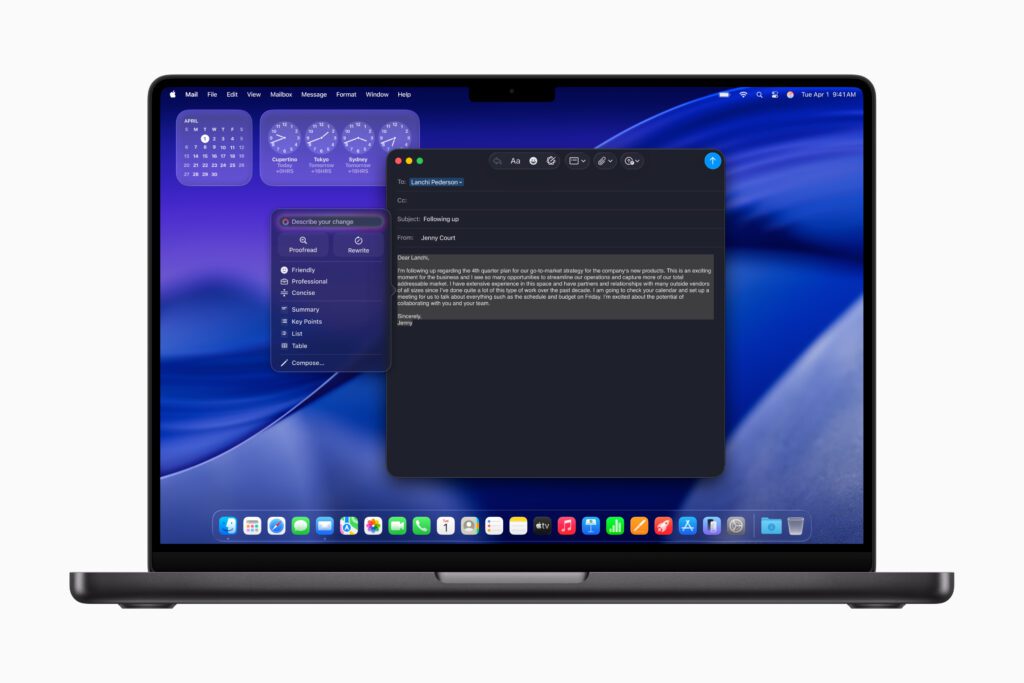
The Neural Engine in M5 also enhances performance for Apple Intelligence.3 On-device AI tools like Image Playground get faster, and the overall performance of Apple Intelligence models are enhanced by the faster Neural Engine and unified memory in M5.4
Also, developers using Apple’s Foundation Models framework will get faster performance.
Enhanced Memory to Do Even More with AI
M5 offers unified memory bandwidth of 153GB/s, providing a nearly 30 percent increase over M4 and more than 2x over M1. The unified memory architecture enables the entire chip to access a large single pool of memory, which allows MacBook Pro, iPad Pro, and Apple Vision Pro to run larger AI models completely on device. It fuels the faster CPU, GPU, and Neural Engine as well, offering higher multithreaded performance in apps, faster graphics performance in creative apps and games, and faster AI performance running models on the Neural Accelerators in the GPU or the Neural Engine. And with 32GB of memory capacity, M5 also helps users to seamlessly run demanding creative suites like Adobe Photoshop and Final Cut Pro simultaneously, while uploading large files to the cloud in the background.
Apple Silicon and the Environment
Apple 2030 is the company’s ambitious plan to be carbon neutral across its entire footprint by the end of this decade by reducing product emissions from their three biggest sources: materials, electricity, and transportation. The power-efficient performance of M5 helps the new 14-inch MacBook Pro, iPad Pro, and Apple Vision Pro meet Apple’s high standards for energy efficiency, and reduces the total amount of energy consumed over the product’s lifetime.
About Apple Apple revolutionised personal technology with the introduction of the Macintosh in 1984. Today, Apple leads the world in innovation with iPhone, iPad, Mac, AirPods, Apple Watch, and Apple Vision Pro. Apple’s six software platforms — iOS, iPadOS, macOS, watchOS, visionOS, and tvOS — provide seamless experiences across all Apple devices and empower people with breakthrough services including the App Store, Apple Music, Apple Pay, iCloud, and Apple TV. Apple’s more than 150,000 employees are dedicated to making the best products on earth and to leaving the world better than we found it.
- Testing conducted by Apple in September 2025 using preproduction 14-inch MacBook Pro systems with Apple M5, 10-core CPU, and 10-core GPU; production 14-inch MacBook Pro systems with Apple M4, 10-core CPU, and 10-core GPU; and production 13-inch MacBook Pro systems with Apple M1, 8-core CPU, and 8-core GPU. Performance measured using select industry‑standard benchmarks. Performance tests are conducted using specific computer systems and reflect the approximate performance of MacBook Pro.
- Testing conducted by Apple in September 2025 using shipping competitive systems and select industry-standard benchmarks.
- Apple Intelligence is available in beta with support for these languages: English, French, German, Italian, Portuguese (Brazil), Spanish, Chinese (simplified), Japanese, and Korean. Some features may not be available in all regions or languages. For feature and language availability and system requirements, see support.apple.com/en-gb/121115.
- Genmoji and Image Playground are available in English, French, German, Italian, Portuguese (Brazil), Spanish, and Japanese.
Please support us
TheAppWhisperer has always had a dual mission: to promote the most talented mobile artists of the day and to support ambitious, interested viewers worldwide. As the years pass, TheAppWhisperer has gained readers and viewers and has found new venues for that exchange.
All this work thrives with the support of our community. Your support helps protect our independence, and we can keep delivering open, global promotion of mobile artists. Every contribution, however big or small, is valuable for our future.

Joanne Carter
Joanne Carter is a British photography journalist, editor, curator, and the founder of *TheAppWhisperer.com*, one of the world’s leading platforms dedicated to mobile photography and art. Since its launch in 2009, TheAppWhisperer has become an international hub for artists of all levels to discover, learn, exhibit, and engage with contemporary photographic practice.Built on principles of inclusivity, accessibility, and artistic excellence, Joanne has spent almost two decades championing mobile photography as a serious artistic medium. Through interviews, critical essays, exhibitions, competitions, and education, she has helped shape and document the evolution of mobile art on a global scale.Her work has taken her internationally, lecturing on photography and mobile art at institutions and events including the Museum of Art in Seoul, South Korea, alongside appearances in the UK and Europe. She has served as a juror for international photography and mobile art awards across Portugal, Canada, the United States, South Korea, Italy, and the UK.Joanne is also the founder of *TheAppWhispererPrintSales.com*, one of the first online galleries dedicated exclusively to collectible mobile art, connecting artists with collectors across Europe, the United States, and Asia.Before founding TheAppWhisperer, Joanne worked extensively in print journalism and photographic publishing, including roles at a paparazzi photo agency and as deputy editor of a leading photography magazine. Her freelance journalism, criticism, and commentary have been published widely in both the UK and the US, with bylines in *The Times*, *The Sunday Times*, *The Guardian*, *Popular Photography*, *NikonPro*, *DPReview*, *Which?*, *Vogue Italia*, *LensCulture*, the *BBC*, and more recently, the *Financial Times*, where her published letters on photography continue to contribute to wider conversations around the medium.Alongside her editorial and curatorial work, Joanne’s own photographic practice has been exhibited internationally across the UK, Europe, South Korea, and the United States. Her work increasingly explores themes of grief, loss, death, memory, and the body.Her current research interests centre on grief, death, and poverty, with forthcoming postgraduate study leading towards doctoral research in these areas.Joanne is currently developing new long-form writing and photographic projects and is available for commissions, editorial projects, speaking engagements, and collaborations.Contact: joannetheappwhisperer@gmail.com)