Tracey Emin, the Bed Trick and a Weekend of Reading
2026-03-09/Comments Off on Tracey Emin, the Bed Trick and a Weekend of Reading
Tracey Emin, the Bed Trick and a Weekend of Reading
Last weekend, Tracey Emin seemed to be everywhere. Her new exhibition ‘Tracey Emin – A Second Life’ at Tate Modern had just opened, and her name kept appearing in the newspapers — in reviews, interviews and photographs of paintings newly hung on the museum’s walls. For a few days, she drifted through the cultural pages in that way certain artists do when a retrospective returns them suddenly to public attention. I was noticing it all from indoors.
Earlier in the week, I had managed to sprain my left ankle badly enough that walking became almost impossible for a few days. The ligament swelled quickly, and the only sensible solution was to stay inside, drench it with witch hazel and bandages, keep it elevated and allow the body to do its slow work of repair.
Outside, it was wet and cold, one of those grey February weekends where the light never quite settles. Inside, however, it was warm and quiet. The enforced stillness brought an unexpected luxury: uninterrupted reading.
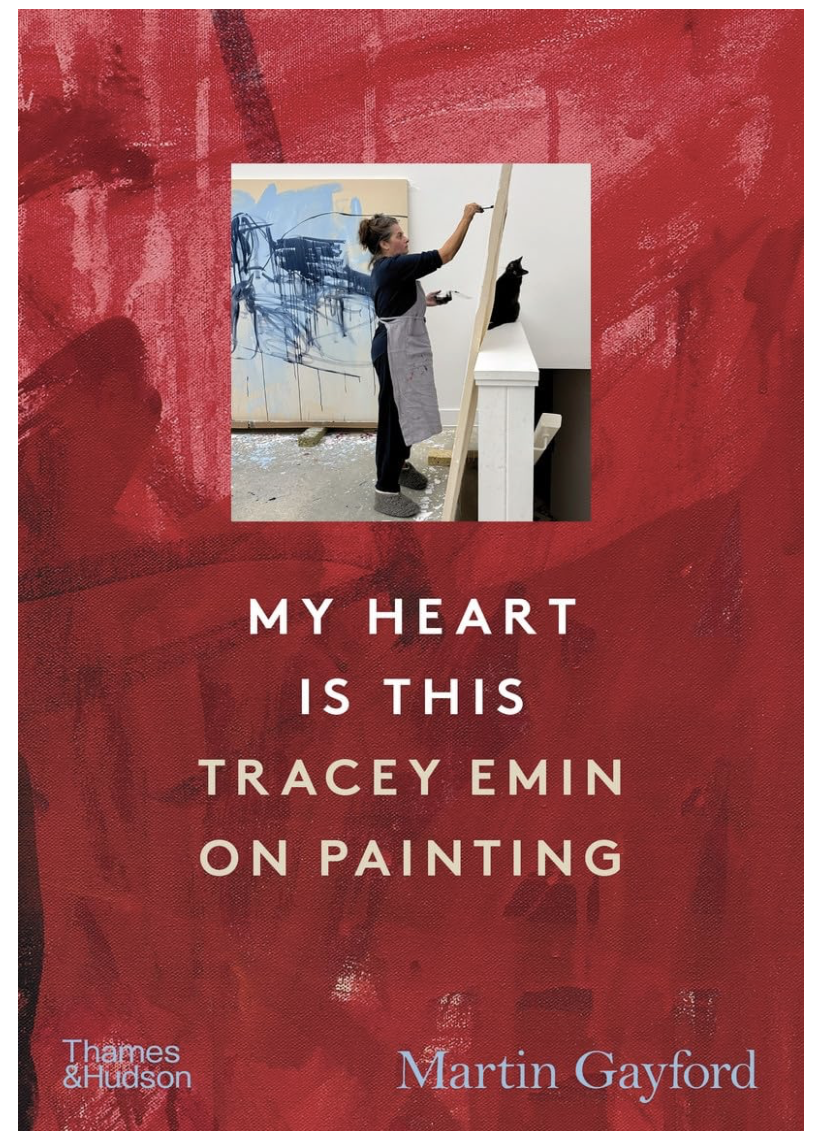
I had been looking forward to Martin Gayford’s new book on Tracey Emin’s painting, My Heart Is This, and finally had the time to sit with it properly. At the same time, I was working my way through the Saturday Financial Times, where another Emin-related piece caught my attention — an essay by Izabella Scott about her new book The Bed Trick: Sex and Deception on Trial.
By Sunday afternoon, the two texts had begun to intersect in my mind in ways I hadn’t expected.
Gayford’s book does something quietly important: it repositions Emin primarily as a painter. For decades, discussion of her work has revolved around My Bed, the installation that propelled her into global attention in 1998. Gayford instead emphasises the paintings that have occupied much of her practice in recent years.
Early in the book, he describes a cork tree outside Emin’s studio that appeared dead but was still alive beneath the bark. The metaphor feels apt. Emin’s work repeatedly returns to survival — bodies damaged but continuing, lives interrupted but still unfolding.
Reading this while resting my own injured ankle gave the passage a small, personal resonance. Bodies fail in ordinary ways. They recover slowly and without drama.
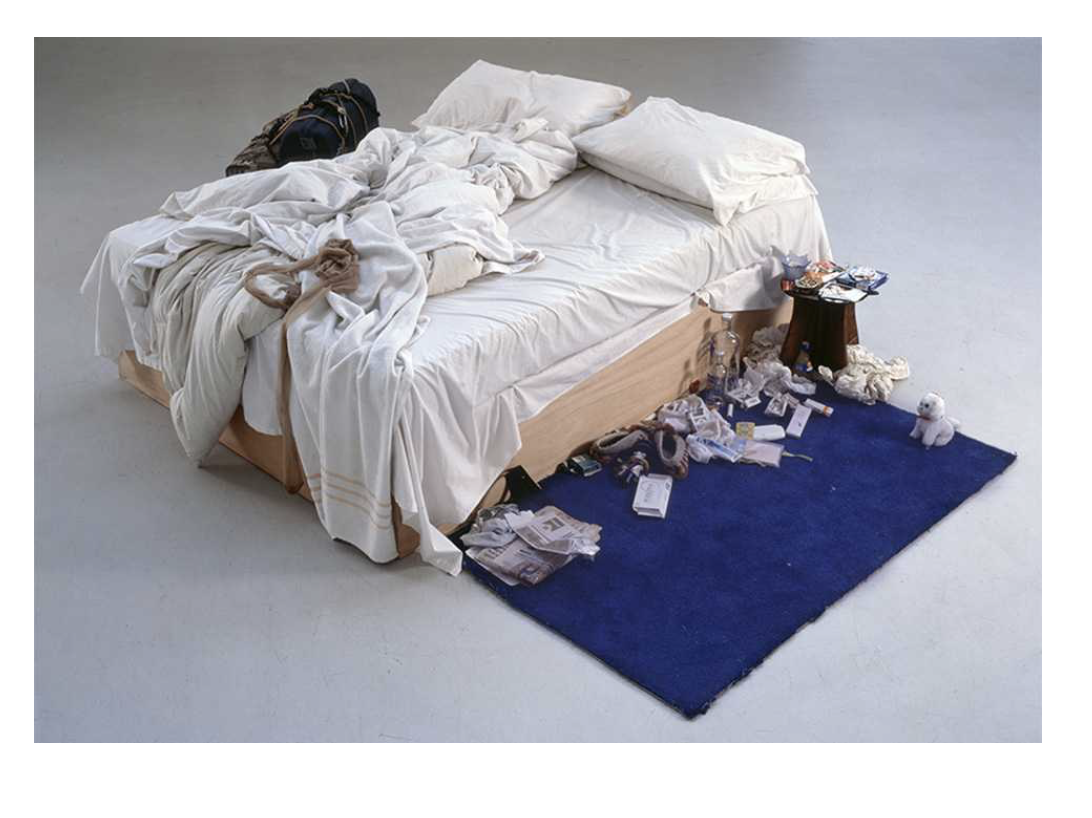
Of course, the bed itself remains central to Emin’s work, whether we intend it to or not. Nearly three decades after it first appeared, My Bed still occupies the centre of the story. When the installation was first shown, it caused immediate controversy. The unmade bed, surrounded by empty bottles, underwear and cigarettes, was widely interpreted as a provocation — a deliberate blurring of private life and public art. The reaction intensified when the work was shortlisted for the Turner Prize in 1999. What might otherwise have remained an unsettling installation suddenly became a national talking point. Tabloid headlines mocked the idea that an unmade bed could be art at all, while television debates and newspaper columns treated the work as proof that contemporary art had finally lost its mind.
Emin did not win the prize — it went instead to Steve McQueen — but by that point, the work had already entered the cultural bloodstream. Looking back now, that early reading of the piece as little more than a scandal feels increasingly superficial.
Writing recently in the Financial Times, the critic Jackie Wullschlager describes My Bed more plainly as a “self-portrait of depression”. Seen through that lens, the installation becomes something far quieter and more unsettling: the physical residue of a moment in which Emin was profoundly unwell.
Emin herself has often resisted the idea that the work was intended simply to shock. “It wasn’t about shock,” she has said. “It was about how I was living.” The crumpled sheets are not theatrical props; they are the traces of a life at a particular moment.
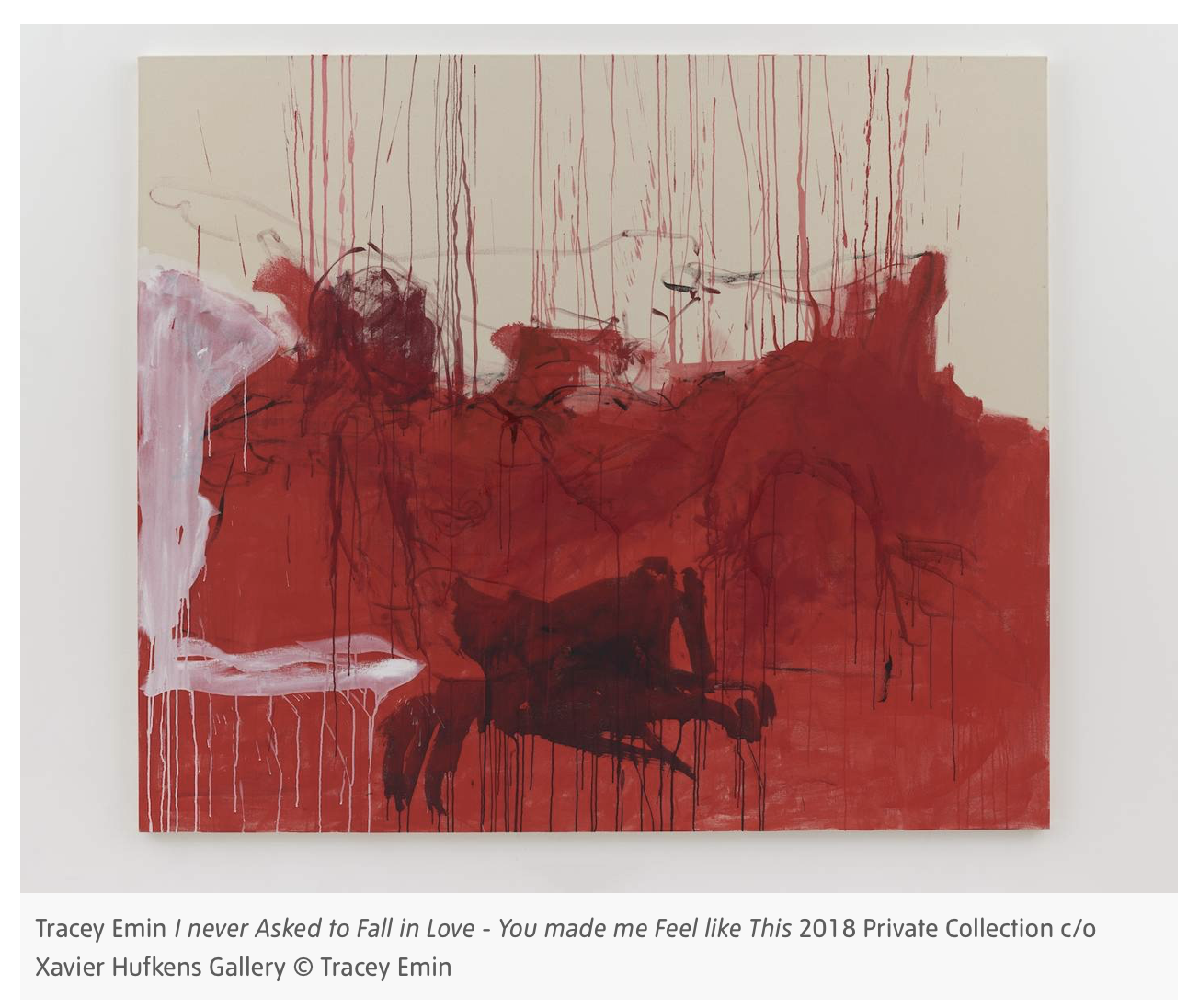
What Gayford’s book helps clarify is that the bed was never a single gesture. In Emin’s work, it becomes an emotional landscape — a place where vulnerability, sexuality, illness and memory intersect. In her recent paintings, the bed sometimes appears directly, sometimes only as a suggestion beneath bodies that seem to dissolve into paint.
It was while thinking about this that Izabella Scott’s essay on the “bed trick” began to feel unexpectedly relevant. Scott describes the bed trick as a literary trope that has appeared in stories and drama for centuries. In its simplest form, the plot involves someone going to bed with one person only to discover that someone else entirely has taken their place. The device appears in medieval folktales, Shakespearean theatre and countless romantic narratives. At first glance, the idea seems absurd. Could someone really fail to recognise who they were sleeping beside?
Yet Scott shows how persistent the story has been across literary history. Darkness, disguise and desire combine to disrupt certainty, allowing characters to project identity onto the body beside them. Her book then traces the trope into modern legal cases, most strikingly the trial of Gayle Newland in the UK. In that case, a woman accused her friend of deceiving her into sexual encounters by posing as a fictional male identity online. The complainant said she had been blindfolded during sex and believed she was with someone else entirely. The case captured national attention precisely because it echoed the logic of the old literary device: a real-life version of the bed trick unfolding in a courtroom.
Scott spent years studying the trial transcripts, trying to understand how such a narrative could operate within modern law. What she discovered was not a tidy moral resolution but something far more complicated. The courtroom became a place where competing stories attempted to reconstruct what had happened in a private bedroom — a space, as Saint Augustine once described it, “removed from witnesses”. That phrase stayed with me.
The bedroom is perhaps the most private environment we inhabit, yet culturally it has always been saturated with stories. In literature, the bed becomes a stage where identities blur, and desire reshapes perception. In courtrooms, the same space becomes evidence, where lawyers and juries attempt to reconstruct events that nobody else witnessed.
Emin’s My Bed performs a similar transformation in art. By moving the bedroom into the gallery, she exposes an intensely private environment to public interpretation. Viewers are confronted with the traces of a life and immediately begin constructing narratives about what might have happened there.
Was it chaos? Sexual confession? Emotional collapse? Performance? The installation never resolves those questions. Instead, it leaves the viewer standing where Scott’s juries stand — interpreting the aftermath of an event that took place in a room from which we were absent.
Art history has long treated the bed as a stage. Titian’s Venus of Urbino lies across immaculate sheets, inviting the viewer’s gaze. Manet’s Olympia confronts that tradition more directly, exposing the dynamics of looking itself. Later artists such as Egon Schiele — whose work Emin encountered as a teenager and recognised immediately as a kind of artistic permission — pushed the body into far more fragile territory.
Emin’s own paintings belong to that lineage. Bodies appear scratched into paint, partially erased, emerging and disappearing across the surface. The bed remains beneath them, both as a physical object and as an emotional ground.
There is another layer now. After surviving major cancer surgery in 2020, Emin has spoken about how her relationship with the bed itself has changed. In recent interviews, she has joked that if she recreated My Bed today, it would look absurdly tidy — immaculate sheets, impossibly high thread counts, none of the chaos that once shocked audiences.
The bed that once symbolised collapse has become something else entirely. A place of rest. A place of recovery. And, as she has recently said with quiet affection, a place now shared with two kittens — Teacup and Pancake — whom she calls her “little sentinels”, watching over her as they sleep beside her.
That small convergence of reading stayed with me. Later in the week, I wrote a short letter to the Financial Times, responding to Jackie Wullschläger’s review of Tracey Emin: A Second Life and noting the connection between Emin’s installation and Izabella Scott’s reflections on the literary “bed trick”. The letter appeared in the paper’s weekend edition and suggested that the enduring fascination of My Bed may lie in something simpler than the controversy that first surrounded it: the way the bedroom, once moved into a gallery, becomes a space where viewers inevitably begin constructing stories of their own.
By Sunday evening, my ankle was still wrapped in its makeshift bandage, and the rain continued tapping gently against the windows. My body was getting on quietly with its work of repair while my mind drifted between books, essays and the strange cultural history of beds.
It struck me then that the bed had quietly become the centre of the whole weekend. Not a spectacle. Not a scandal. Just the place where bodies fail, heal, dream and begin again.
Please support us
TheAppWhisperer has always had a dual mission: to promote the most talented artists of the day and to support ambitious, interested viewers worldwide. As the years pass, TheAppWhisperer has gained readers and viewers and has found new venues for that exchange.
All this work thrives with the support of our community. Your support helps protect our independence, and we can keep delivering open, global promotion of artists. Every contribution, however big or small, is valuable for our future.
Joanne Carter is a British photographer, photography journalist, editor and curator and the founder and editorial director of TheAppWhisperer.com, an independent international photography publication established in 2009.Her journalism, criticism and commentary have appeared in The Times, The Sunday Times, The Guardian, Financial Times, BBC, Vogue Italia, LensCulture, Popular Photography, Android Magazine, NikonPro, DPReview, Which Digital Camera and Which Camera. She has lectured internationally on photography and mobile art, served as a juror for international photography awards, and exhibited her own photographic work across the UK, Europe, South Korea and the United States.Alongside her editorial work, Joanne's photographic and postgraduate research explores death, grief, memory, representation and social inequality through contemporary photography, participatory practice and visual research methods, with the longer-term aim of developing this work through doctoral research.Through TheAppWhisperer, she continues to publish independent photography journalism spanning contemporary photographic practice, mobile imaging, photographic apps, computational photography and emerging imaging technologies.Joanne is available for editorial commissions, photography projects, judging, curatorial work, speaking engagements, consultancy and selected collaborations.