VISIONS OF HOME – by Ukrainian Artists
A Homage to their Homeland by Ukrainian Artists, Photographers and Architects
Wembley Park Art Trail – Open Air Exhibition
Wembley Park unveils a new public, open air exhibition curated by Ukrainian-born artist and photographer Ira Lupu. ‘Visions of Home’ launched 1st August and will be on display until 31st October 2022, forming part of the summer Wembley Park Art Trail, and incorporates a variety of photographs, site-specific installations, and digital artworks – all conveying powerful messages to raise awareness of how, from the perspective of Ukrainian artists, a sense of home has been forever altered.
Building on the area’s global reputation for music and sporting events, Wembley Park launched its Art Trail in September 2020; since then, it has continued to focus on making art accessible across the neighbourhood to all, showcasing both local and global talent. Working with leading artists and community contributors, Wembley Park’s public realm is now a vast free open-air gallery of art and culture. Artists with permanent pieces on display include iconic “graffiti spaghetti” style murals from Mr Doodle, whose artwork has been valued at over USD 1 million and the interactive “Shadow Wall” by internationally renowned artist and designer Jason Bruges, alongside local artists including Brent resident Laxmi Hussain. In the wake of the pandemic, Wembley Park’s 2022 Art Trail explored the positive shift in attitudes towards women and a collective desire for change. Launched on International Women’s Day, it included a collection of eight major public realm artworks by leading female artists and assembled by an all-female team.
As part of Wembley Park’s ongoing, year-round arts and culture strategy, they have a commitment to support artists and amplify their voices. As such, ‘Visions of Home’ intends to convey how the perception of home has shifted catastrophically for much of the Ukrainian population – despite the war sliding out of the headlines. By observing how the perception of home has shifted for millions of Ukrainians affected by the Russian war, ‘Visions of Home’ gently celebrates this peaceful place of belonging as an inseparable concept that lives forever in the Ukrainian consciousness. Using the urban landscape of Wembley Park, with careful consideration, as the canvas for art allows the viewer to absorb its power and beauty at every turn, in a subtle yet impactful way.
“What is Home? How does the perception of home shift when it is taken away, temporarily, or forever? When your sense of place and existence is pierced — what is left? My dream is to develop something that opens up the real beauty of Ukraine and its people — a different take to the casual display of Ukrainian bodies we see in the global media. As highly important as such documentations are, their abundance tends to make people even more desensitised and distant to the tragedy.” Ira Lupu
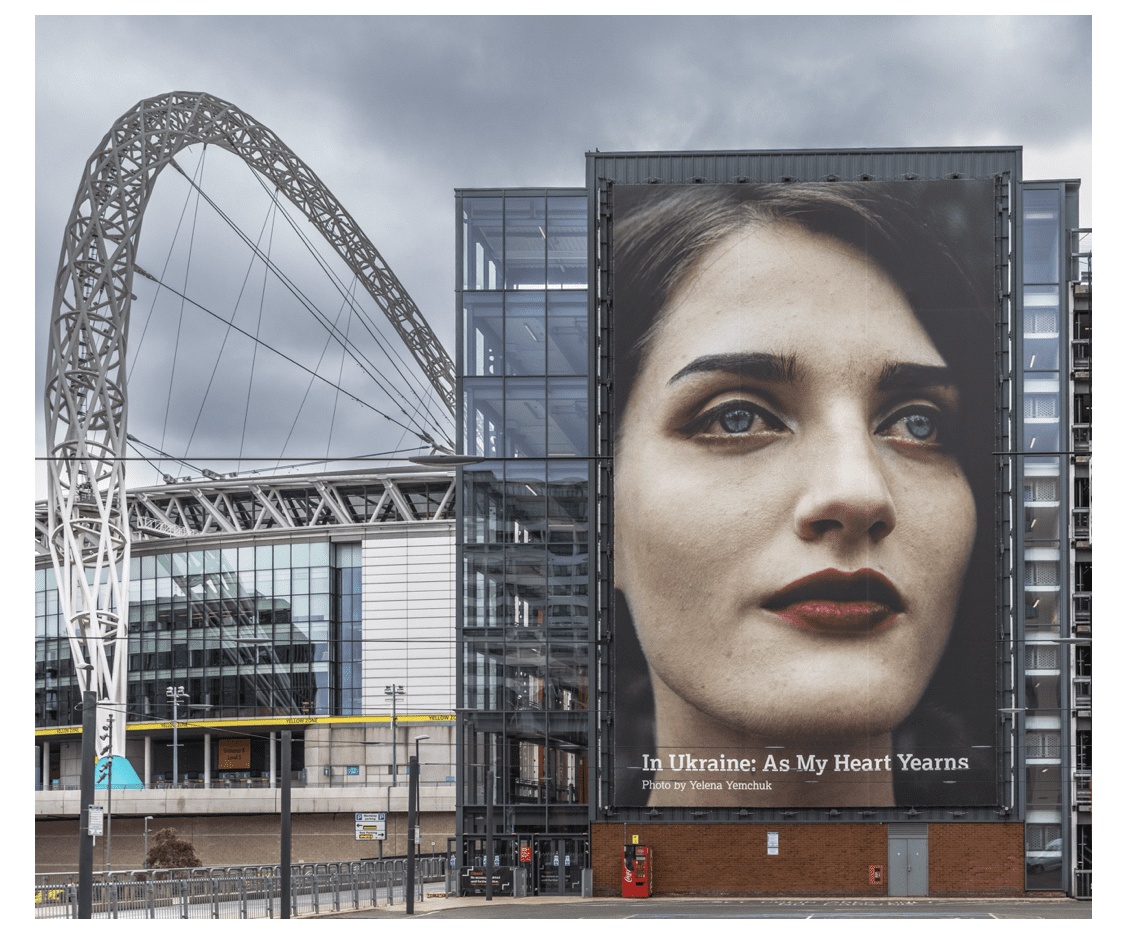
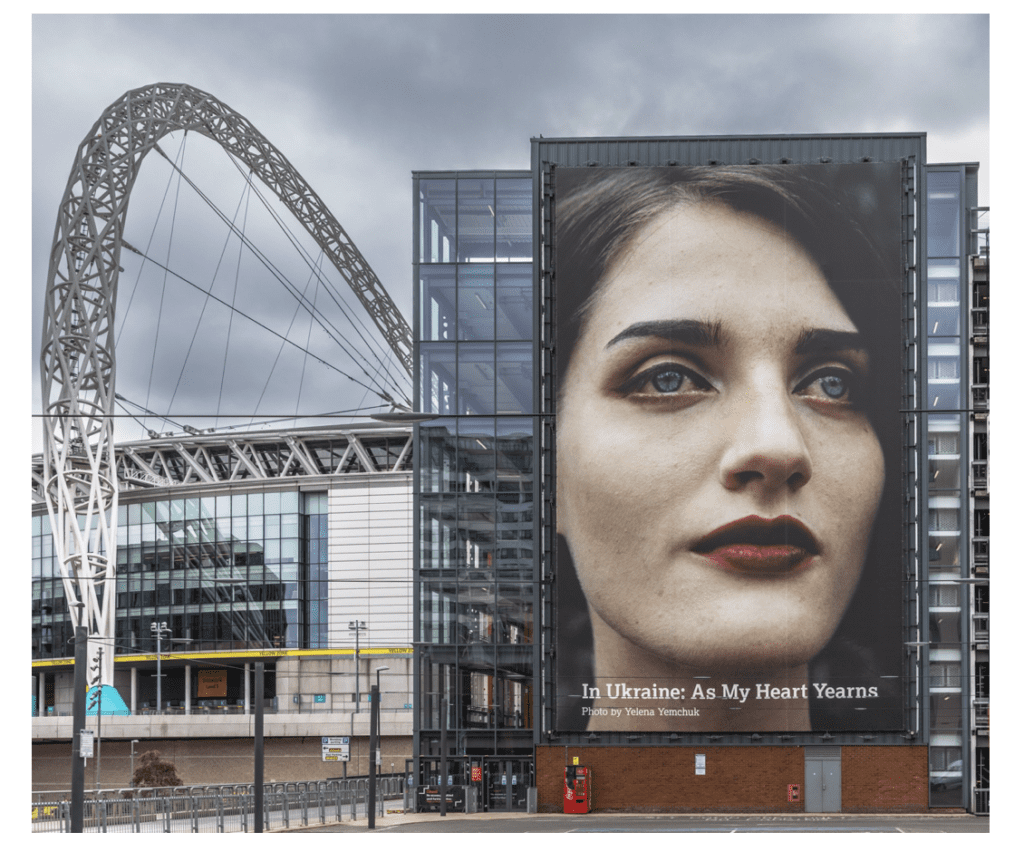
“In Ukraine: As My Heart Yearns” – an exhibition forming part of ‘Visions of Home’ – is a continuation of an international photography series started in March 2022, showcasing Ukraine’s past and present and includes pastoral archival imagery and recent refugee portraiture by Yana Kononova, Ira Lupu, Paraska Plytka-Horytsvit and Elena Subach & Helen Zhgir. It will also feature the work of internationally acclaimed documentary photographer Yelena Yemchuk with a seven storey-high captivating portrait – entitled Anna Domashyna – taken from her book, Odesa, which was recently published by Gost Books (May 2022). Installed on the side of the Red Car Park in front of Wembley Stadium, the photo will be seen by tens of thousands of people every day.
“I hope to share the beauty of Odesa and its inhabitants to the world, and to connect the viewer to the life Ukrainians lived before the horrors of the last two months. To me they are all heroes.” Yelena Yumchuk
Yemchuk’s portraits are tonally varied, blissful scenes of youthful abandon contrasted with young people who are carefully poised, whether in ballerina attire or military uniform. In her colossal banner work, focusing on the subject of Anna Domashyna – an inspiring young woman who remained voluntarily in Ukraine to support those in need throughout the crisis – Yemchuk’s portrait represents beauty, strength, and dignity, revealing at scale a personal, delicate and intimate view of the Ukrainian people.
“In Ukraine: As My Heart Yearns” also comprises “We No Longer Feel the Future,” a refugee project by Elena Subach & Helen Zhgir started a month after the Russian military invasion of Ukraine. With a goal to portray and record the verbal stories of people forced to leave their homes, the photos probe sensitively into the experience of abandoning everything, and of going into the unknown. Also featured is the extraordinary work of Paraska Plytka-Horytsvit (1927-1998), who joined the national liberation movement as a courier of the Ukrainian Insurgent Army in 1945. When Paraska was eighteen, she was arrested and spent the next ten years in Kazakhstan labour camps. Her works at Wembley Park come from an archive of over 4,000 posthumously discovered photographs, chronicling the life of the Carpathian village of Kryvorivnia. Paraska started taking photos after her return from the labour camps in the 1950s, and was present at the celebrations and funerals, shooting individuals, group photos, landscapes, and scenes from everyday life.
“Remember Ukraine” is a powerful screen installation by Kateryna Gaidamaka, on display across six 6m-tall totem structures, half of which are covered in wrap-around digital screens. The totems are located on White Horse Square and Olympic Way, framing the new Olympic Steps which lead visitors up to the National Stadium.
As of July 2022, the war in Ukraine is still ongoing, but media coverage has decreased. “Remember Ukraine” is borne out of a need to remind us once again about the horrific truth – that one of the most atrocious genocidal events of the 21st century is taking place right here, right now, in the heart of Europe. The artwork is also displayed across two supersized digital screens on both sides of the Bobby Moore Bridge, acting as the main gateway into the neighbourhood for millions of residents and visitors each year. Here, the screens make use of the direct composition of words “Remember Ukraine” – with “Ukraine” interchanging with names of the many cities and towns being heavily affected by the Russian aggression. The composition brings the message home for even a casual passer-by – ultimately, encouraging the beholder to not let this war sink into collective oblivion.
Finally, installed across the Spanish Steps, which connect Wembley Stadium with the OVO Arena Wembley, is “Facade” by MNPL, an architectural and art group mainly specialising in conceptual architecture, painting, and graphics, and was developed in close connection with studying the local Ukrainian architectural environment. Founded in 2009, since 2010 MNPL has been operating a workshop in Odesa, Ukraine. The seemingly abstract composition adorning the steps is in fact inspired by particular motifs and features of the architectural environment and cultural heritage in Ukraine of different periods. For example, through its widespread vernacular rhomboid pattern, or pixels imitating traditional Ukrainian embroidery, the patterns have been designed to create a timeless, objectless aesthetic.
“As a curator, it is my honour and duty to enable artists to tell stories, especially about marginalised people and neglected places. News about the war in Ukraine has been ubiquitous for months now, but I hope Wembley Park’s summer exhibition showcases a new insight into this resilient and hopeful country. Ukrainian artists have a powerful perspective, and their stories need to be told now more than ever.” Josh McNorton, Cultural Director, Wembley Park.
Community creation through the presence, observation and discussion of art is a key aspect of creative placemaking within neighbourhoods. Bringing art outside of the traditional gallery setting and into the public realm enables the millions of Wembley Park visitors, and the 10,000 residents who call Wembley Park home, the opportunity to embrace culture within their immediate surroundings.
For ‘Visions of Home,’ Wembley Park is partnering with the charity fund Tvoya Opora, which is currently fundraising to expand and improve the refugee shelter in Lviv, “Vse Bude Dobre” which translates to; “Everything Will be Fine”– the most populated refugee camp in the country at present. Tvoya Opora is the shelter where Elena Subach & Helen Zhgir photographed much of the people featured in the exhibition.
Next to each artwork, interactive signage will enable visitors to unlock rich content via QR codes, including a GPS-enabled map to follow the trail from mobile devices.
Follow the Wembley Park Art Trail on wembleypark.com/art
About Wembley Park
Wembley Park is London’s most exciting new neighbourhood. Already home to the iconic OVO Arena, Wembley (formerly The SSE Arena, Wembley) and Wembley Stadium, it is building on its international reputation for music and sporting events and becoming a landmark destination with culture, entertainment and community at its heart.
As a neighbourhood, Wembley Park includes over 4,700 new homes, shops, and places to work, as well as attractive public spaces, with parks and gardens, public squares and wide boulevards for locals and visitors alike to enjoy. When completed, nearly half of the 85-acre site will be open space and private gardens and Wembley Park will be home to the largest single site of Build to Rent in the UK, with over 6,000 homes, all managed by Quintain Living.
The three-acre southern section of what will be the seven-acre Union Park is the latest milestone in the transformation of Wembley Park, including brand new amenities such as a children’s paddling pool, a playground, a pond, new trees, and expansive lawns, as well as outdoor training equipment.
Wembley Park’s cultural strategy features a year-long programme of free public events. Recent highlights include the award-winning International Busking Day, an annual music festival supporting street performance; Winterfest, Wembley Park’s immersive lights festival; Wemba’s Dream, a performance festival co-produced with the Royal Philharmonic Orchestra, which will soon be moving its headquarters to the neighbourhood. An extensive public art programme animates Wembley Park’s open spaces, with recent commissions by JR, Jason Bruges, Mr Doodle, Pref, Miriamandtom, Vivien Zhang and Maser. The Yellow, a purpose-built neighbourhood centre entirely funded by Wembley Park, provides a weekly programme of community activities, ranging from youth theatre to Indian classical dance.
The neighbourhood boasts the 2,000 seat Troubadour Wembley Park Theatre, opened in 2019, and affordable artist studios, run by Second Floor Studios & Arts. It is also home to London’s largest BOXPARK, featuring a whole floor dedicated to gaming and immersive VR experiences. Wembley Park is just 12 minutes from Central London and is one of Europe’s largest regeneration schemes, led by developer Quintain.
Follow Wembley Park on Twitter, Instagram, or Facebook
About the Artists
Yelena Yemchuk
Born in Kyiv, Ukraine, in 1970 Yelena Yemchuk emigrated to New York with her parents when she was eleven. Her interest in photography bloomed after her father gave her a 35 mm Minolta camera for her fourteenth birthday. She went on to study at both the Parsons School of Design, New York, and ArtCenter College of Design in Pasadena, California. Her new book, Odesa 2022 melds images of Odesa and its inhabitants between 2015 and 2019.
Elena Subach and Helen Zhgir
Elena Subach is a visual artist and curator, born 1980 in Chervonohrad, Ukraine. She has a degree in Economics but works now as a researcher in Lviv National Art Gallery, Ukraine.
Helen Zhgir is a Ukrainian artist and philologist previously working in Kyiv and Lviv, and since 2018 has been professionally engaged in illustrative graphics, comics, and animation.
Subacha and Zhgir started work in their latest project, “We no longer feel the future,” a month after the Russian military invasion of Ukraine, their goal being to portray and record verbal stories of people forced to leave their homes because of the war.
Paraska Plytka-Horytsvit
Paraska Plytka-Horytsvit (1927-1998) is a Ukrainian artist, photographer, grassroots philosopher, and ethnographer. In 1945, she joined the national liberation movement as a courier of the Ukrainian Insurgent Army. When Paraska was eighteen, she was arrested and spent the next ten years in Kazakhstan labour camps. Upon her return, she devoted herself to art.
In 2014, a box with Paraska’s photographic negatives was discovered. Stored for a long time in poor conditions – under her bed in her house, the images were partly ruined by mildew, dirt, and mould, the damage added a new historical and conceptual layer onto the surface of pictures. This accidental discovery triggered a re-interpretation of Paraska’s art, the analysis of her archive, and her re-introduction as a Ukrainian photographer.
Ira Lupu
Ira Lupu is a photographer, multimedia artist, and writer born in Odesa, Ukraine, and currently based in New York City. She is a graduate of the New Media Narratives program at the International Center of Photography (NYC), and Viktor Marushchenko’s School of Photography (Kyiv).
Ira Lupu’s work explores the intersection of documentary and metaphorical space, where the carefully researched human worlds collide with ethereality. A core part of her photography is centred around the female experience — in her own body, emotional mind, or given environment.
Her ongoing project “On Dreams and Screens” focuses on the experiences of six online sex workers in Ukraine and the US exploring the place where an electronic body transitions into a real one.
Yana Kononova
Born near Baku on the Pirallakhi island in the Caspian Sea, Kononova’s family moved to Ukraine. She received a PhD. in Sociology through work on contemporary anthropology.
She started photography after moving to the Trakhtemyriv peninsula – a few hours’ drive from Kyiv. She subsequently graduated from the Photoschool of Viktor Marushchenko and did photography at the US ‘Image Threads Collective.’
Her latest work is “Radiations of War.”

Joanne Carter
Joanne Carter is a British photography journalist, editor, curator, and the founder of *TheAppWhisperer.com*, one of the world’s leading platforms dedicated to mobile photography and art. Since its launch in 2009, TheAppWhisperer has become an international hub for artists of all levels to discover, learn, exhibit, and engage with contemporary photographic practice.Built on principles of inclusivity, accessibility, and artistic excellence, Joanne has spent almost two decades championing mobile photography as a serious artistic medium. Through interviews, critical essays, exhibitions, competitions, and education, she has helped shape and document the evolution of mobile art on a global scale.Her work has taken her internationally, lecturing on photography and mobile art at institutions and events including the Museum of Art in Seoul, South Korea, alongside appearances in the UK and Europe. She has served as a juror for international photography and mobile art awards across Portugal, Canada, the United States, South Korea, Italy, and the UK.Joanne is also the founder of *TheAppWhispererPrintSales.com*, one of the first online galleries dedicated exclusively to collectible mobile art, connecting artists with collectors across Europe, the United States, and Asia.Before founding TheAppWhisperer, Joanne worked extensively in print journalism and photographic publishing, including roles at a paparazzi photo agency and as deputy editor of a leading photography magazine. Her freelance journalism, criticism, and commentary have been published widely in both the UK and the US, with bylines in *The Times*, *The Sunday Times*, *The Guardian*, *Popular Photography*, *NikonPro*, *DPReview*, *Which?*, *Vogue Italia*, *LensCulture*, the *BBC*, and more recently, the *Financial Times*, where her published letters on photography continue to contribute to wider conversations around the medium.Alongside her editorial and curatorial work, Joanne’s own photographic practice has been exhibited internationally across the UK, Europe, South Korea, and the United States. Her work increasingly explores themes of grief, loss, death, memory, and the body.Her current research interests centre on grief, death, and poverty, with forthcoming postgraduate study leading towards doctoral research in these areas.Joanne is currently developing new long-form writing and photographic projects and is available for commissions, editorial projects, speaking engagements, and collaborations.Contact: joannetheappwhisperer@gmail.com)