Julia Margaret Cameron’s Working Methods
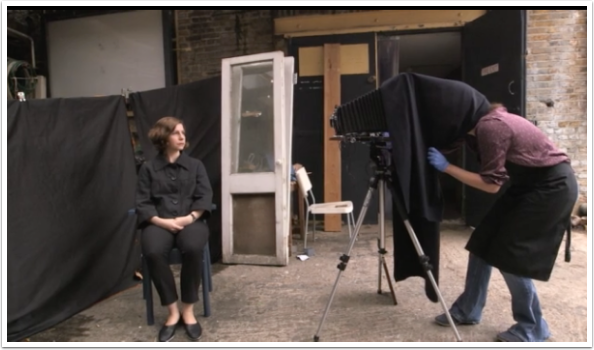
Not mobile photography but something to savour on New Years Eve, 2015. One of my favourite British Portrait Photographers of all time, Julia Margaret Cameron. Exhibition curator (at the V&A) Marta Weiss explains Julia Margaret Cameron’s unique working methods, and the personal touches in her photographs that make her work so highly regarded today. Enjoy…
Video
Transcript of the Video
She was using the wet collodion process, and this was a very cumbersome process. The photographs were made onto glass plates. These are large glass plates, all of her prints are contact prints, so whenever you see a Julia Margaret Cameron print, you know that the negative had to be at least as large as the image that you are looking at. So, these are large glass plates, they’re fragile and they have to be coated with a number of different substances at different stages in their processing. There are a lot of opportunities to make mistakes, and Cameron was a very exuberant character, and you feel her energy when you look at her photographs. She was so excited about this new way that she was making art, that she was expressing herself artistically. In Cameron’s photographs, there are all sorts of things that other photographers would have dismissed as flaws, but what she seemed to embrace. So for example there are smudges, there are even her own fingerprints sometimes on the photographs, embedded into the photographic negative. There are smears, there are swirls, and today, I think those imperfections are very attractive to contemporary audiences, because we can see that these are handmade objects. These aren’t the cool, precise results of a machine. And we really get a sense of an individual artist who produced these works of art.

Joanne Carter
Joanne Carter is a British photographer, photography journalist, editor and curator and the founder and editorial director of TheAppWhisperer.com, an independent international photography publication established in 2009.Her journalism, criticism and commentary have appeared in The Times, The Sunday Times, The Guardian, Financial Times, BBC, Vogue Italia, LensCulture, Popular Photography, Android Magazine, NikonPro, DPReview, Which Digital Camera and Which Camera. She has lectured internationally on photography and mobile art, served as a juror for international photography awards, and exhibited her own photographic work across the UK, Europe, South Korea and the United States.Alongside her editorial work, Joanne's photographic and postgraduate research explores death, grief, memory, representation and social inequality through contemporary photography, participatory practice and visual research methods, with the longer-term aim of developing this work through doctoral research.Through TheAppWhisperer, she continues to publish independent photography journalism spanning contemporary photographic practice, mobile imaging, photographic apps, computational photography and emerging imaging technologies.Joanne is available for editorial commissions, photography projects, judging, curatorial work, speaking engagements, consultancy and selected collaborations.