
Announcing Lightroom for iOS 2.6 and Lightroom for Android 2.2.2
Adobe have today announced updates for Lightroom Mobile as well as to Lightroom CC, and Adobe Camera Raw.
Lightroom for iPhones includes a new edit experience, a new info section, a new capture interface with a brand new professional mode, support for all of the latest cameras and lenses provided in today’s Adobe Camera Raw and Lightroom releases, as well as bug fixes and improvements. Lightroom for iPads adds in the new capture interface, camera and lens support, and bug fixes, and Lightroom for Android provides support for new cameras and lenses as well as bug fixes.
Lightroom has always been about helping you get the most out of your images, and with Lightroom for Android 2.2, you can now import raw files directly into your Android device. The Raw Technology Preview makes it possible for you to connect your camera to your Android device and import photos directly from your camera. With this Technology Preview now available for Android (released for iOS in July of this year), you can capture, edit, and share raw photos, in full resolution, and have access to them wherever you are in the world.
The teams for both Lightroom for iPads as well as Lightroom for Android are also working on adding in the new edit and info experiences and we hope to release those updates soon.
To download/update to Adobe Lightroom 2.6, click here
To download/update to Lightroom 2.2.2 for Android, click here.
More details regarding both updates, to both platforms below:
New Edit Interface
Lightroom mobile 2.6 represents a significant evolution of editing on mobile devices. Adobe wanted to improve the ability to quickly find and access tools and ensure the fastest way to enhance and edit images on a phone. Their design team reached out to photographers of all skill levels to help them figure out how people edit with Lightroom mobile, what’s missing, and how they could make it even better. This update represents Adobe’s first release taking advantage of this research.
The first step Adobe took was to organize similar tools into categories to make it faster to use tools that are often used together.
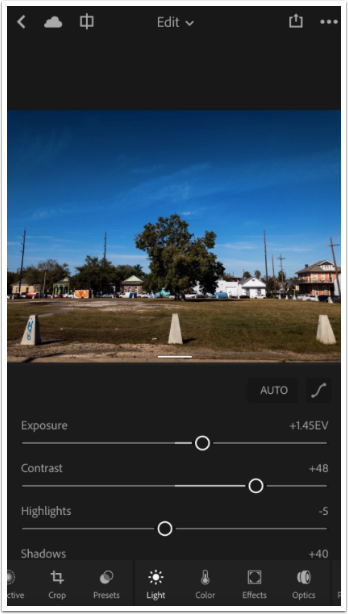
They then built an interface that was easy to use with a single hand, something we find ourselves doing pretty often while on our phones. This meant ensuring that you could see the entire image while editing it, but also to ensure that you can easily get to often used tools like showing the before and after without having to use your second hand (goodbye three-finger before and after, hello single finger tap and hold).
New Info Section
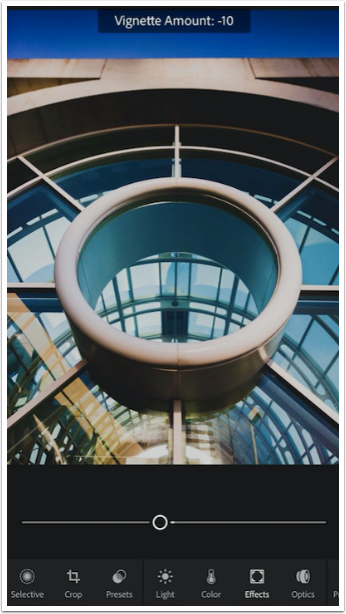
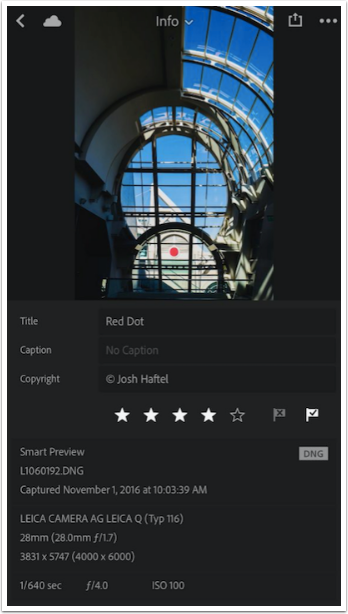
Finally, Adobe built ways of expanding the interface so that additional groups of functionality could be added in, like the often requested ability to add in titles, captions, and copyright from mobile devices. This new interface extensibility means Adobe can continue to deliver on the features that photographers have been asking for, turning their mobile devices into more and more capable image processing devices.
New Capture Interface and Professional Mode
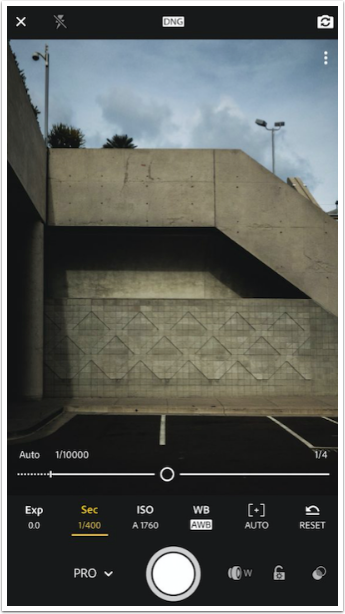
Version 2.6 also adds in a brand new capture interface (the same that Android users received earlier this year) that provides access to a new professional mode that provides control over all aspects of your camera’s exposure and focus. This new mode makes it easy to dial in exactly the exposure you need to capture the shot you want.
Lightroom for Android 2.2 — Raw Technology Preview
Lightroom has always been about helping you get the most out of your images, and with Lightroom for Android 2.2, you can now import raw files directly into your Android device. The Raw Technology Preview makes it possible for you to connect your camera to your Android device and import photos directly from your camera. With this Technology Preview now available for Android (released for iOS in July of this year), you can capture, edit, and share raw photos, in full resolution, and have access to them wherever you are in the world.
Lightroom for Android now supports all of the same raw files that Lightroom for desktop as well as Adobe Camera Raw support, with the full list available here.
To transfer photos to your mobile device, you’ll need a USB On-The-Go adapter, sometimes just referred to an OTG cable. An OTG cable enables you to connect your mobile device directly to your camera and transfer your images with the PTP transfer mode. We recommend getting an OTG cable that matches the ports on both your camera as well as your Android device. For example, if your camera uses a Micro USB port and your Android device has a USB-C port, you’d want a Micro USB to USB-C OTG cable. These cables, and nearly every other imaginable combination of ports and connectors can easily be found online and are quite inexpensive.
After installing the Lightroom for Android 2.2, plug your camera into your Android device, and change to the PTP transfer mode in the Android Notification Center. Then, tap on the notification that indicates “Connected to USB PTP Camera. Tap to view files.”
You’ll be presented with an importer to select from the photos found on your camera to import into Lightroom on your Android device. Select the photos you want to import, the collection you want to import the photos into, and tap transfer. Lightroom will transfer the photos and notify you once all of the photos have been imported.
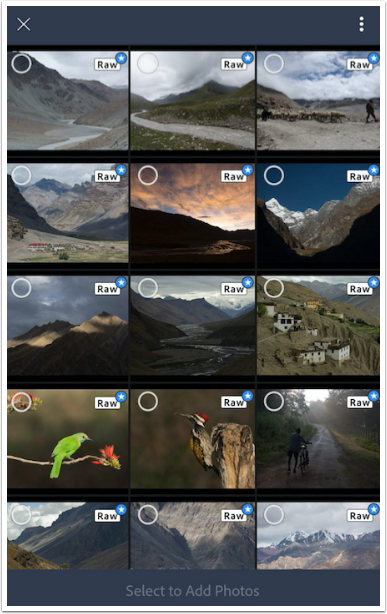
You get all of the benefits of raw, such as the ability to change the white balance, being able to recover blown out highlights, access to the full range of color information, as well as editing an uncompressed file, all using the exact same technology that powers Lightroom on your desktop. An added benefit is that the raw file that you’ve imported into Lightroom for Android will be synced with Lightroom on your other devices, such as Lightroom for desktop or Lightroom on the web, along with any of the edits, star ratings, or flags that you’ve added.
Donating = Loving = TheAppWhisperer.com
Bringing you (ad-free) TheAppWhisperer.com takes hundreds of hours each month and hundreds of pounds to sustain. If you find any joy and stimulation here, please consider becoming a Supporting Member with a recurring monthly donation of your choosing, or possibly making a one-time donation. This is a not for profit website and one that can only grow with your support.
[seamless-donations]

Joanne Carter
Joanne Carter is a British photographer, photography journalist, editor and curator and the founder and editorial director of TheAppWhisperer.com, an independent international photography publication established in 2009.Her journalism, criticism and commentary have appeared in The Times, The Sunday Times, The Guardian, Financial Times, BBC, Vogue Italia, LensCulture, Popular Photography, Android Magazine, NikonPro, DPReview, Which Digital Camera and Which Camera. She has lectured internationally on photography and mobile art, served as a juror for international photography awards, and exhibited her own photographic work across the UK, Europe, South Korea and the United States.Alongside her editorial work, Joanne's photographic and postgraduate research explores death, grief, memory, representation and social inequality through contemporary photography, participatory practice and visual research methods, with the longer-term aim of developing this work through doctoral research.Through TheAppWhisperer, she continues to publish independent photography journalism spanning contemporary photographic practice, mobile imaging, photographic apps, computational photography and emerging imaging technologies.Joanne is available for editorial commissions, photography projects, judging, curatorial work, speaking engagements, consultancy and selected collaborations.
2 Comments
Martin Harvey
Is Android 2.2 featured as iOS 2.6?
Joanne Carter
I am sorry, I do not understand your question Martin