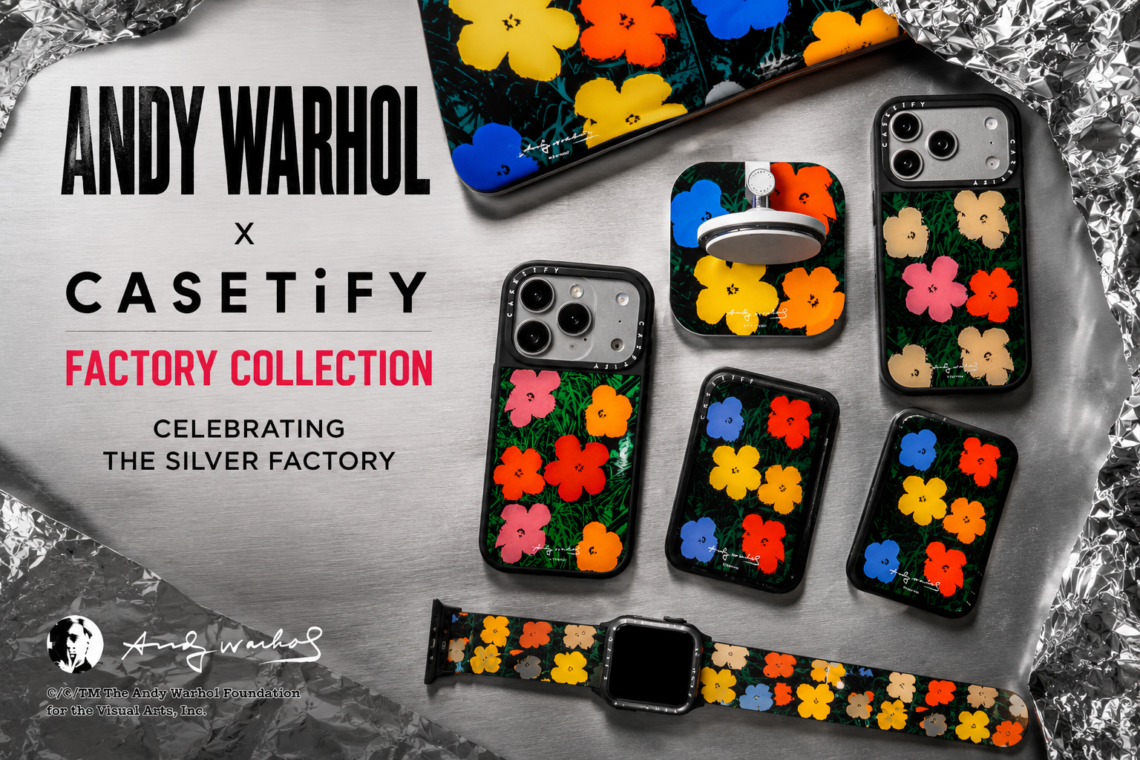
Andy Warhol x CASETiFY Factory Collection Celebrates the Silver Factory
There are some collaborations that feel almost inevitable. Andy Warhol spent his career questioning originality, repetition and mass production, transforming familiar images into works that challenged the very definition of art. More than half a century later, we carry our own canvases in our pockets. Smartphones have become the cameras, sketchbooks, portfolios and publishing platforms of our time, making CASETiFY‘s latest collaboration with The Andy Warhol Foundation for the Visual Arts feel both timely and surprisingly appropriate.
Launching today, the new Andy Warhol x CASETiFY Factory Collection shifts the focus away from Warhol’s instantly recognisable Pop Art imagery alone to celebrate something arguably even more influential: The Factory itself.
For photographers, artists and anyone interested in visual culture, The Factory represents far more than a famous New York studio. It became a creative laboratory where photography, filmmaking, painting, music, fashion and performance existed side by side. It challenged the romantic idea of the solitary artist and replaced it with collaboration, experimentation and industrial production.
That philosophy feels remarkably contemporary. As someone who spends much of her time writing about photography, mobile imaging and visual culture, I often find myself returning to Warhol—not because of the Campbell’s Soup Cans or the Marilyn portraits, but because he understood something fundamental about images long before the digital age. Images gain meaning not simply through their uniqueness, but through their circulation. They are reproduced, shared, copied, reinterpreted and, ultimately, absorbed into our collective visual memory.
Today, photographs move across social media within seconds. Artificial intelligence generates countless visual variations at the click of a button. Smartphones have democratised image-making in ways that would have fascinated Warhol, whose fascination with repetition and mechanical reproduction continues to shape contemporary visual culture.
Perhaps that is why this collaboration feels more thoughtful than many artist licensing projects. Rather than simply placing famous artworks onto phone cases, CASETiFY has chosen to reference the ideas behind The Factory itself—its celebration of accessibility, industrial production and the belief that art belongs in everyday life rather than behind the walls of elite institutions.
Revisiting Warhol’s Most Iconic Series
The collection draws upon four of Warhol’s best-known bodies of work, each translated across CASETiFY’s growing range of technology accessories.
Flowers (1964–1968)
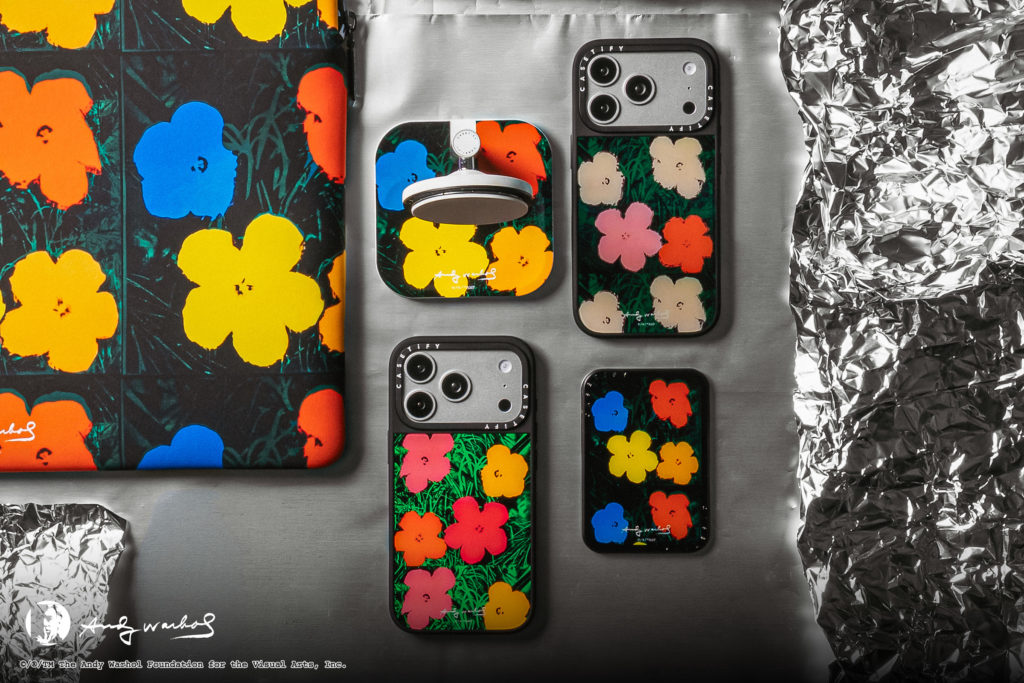
Warhol’s Flowers remain among his most recognisable works. Based on a photographic source image before being transformed through silkscreen printing, the series reduced natural forms into bold graphic compositions defined by repetition and colour.
Within the CASETiFY collection, these vibrant floral works appear across phone cases, tablet covers, laptop sleeves and Apple Watch bands, preserving the rhythmic quality that became synonymous with Warhol’s visual language.
Cows (1966 & 1971)
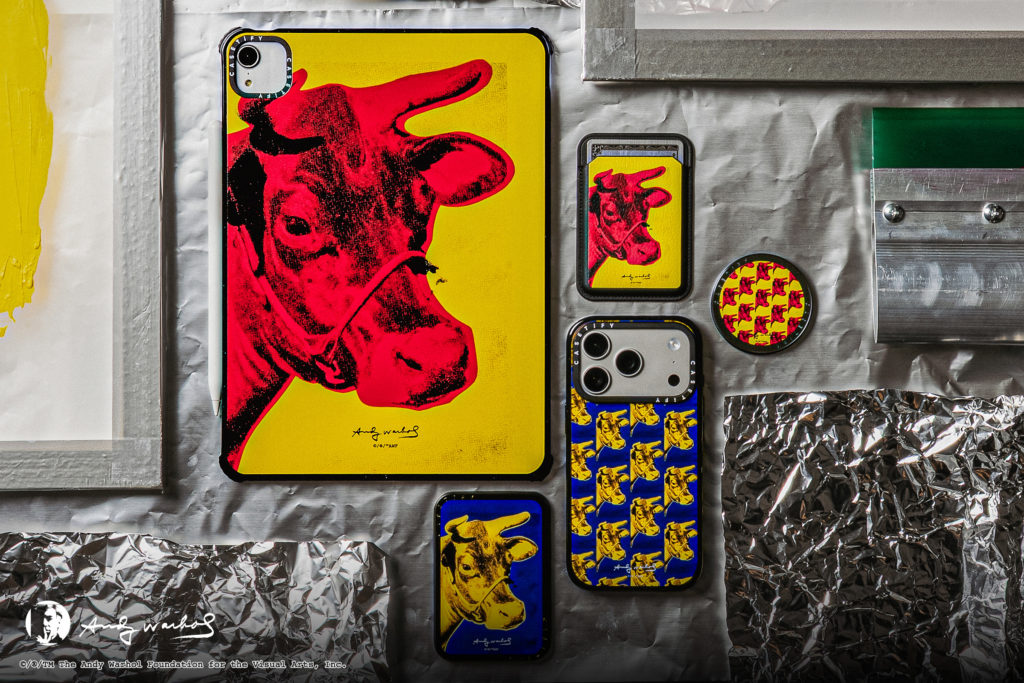
Originally created as wallpaper rather than conventional gallery pieces, Cows challenged expectations about where art could exist.
Bright colours, repeated motifs and playful composition transformed an ordinary rural subject into something strikingly contemporary. Even today, the work retains its ability to surprise, making it particularly well suited to CASETiFY’s colourful range of accessories.
Dollar Signs (1981)
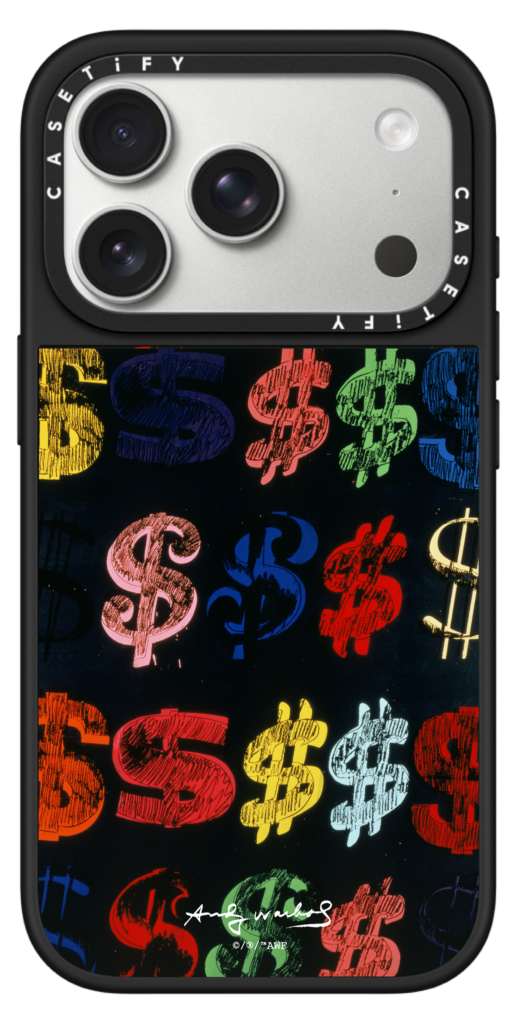
Few artists examined the relationship between commerce and creativity as directly as Andy Warhol. The Dollar Signs series openly acknowledged the increasingly blurred relationship between artistic practice and commercial culture. Displayed on everyday technology, these works feel as relevant now as they did when they were first created, reflecting our continuing relationship with branding, consumer culture and visual identity.
Fragile (1962)
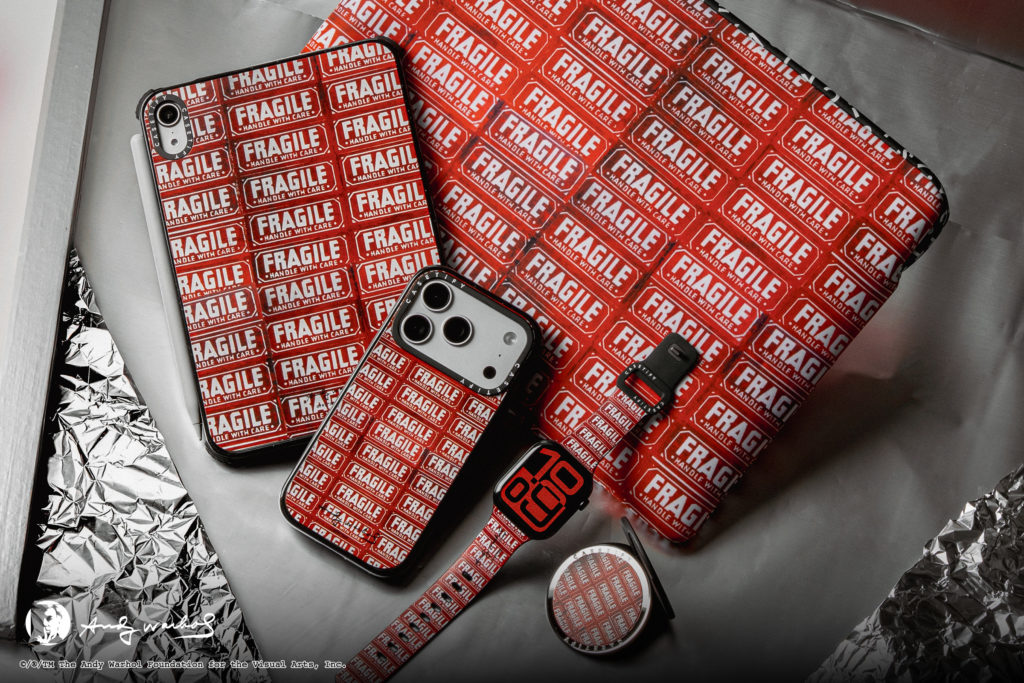
One of my favourite inclusions is Fragile. Inspired by the utilitarian graphics found on shipping labels and packaging, it celebrates the overlooked visual language of commerce rather than traditional artistic subjects. It also feels entirely appropriate on protective technology accessories, where the familiar warning takes on an entirely new context.
More Than Decorative Design
What interests me most about this collaboration is not simply the products themselves but the conversation they continue. Warhol believed that art should exist beyond galleries and museums. He embraced advertising, magazines, commercial printing and consumer culture long before these subjects were widely accepted within fine art. He understood that images gain their power through visibility.
Today, smartphones occupy much the same cultural position. They are where photographs are made, edited, shared and archived. They have become the primary tools through which many photographers experience and communicate with the world.
In that sense, CASETiFY’s decision to place Warhol’s imagery onto everyday devices feels less like merchandising and more like a continuation of his original philosophy. Art becomes something encountered during daily life rather than reserved for occasional visits to museums.
Designed for Creative Devices
The collection includes a wide range of accessories, including:
- Phone cases
- iPad cases
- Laptop cases
- Laptop sleeves
- Apple Watch bands
- MagSafe wallets
- Grip stands
- Cardholder stands
- Charging accessories
Prices range from £33 to £95, with compatibility across recent iPhone, Samsung Galaxy, Google Pixel, iPad and MacBook models.
Why It Matters
Photography has always evolved alongside technology. From glass plates to roll film, from digital cameras to smartphones and now artificial intelligence, every technological shift has changed not only how images are produced but also how they are understood. Warhol recognised that decades before most artists.
That is perhaps why this collaboration feels so successful. Rather than simply celebrating one of the twentieth century’s most famous artists, it acknowledges the continuing relevance of his ideas. Questions about originality, reproduction, mass communication and the democratisation of art remain just as important today as they were inside the Silver Factory during the 1960s.
For photographers, artists and anyone interested in visual culture, the Andy Warhol x CASETiFY Factory Collection is a reminder that great art continues to evolve—not only through museums and galleries but also through the objects we carry with us every single day.

Joanne Carter
Joanne Carter is a British photography journalist, editor, curator, and the founder of *TheAppWhisperer.com*, one of the world’s leading platforms dedicated to mobile photography and art. Since its launch in 2009, TheAppWhisperer has become an international hub for artists of all levels to discover, learn, exhibit, and engage with contemporary photographic practice.Built on principles of inclusivity, accessibility, and artistic excellence, Joanne has spent almost two decades championing mobile photography as a serious artistic medium. Through interviews, critical essays, exhibitions, competitions, and education, she has helped shape and document the evolution of mobile art on a global scale.Her work has taken her internationally, lecturing on photography and mobile art at institutions and events including the Museum of Art in Seoul, South Korea, alongside appearances in the UK and Europe. She has served as a juror for international photography and mobile art awards across Portugal, Canada, the United States, South Korea, Italy, and the UK.Joanne is also the founder of *TheAppWhispererPrintSales.com*, one of the first online galleries dedicated exclusively to collectible mobile art, connecting artists with collectors across Europe, the United States, and Asia.Before founding TheAppWhisperer, Joanne worked extensively in print journalism and photographic publishing, including roles at a paparazzi photo agency and as deputy editor of a leading photography magazine. Her freelance journalism, criticism, and commentary have been published widely in both the UK and the US, with bylines in *The Times*, *The Sunday Times*, *The Guardian*, *Popular Photography*, *NikonPro*, *DPReview*, *Which?*, *Vogue Italia*, *LensCulture*, the *BBC*, and more recently, the *Financial Times*, where her published letters on photography continue to contribute to wider conversations around the medium.Alongside her editorial and curatorial work, Joanne’s own photographic practice has been exhibited internationally across the UK, Europe, South Korea, and the United States. Her work increasingly explores themes of grief, loss, death, memory, and the body.Her current research interests centre on grief, death, and poverty, with forthcoming postgraduate study leading towards doctoral research in these areas.Joanne is currently developing new long-form writing and photographic projects and is available for commissions, editorial projects, speaking engagements, and collaborations.Contact: joannetheappwhisperer@gmail.com)


You May Also Like
Reeflex Pro Camera V3: A Powerful New Era for iPhone Photography 2026

New AirPods Are Powered by the New H1 Chip and Feature 50 Percent More Talk Time, Hands-Free “Hey Siri” and the Option of a Wireless Charging Case