Photography & Art – Tickle Your Fancy #46
Welcome back to our forty sixth post in our new section ‘Tickle Your Fancy’. ‘Tickle Your Fancy’ includes a round-up of between three to five links to articles from around the internet that have specifically interested us during the course of the week. Ones that we feel are relevant to your interest in photography and art.
Just to explain the title for this section ‘Tickle Your Fancy’ is an English idiom and essentially means that something appeals to you and perhaps stimulates your imagination in an enthusiastic way, we felt it would make a great title for this new section of the site.
We really hope you enjoy these articles over the weekend…
Mary Ellen Mark Obituary
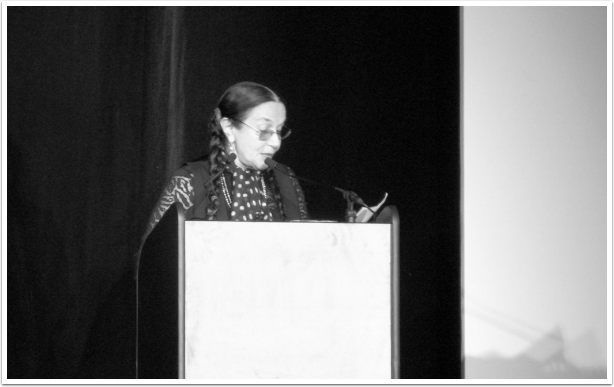
Mary Ellen Mark was truly a remarkable woman both as you imagine and also in reality – the two do not always correspond. My husband met her just a few years ago at the Cannes Film Festival, it’s something he will always hold close.
The following obituary in The Guardian two days ago, gives a very good insight and viewpoint of Mark’s precious life’s work. I’ve mentioned many times within TheAppWhisperer, that I enjoy reading well written obituaries; not for morbid reasons but because the writing is usually very good. To condense a life within a national newspaper’s limited word count, is always something I admire, as writing is one of my prerequisites in life, as is photography as is reading, I try to read a solid book each week.
Image – Mary Ellen Mark delivering an award at Cannes Film Festival, 2009 – ©Kevin Carter
I just noted her final tweet…

The Day Albert Einstein Died: A Photographer’s Story
Albert Einstein, whose theories exploded and reshaped our ideas of how the universe works, died on April 18, 1955, of heart failure. He was 76. His funeral and cremation were intensely private affairs, and only one photographer managed to capture the events of that extraordinary day: LIFE magazine’s Ralph Morse.
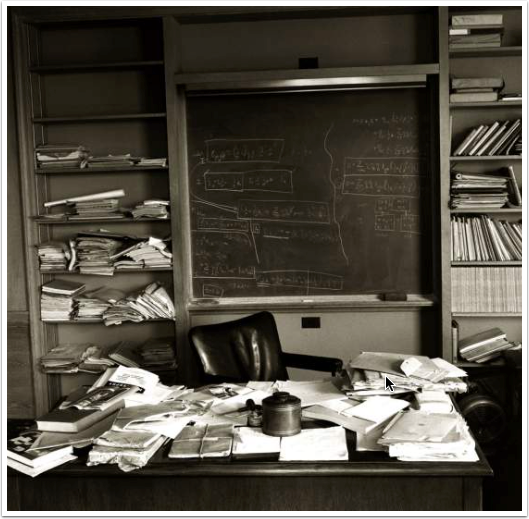
Armed with his camera and a case of scotch — to open doors and loosen tongues — Morse compiled a quietly intense record of a 20th-century icon’s passing. But aside from one now-famous image — of Einstein’s office, exactly as he left it, taken hours after his death — the pictures Morse took that day were never published. At the request of Einstein’s son, who asked that the family’s privacy be respected while they mourned, LIFE’s editors chose not to run the full story, and for more than five decades Morse’s photographs lay in the magazine’s archives, forgotten.
Ralph Morse—Time & Life Pictures/Getty Images
A History of Nautical Camouflage
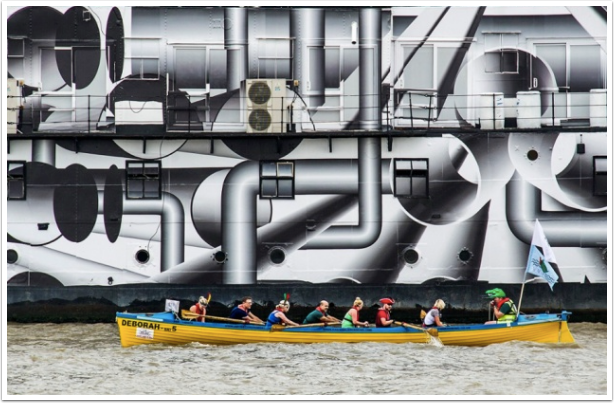
Dazzle painting was created during the first world war to protect British naval vessels from German attack. The jagged, almost psychedelic designs were inspired by the work of the vorticists, and have influenced modern artists such as Peter Blake, Carlos Cruz-Diez and Tobias Rehberger – each of whom has created their own tribute to this extraordinary artistic movement.
Boats pass HMS President designed by Tobias Rehberger, 2014 – Photograph: Alamy
How Ford Models Changed the Face of Beauty
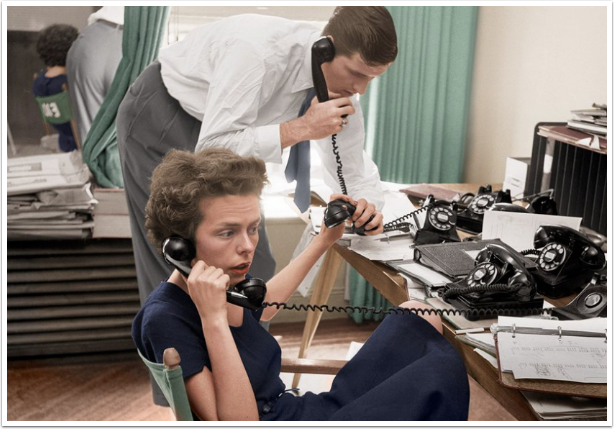
When Eileen Otte and Jerry Ford eloped to San Francisco in November 1944, in the midst of World War II, it was hardly surprising that Jerry should declare his profession as “Naval Officer” on his marriage certificate. His new spouse, however, set down an occupation that was more unusual in a time of war, “Stylist,” and she listed her employer as a “commercial photographer.” Earlier that spring, around the same time the young couple first met, Eileen had embarked on the career path that would lead to her creation with Jerry of what would become the Ford modeling agency.
Eileen Ford and her husband, Jerry, juggle phones and field requests for Ford models in the agency’s New York office, 1948.
Digital Colorization by Lorna Clark; By Nina Leen/The LIFE Picture Collection/Getty Images.
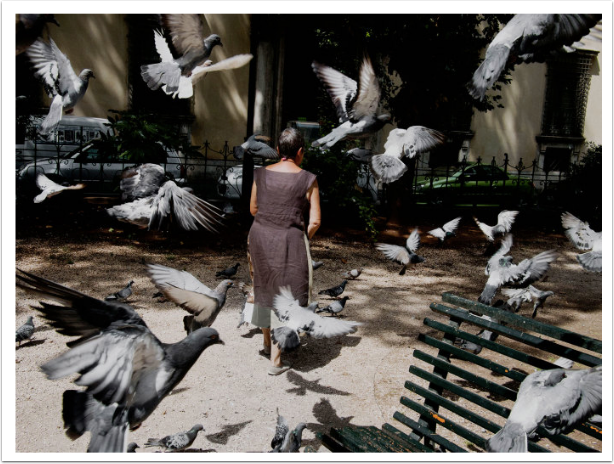
A Scholar of Pigeons
Chloé Roubert has been to Paris, London, Montreal, Toronto, Shanghai, Frankfurt, and New York, cultivating herself as a pigeon scholar. “I’m kind of following my pigeons,” she said on a recent morning on Stanton Street, in lower Manhattan. “My home is everywhere, because they are everywhere.”
Roubert, who is thirty-one, was in town scouting locations for her latest endeavour: a pigeon tour of the Lower East Side for the New Museum’s “Ideas City” festival, which starts today. She has pale skin and dark hair flecked with gray. She wears thick-rimmed glasses and, that day, a trench coat. For the past year, she has been wandering through the neighbourhood, noting pigeon behaviour, taking photographs, and talking to the people who linger on the street—those feeding and watching and growing attached to the birds, leaving the occasional can of cat food (accepted, though pigeons don’t usually eat meat) or dumping out an unfinished loaf of bread (a crowd forms, and there’s a long wait for a spot around the crust). She has found that pigeons, like many New Yorkers, are bagel-eaters, immigrants, and scavengers, and are put off by new high-rises that are inhospitably spiffy.
Pigeons don’t live long in New York—their typical lifespan is two and a half years—elsewhere, they can live to be six.
PHOTOGRAPH BY ALEX MAJOI / MAGNUM

Joanne Carter
Joanne Carter is a British photographer, photography journalist, editor and curator and the founder and editorial director of TheAppWhisperer.com, an independent international photography publication established in 2009.Her journalism, criticism and commentary have appeared in The Times, The Sunday Times, The Guardian, Financial Times, BBC, Vogue Italia, LensCulture, Popular Photography, Android Magazine, NikonPro, DPReview, Which Digital Camera and Which Camera. She has lectured internationally on photography and mobile art, served as a juror for international photography awards, and exhibited her own photographic work across the UK, Europe, South Korea and the United States.Alongside her editorial work, Joanne's photographic and postgraduate research explores death, grief, memory, representation and social inequality through contemporary photography, participatory practice and visual research methods, with the longer-term aim of developing this work through doctoral research.Through TheAppWhisperer, she continues to publish independent photography journalism spanning contemporary photographic practice, mobile imaging, photographic apps, computational photography and emerging imaging technologies.Joanne is available for editorial commissions, photography projects, judging, curatorial work, speaking engagements, consultancy and selected collaborations.