
Introducing Apple Vision Pro: Apple’s first spatial computer
Introducing Apple Vision Pro: Apple’s first spatial computer
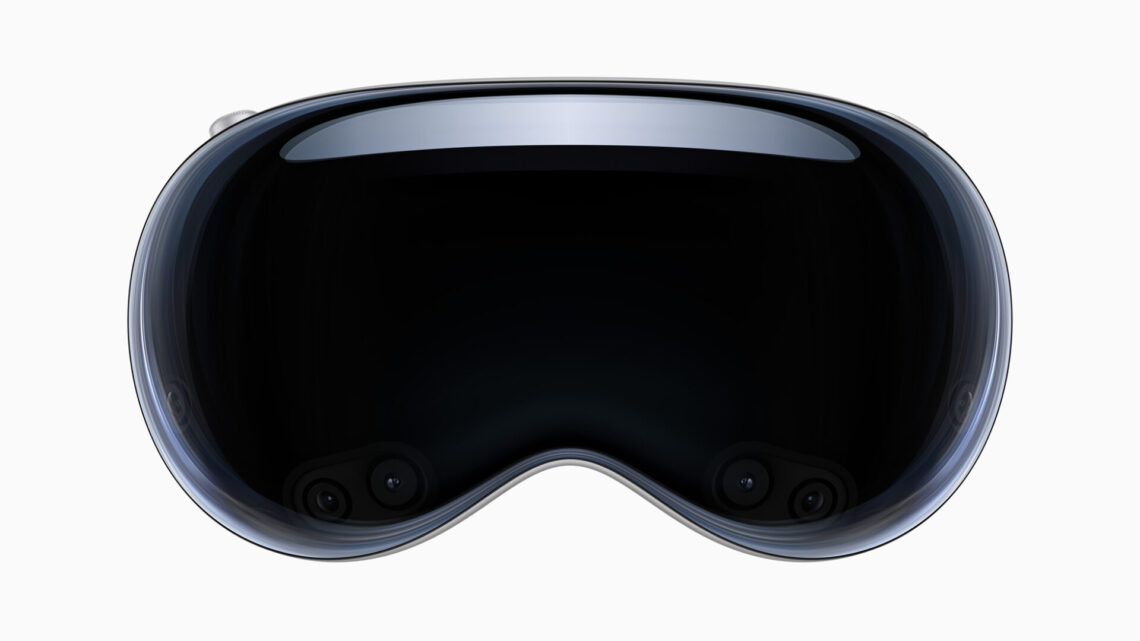
Apple have unveiled Apple Vision Pro, a revolutionary spatial computer that seamlessly blends digital content with the physical world while allowing users to stay present and connected to others. Vision Pro creates an infinite canvas for apps that scales beyond the boundaries of a traditional display and introduces a fully three-dimensional user interface controlled by the most natural and intuitive inputs possible — a user’s eyes, hands, and voice. Featuring visionOS, the world’s first spatial operating system, Vision Pro lets users interact with digital content in a way that feels like it is physically present in their space. The breakthrough design of Vision Pro features an ultra-high-resolution display system that packs 23 million pixels across two displays, and custom Apple silicon in a unique dual-chip design to ensure every experience feels like it’s taking place in front of the user’s eyes in real-time.
“Today marks the beginning of a new era for computing,” said Tim Cook, Apple’s CEO. “Just as the Mac introduced us to personal computing, and iPhone introduced us to mobile computing, Apple Vision Pro introduces us to spatial computing. Built upon decades of Apple innovation, Vision Pro is years ahead and unlike anything created before — with a revolutionary new input system and thousands of groundbreaking innovations. It unlocks incredible experiences for our users and exciting new opportunities for our developers.”
“Creating our first spatial computer required invention across nearly every facet of the system,” said Mike Rockwell, Apple’s vice president of the Technology Development Group. “Through a tight integration of hardware and software, we designed a standalone spatial computer in a compact wearable form factor that is the most advanced personal electronics device ever.”
Extraordinary New Experiences
Apple Vision Pro brings a new dimension to powerful, personal computing by changing the way users interact with their favourite apps, capture and relive memories, enjoy stunning TV shows and movies, and connect with others in FaceTime.
An infinite canvas for apps at work and at home: visionOS features a three-dimensional interface that frees apps from the boundaries of a display so they can appear side by side at any scale. Apple Vision Pro enables users to be even more productive, with infinite screen real estate, access to their favourite apps, and all-new ways to multitask. And with support for Magic Keyboard and Magic Trackpad, users can set up the perfect workspace or bring the powerful capabilities of their Mac into Vision Pro wirelessly, creating an enormous, private, and portable 4K display with incredibly crisp text.
Engaging entertainment experiences: With two ultra-high-resolution displays, Apple Vision Pro can transform any space into a personal movie theatre with a screen that feels 100 feet wide and an advanced Spatial Audio system. Users can watch movies and TV shows, or enjoy stunning three-dimensional movies. Apple Immersive Video offers 180-degree high-resolution recordings with Spatial Audio, and users can access an exciting line-up of immersive videos that transport them to entirely new places.
Spatial computing makes new types of games possible with titles that can span a spectrum of immersion and bring gamers into all-new worlds. Users can also play over 100 Apple Arcade games on a screen as large as they want, with incredible immersive audio and support for popular game controllers.
Immersive Environments: With Environments, a user’s world can grow beyond the dimensions of a physical room with dynamic, beautiful landscapes that can help them focus or reduce clutter in busy spaces. A twist of the Digital Crown lets a user control how present or immersed they are in an environment.
Memories come alive: Featuring Apple’s first three-dimensional camera, Apple Vision Pro lets users capture, relive, and immerse themselves in their favourite memories with Spatial Audio. Every spatial photo and video transports users back to a moment in time, like a celebration with friends or a special family gathering. Users can access their entire photo library on iCloud, and view their photos and videos at a life-size scale with brilliant colour and spectacular detail. Every Panorama shot on iPhone expands and wraps around the user, creating the sensation they are standing right where it was taken.
FaceTime becomes spatial: With Apple Vision Pro, FaceTime calls take advantage of the room around the user, with everyone on the call reflected in life-size tiles, as well as Spatial Audio, so it sounds as if participants are speaking right from where they are positioned. Users wearing Vision Pro during a FaceTime call are reflected as a Persona — a digital representation of themselves created using Apple’s most advanced machine learning techniques — which reflects face and hand movements in real time. Users can do things together like watch a movie, browse photos, or collaborate on a presentation.
Even more app experiences: Apple Vision Pro has an all-new App Store where users can discover apps and content from developers, and access hundreds of thousands of familiar iPhone and iPad apps that run great and automatically work with the new input system for Vision Pro. Apple’s developer community can go even further and take advantage of the powerful and unique capabilities of Vision Pro and visionOS to design brand-new app experiences, and reimagine existing ones for spatial computing.
A Revolutionary Operating System and User Interface
Built on the foundation of decades of engineering innovation in macOS, iOS, and iPadOS, visionOS was designed from the ground up to support the low-latency requirements of spatial computing. The result is a revolutionary operating system that delivers powerful spatial experiences that can take advantage of the space around the user, unlocking new opportunities at work and at home.
visionOS features a brand-new three-dimensional interface that makes digital content look and feel present in a user’s physical world. By responding dynamically to natural light and casting shadows, it helps the user understand scale and distance. To enable user navigation and interaction with spatial content, Apple Vision Pro introduces an entirely new input system controlled by a person’s eyes, hands, and voice. Users can browse through apps by simply looking at them, tapping their fingers to select, flicking their wrist to scroll, or using voice to dictate.
Vision Pro also features EyeSight, an extraordinary innovation that helps users stay connected with those around them. When a person approaches someone wearing Vision Pro, the device feels transparent — letting the user see them while also displaying the user’s eyes. When a user is immersed in an environment or using an app, EyeSight gives visual cues to others about what the user is focused on.
Breakthrough Design
Apple Vision Pro builds on Apple innovation and experience designing high-performance products like Mac, iPhone, and wearables like Apple Watch, culminating in the most advanced personal electronics device ever. To achieve ambitious goals for performance, mobility, and wearability, Apple utilised the most advanced materials possible.
Apple Vision Pro has an astonishing amount of technology in a compact design. A singular piece of three-dimensionally formed and laminated glass is polished to create an optical surface that acts as a lens for the wide array of cameras and sensors needed to blend the physical world with digital content. The glass flows into the custom aluminium alloy frame that gently curves around the user’s face, while the modular system allows for a tailored fit to accommodate a wide range of people. The Light Seal is made of a soft textile, and comes in a range of shapes and sizes, flexing to conform to a user’s face for a precise fit. Flexible straps ensure audio remains close to the user’s ears, while a Head Band — available in multiple sizes — is three-dimensionally knitted as a single piece to provide cushioning, breathability, and stretch.1 The band is secured with a simple mechanism, making it easy to change to another size or style of band.
Unrivalled Innovation in Hardware
Apple Vision Pro is designed to deliver phenomenal compute performance in a compact wearable form factor. Featuring a breakthrough ultra-high-resolution display system built on top of an Apple silicon chip, Vision Pro uses micro-OLED technology to pack 23 million pixels into two displays, each the size of a postage stamp, with wide colour and high dynamic range. This technological breakthrough, combined with custom catadioptric lenses that enable incredible sharpness and clarity, delivers jaw-dropping experiences. Users with vision correction needs will use ZEISS Optical Inserts to ensure visual fidelity and eye tracking accuracy.2
An advanced Spatial Audio system is core to the Apple Vision Pro experience, creating the feeling that sounds are coming from the environment around the user and matching the sound to the space. Two individually amplified drivers inside each audio pod deliver Personalised Spatial Audio based on the user’s own head and ear geometry.3
In addition to creating a breakthrough display and advanced audio experiences, the high-performance eye tracking system in Vision Pro uses high-speed cameras and a ring of LEDs that project invisible light patterns onto the user’s eyes for responsive, intuitive input.
These groundbreaking innovations are powered by Apple silicon in a unique dual-chip design. M2 delivers unparalleled standalone performance, while the brand-new R1 chip processes input from 12 cameras, five sensors, and six microphones to ensure that content feels like it is appearing right in front of the user’s eyes, in real time. R1 streams new images to the displays within 12 milliseconds — 8x faster than the blink of an eye. Apple Vision Pro is designed for all-day use when plugged in, and up to two hours of use with its external, high-performance battery.
Industry-Leading Privacy and Security
Apple Vision Pro is built on a strong foundation of privacy and security, and keeps users in control of their data.
Optic ID is a new secure authentication system that analyses a user’s iris under various invisible LED light exposures, and then compares it to the enrolled Optic ID data that is protected by the Secure Enclave to instantly unlock Apple Vision Pro. A user’s Optic ID data is fully encrypted, is not accessible to apps, and never leaves their device, meaning it is not stored on Apple servers.
Where a user looks stays private while navigating Vision Pro, and eye tracking information is not shared with Apple, third-party apps, or websites. Additionally, data from the camera and other sensors is processed at the system level, so individual apps do not need to see a user’s surroundings to enable spatial experiences. EyeSight also includes a visual indicator that makes it clear to others when a user is capturing a spatial photo or video.
Pricing and Availability
Apple Vision Pro starts at $3,499 (U.S.), and will be available early next year on apple.com and at Apple Store locations in the U.S., with more countries coming later next year. Customers will be able to learn about, experience, and personalise their fit for Vision Pro at Apple Store locations. For more information about Vision Pro, visit apple.com/apple-vision-pro.
Please support us
TheAppWhisperer has always had a dual mission: to promote the most talented mobile artists of the day and to support ambitious, inquisitive viewers the world over. As the years pass TheAppWhisperer has gained readers and viewers and found new venues for that exchange.
All this work thrives with the support of our community.
Please consider donating to TheAppWhisperer as this New Year commences because your support helps protect our independence and we can keep delivering the promotion of mobile artists that’s open for everyone around the world. Every contribution, however big or small, is so valuable for our future.

Joanne Carter
Joanne Carter is a British photographer, photography journalist, editor and curator and the founder and editorial director of TheAppWhisperer.com, an independent international photography publication established in 2009.Her journalism, criticism and commentary have appeared in The Times, The Sunday Times, The Guardian, Financial Times, BBC, Vogue Italia, LensCulture, Popular Photography, Android Magazine, NikonPro, DPReview, Which Digital Camera and Which Camera. She has lectured internationally on photography and mobile art, served as a juror for international photography awards, and exhibited her own photographic work across the UK, Europe, South Korea and the United States.Alongside her editorial work, Joanne's photographic and postgraduate research explores death, grief, memory, representation and social inequality through contemporary photography, participatory practice and visual research methods, with the longer-term aim of developing this work through doctoral research.Through TheAppWhisperer, she continues to publish independent photography journalism spanning contemporary photographic practice, mobile imaging, photographic apps, computational photography and emerging imaging technologies.Joanne is available for editorial commissions, photography projects, judging, curatorial work, speaking engagements, consultancy and selected collaborations.