
Gray’s Anatomy – How Ironic – By Richard Gray
Another week has come and gone but just before the weekend starts we have the pleasure in publishing the wonderful words and wisdom of none other, than our great columnist, Richard Gray. This week Richard discusses the ‘history’ of photography in his own very special humorous way, don’t miss this. (Foreword by Joanne Carter). Over to you Richard…
“I love Hipstamatic’s recent Tintype SnapPak, which includes the C-type (or cyanotype) film. In the words of the Hipsta blurb, this “film” adds a hand-painted quality to your portraiture” (not sure why they mention portraiture in particular – it does allow you take photos of non-portrait things).
Some interesting things about cyanotype I found on Wiki (I read it so you don’t have to): 1) The process was discovered in 1842. Wow! That’s a long time ago. We think of photography as fairly recent, but, hell, we’re coming up for the double century; 2) The term “blueprint” comes from cyanotype (cyan is also the name for a type of blue) because the first prints had a blueish hue; 3) Cyanotype prints don’t like being put next to things that have chemicals in them and they can fade as a result. But here’s a lovely thing. If they’ve faded a bit, if you put them in a dark room for a while, they recover. So they’re almost alive in an organic sort of way. A bit like humans.
But enough of the historical stuff. Hipstamatic’s new C-type film produces pictures with beautifully cool colors with a rough texture that you can almost feel, even though of course all you’re looking at is a million or so pixels on a screen. But it has one slightly annoying thing. It delivers your “prints” with these little black triangles in the corners. I just don’t like them, so I usually take them out using Touch Retouch. I mentioned this to someone on Instagram recently and they came back to me and pointed out that without the corners the print wouldn’t be authentic. Of course. But then I thought, isn’t that a little bit ironic? The Hipstamatic process is a completely artificial reproduction of an old process and its lenses, films and prints are all pure figments of our pixel-imaginations. Compared to the real thing, they’re about as authentic as Justin Bieber is to Bob Dylan.
But they’re brilliant. Who cares if Hipstamatic’s game is the backward-looking reproduction of old processes and equipment. It produces beautiful images. Now, if you’ll excuse me, I’m off to lie down in a dark room”.
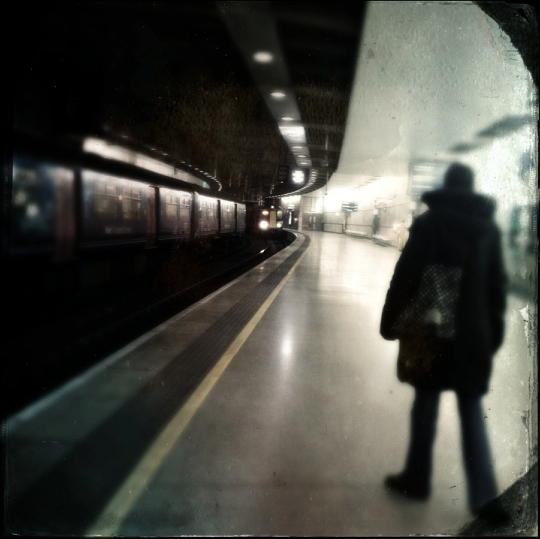
© Richard Gray – ‘Those triangles need to go’

Joanne Carter
Joanne Carter is a British photography journalist, editor, curator, and the founder of *TheAppWhisperer.com*, one of the world’s leading platforms dedicated to mobile photography and art. Since its launch in 2009, TheAppWhisperer has become an international hub for artists of all levels to discover, learn, exhibit, and engage with contemporary photographic practice.Built on principles of inclusivity, accessibility, and artistic excellence, Joanne has spent almost two decades championing mobile photography as a serious artistic medium. Through interviews, critical essays, exhibitions, competitions, and education, she has helped shape and document the evolution of mobile art on a global scale.Her work has taken her internationally, lecturing on photography and mobile art at institutions and events including the Museum of Art in Seoul, South Korea, alongside appearances in the UK and Europe. She has served as a juror for international photography and mobile art awards across Portugal, Canada, the United States, South Korea, Italy, and the UK.Joanne is also the founder of *TheAppWhispererPrintSales.com*, one of the first online galleries dedicated exclusively to collectible mobile art, connecting artists with collectors across Europe, the United States, and Asia.Before founding TheAppWhisperer, Joanne worked extensively in print journalism and photographic publishing, including roles at a paparazzi photo agency and as deputy editor of a leading photography magazine. Her freelance journalism, criticism, and commentary have been published widely in both the UK and the US, with bylines in *The Times*, *The Sunday Times*, *The Guardian*, *Popular Photography*, *NikonPro*, *DPReview*, *Which?*, *Vogue Italia*, *LensCulture*, the *BBC*, and more recently, the *Financial Times*, where her published letters on photography continue to contribute to wider conversations around the medium.Alongside her editorial and curatorial work, Joanne’s own photographic practice has been exhibited internationally across the UK, Europe, South Korea, and the United States. Her work increasingly explores themes of grief, loss, death, memory, and the body.Her current research interests centre on grief, death, and poverty, with forthcoming postgraduate study leading towards doctoral research in these areas.Joanne is currently developing new long-form writing and photographic projects and is available for commissions, editorial projects, speaking engagements, and collaborations.Contact: joannetheappwhisperer@gmail.com)

2 Comments
Robert Lancaster
My and those pesky black triangles are embroiled in a serious love hate relationship.
On occasion I have found that they add that special something to an image
And in other images (such as your station scene) they are a bit of an annoyance.
Catherine
Great article Richard! Didn’t know the history of cyanotype prints and found that quite interesting. Also agree with you about the triangles…sometimes they’re okay, but in many compositions I don’t want them. Touch Retouch is a miracle app, IMO. 🙂