‘Impossible’ Interview with ‘Elegia’
We’re delighted to be working closer with The Impossible Project team as we continue to branch out and expand our reach with all things related to mobile photography. Analog post-processing of mobile images is becoming more and more popular and we’re going to make sure our readers are fully briefed on this very exciting development.
The Impossible Project is in many ways leading the way, but there is also a growing community of mobile artists and photographers experimenting with other analog post processing techniques in an attempt to make their mobile images stand out even more, in galleries, magazines and the like and we have viewed some outstanding images and techniques.
A good deal of my formal photographic training (many years ago) was spent in a huge college darkroom and it is an area that I’ve always enjoyed, I think you will too. I also had a very close working relationship with Polaroid built up through my years as Technical Editor for various UK photography print magazines/titles.
Today we are publishing the sixth of a series of ‘Impossible’ articles, this time with Elegia. Elegia lives with her two cats – Baby Blue and Gypsy Lou and has “a boring part-time job which pays the bills, but allows me to have my days and weekends free to work on my photography.” She relocated to Manchester (England) to focus on pushing her work forward.
This is an interview that was conducted by the team at Impossible and they have given us kind permission to republish it here. We think you will enjoy this very much…
Elegia
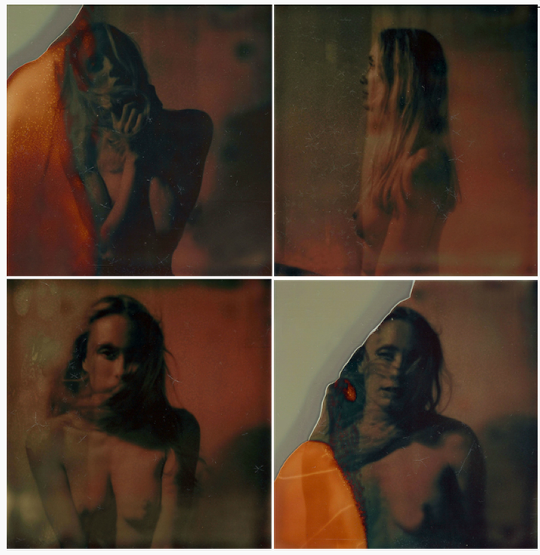
‘Fire walk with me’ – Elegia
Contact details for Elegia
How long have you been shooting Polaroid/Impossible film?
Two years.
What cameras do you use?
I use a box type that was my first Polaroid camera (Supercolor, an Image System, an SX-70 and an Automatic Land camera (100 version). I like the variation I get from all these. The Supercolor is dependable and sturdy (I’m pretty clumsy). The Image System is great for light leaks and playing around with multiple exposures. The SX-70 gives me scope with focusing and DOF. The Automatic Land camera is a bit more fiddly and interesting, as it’s one of the older types. I haven’t used that as much as I should really. It has bellows – gotta love bellows! I get old people coming up to me to talk about it whenever I take it out to shoot, which is really sweet. Polaroid cameras stir up a lot of love and nostalgia in people.
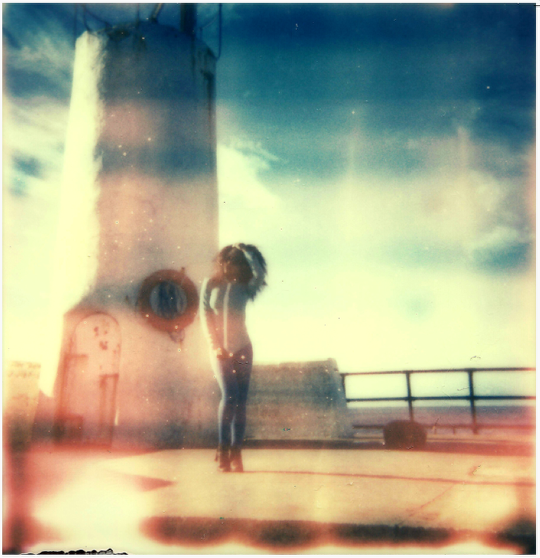
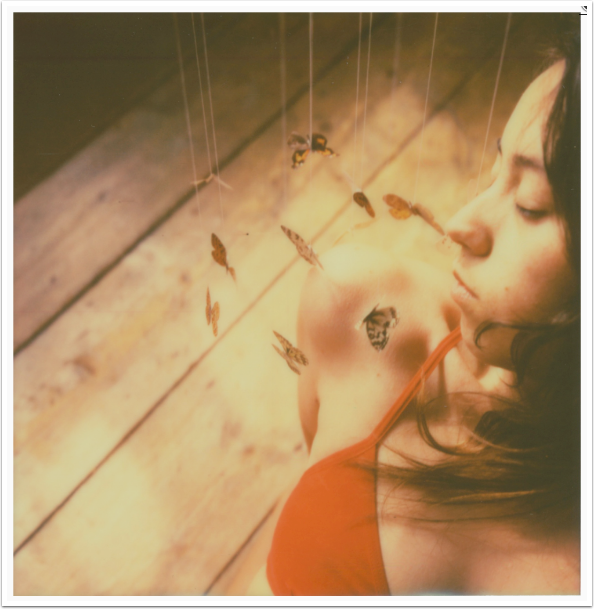
‘Dr J’ – Elegia
Where do you shoot most often?
Outdoors mostly, I prefer natural light and in the UK, ours is pretty poor. So I’m dying for the days to get longer again so that I can shoot more without freezing my bum off! I like expired IP films at the moment as they allow me to experiment with the flaws that they can give you. The Silver Shade has been really great for producing wonderful solarization effects. I’ve also been given a lot of film to be honest – most recently a batch of expired original Polaroid film from the eighties, which I’m treasuring. It could be dust inside but it could also be full of magical flaws and damage. Happy Dee.
How would you describe your work?
Cathartic, schizophrenic, personal. Evolving, hopefully. I never know how to answer questions concerning my inspirations as it’s quite a complicated myriad of things. I’ve begun to realise that mine are all deep-rooted in my childhood, hence loving things that remind me of it. I like objects, people and art that have an identity to them so I guess that I am inspired by those. People who tell you a bit about themselves via their work really inspire me a lot. Music, film and of course my surroundings too. My main drive is the need to improve and be more open about myself through my work. Those goals inspire me.
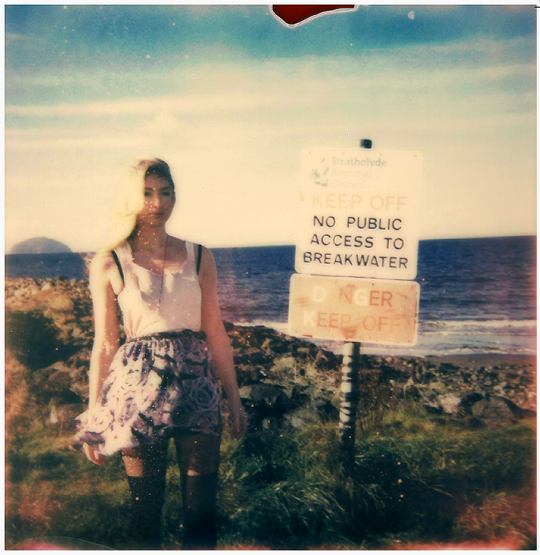
‘Alisa Craig’ – Elegia
Tell us a little about the four works you have chosen as your favourites?
Fire Walk With Me is a series that I shot using expired Silver Shade film for the first time. I wrote a blog on my website about shooting those (and other shots). These will always have a sentimental meaning to me as they ignited my love for that serendipitous element within expired film.
Dr J is the first Polaroid that I took where I tested the film by shooting into direct sunlight. I know some people love accuracy and strive for it, but I aim for damage and that little bit of a painterly effect in my work. This was shot on Cool Color Shade which was brilliant for giving you pastel colours.
Ailsa Craig is a Polaroid shot back home in Scotland, again using Cool Color shade. This has a few personal connotations, the smudge in the water to the left of the model Jenna, is actually an island called Ailsa Craig. It reminds me of a story that my Dad told me when I was wee. The signpost is one of those old objects with an identity that I love, the logo is out-of-date and the sign itself shouldn’t really still be there. I find lots of things in towns are losing their identity these days and I love looking for things like this to shoot. As soon as I found this place I knew that I needed to get a shot of it before it was gone. I was really pleased with how the colours and detail came out.
Lastly a more recent shot with a model I have shot the most, Faye. These were shot on the Color Protection film on my Image System in Faye’s hometown of Sheffield. We share a mutual obsession for rundown places so we tend to go on a wander until we find somewhere interesting to shoot at. The viewfinder in my Image System is broken currently so I’ve learned to judge composing shots differently. I know how to fix it but I’m kinda enjoying shooting this way. These were the first shots I produced using it with the broken viewfinder.
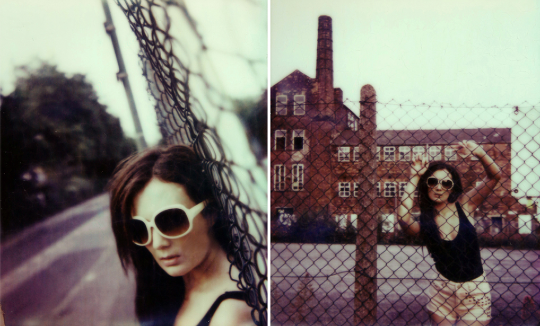
‘Faye’ – Elegia
Do you have any helpful creative techniques or advice you would like to share?
In the past I have spent a lot of time answering emails from people who ask about everything from how I edited something to what cameras/films I use. I’ve found that people are too focused on trying to find out the quickest and easiest way of reproducing something, instead of learning the techniques themselves. Every time I’ve thought about getting a certain camera, I’ve researched it online. I do the same with film types.
The best way to be creative or to learn a new technique is to do it yourself. I can’t teach anyone anything because my style is about me and anyone trying to recreate it is always going to fail or produce a poor copy. Why would you even want to do that? The only advice I would give is to be yourself, shoot for yourself and learn for yourself. It’s so much more rewarding.
Do you have any upcoming exhibitions/publications?
I do! I’m having an exhibition back home in Scotland. I will be producing solely new work for it this year so it’s a long process. I’m very excited and scared about it but having a goal for my work to be seen somewhere, other than online, is really important to me. There’s no point in being an analogue photographer if you don’t make prints. Analogue is all about what you hold in your hand. I’m also holding a small exhibit of some of my Polaroid work here in the North West of England.
Who are your favourite photographers?
Francesca Woodman, Guy Bourdin and Sally Mann are the three photographers that I most admire. I’m also a huge David Hockney fan these days despite not liking his work when I studied it a bit at college. I rediscovered him a couple of years ago. I guess that some work doesn’t resonate with you until you get to a certain point in your life.
What are you hoping for from Impossible during the next year?
I’ve spent the last two years supporting and standing up for Impossible due to quite a lot of vitriol from digital photographers who don’t ‘get’ it. I’m hoping to keep on proving just how amazing the entire instant photography medium is and that more people will come on board with me. The Impossible community is passionate and positive and that’s the kind of environment where people and their work flourish. I’m hoping to see that spirit continue on this year and for more years to come.

Joanne Carter
Joanne Carter is a British photography journalist, editor, curator, and the founder of *TheAppWhisperer.com*, one of the world’s leading platforms dedicated to mobile photography and art. Since its launch in 2009, TheAppWhisperer has become an international hub for artists of all levels to discover, learn, exhibit, and engage with contemporary photographic practice.Built on principles of inclusivity, accessibility, and artistic excellence, Joanne has spent almost two decades championing mobile photography as a serious artistic medium. Through interviews, critical essays, exhibitions, competitions, and education, she has helped shape and document the evolution of mobile art on a global scale.Her work has taken her internationally, lecturing on photography and mobile art at institutions and events including the Museum of Art in Seoul, South Korea, alongside appearances in the UK and Europe. She has served as a juror for international photography and mobile art awards across Portugal, Canada, the United States, South Korea, Italy, and the UK.Joanne is also the founder of *TheAppWhispererPrintSales.com*, one of the first online galleries dedicated exclusively to collectible mobile art, connecting artists with collectors across Europe, the United States, and Asia.Before founding TheAppWhisperer, Joanne worked extensively in print journalism and photographic publishing, including roles at a paparazzi photo agency and as deputy editor of a leading photography magazine. Her freelance journalism, criticism, and commentary have been published widely in both the UK and the US, with bylines in *The Times*, *The Sunday Times*, *The Guardian*, *Popular Photography*, *NikonPro*, *DPReview*, *Which?*, *Vogue Italia*, *LensCulture*, the *BBC*, and more recently, the *Financial Times*, where her published letters on photography continue to contribute to wider conversations around the medium.Alongside her editorial and curatorial work, Joanne’s own photographic practice has been exhibited internationally across the UK, Europe, South Korea, and the United States. Her work increasingly explores themes of grief, loss, death, memory, and the body.Her current research interests centre on grief, death, and poverty, with forthcoming postgraduate study leading towards doctoral research in these areas.Joanne is currently developing new long-form writing and photographic projects and is available for commissions, editorial projects, speaking engagements, and collaborations.Contact: joannetheappwhisperer@gmail.com)