How To Travel Light And Shoot Like A Pro
Some travelers roam the world because of their love of photography. There is something quite invigorating and fulfilling in capturing the earth’s wonders into still photos. It is often assumed that in order to capture amazing and intricate travel photos, a lot of camera gear is necessary. This is a drawback in travelling because camera equipment is more often than not, difficult to carry around. The tips below will shed some light on how to resolve this dilemma.
Choose your gear
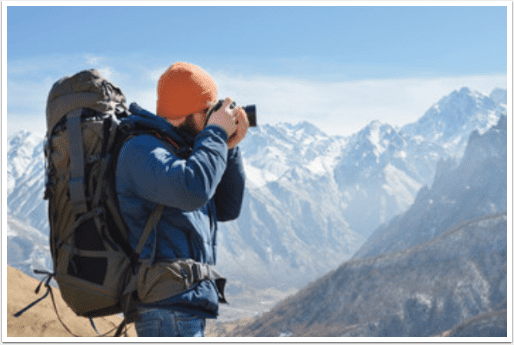
Photographers find it rather difficult to leave behind their camera gear when they travel and this is because they assume that all their gear is necessary. But bringing everything is not advisable, especially when basic needs such as clothing and footwear also need to take up space in the luggage. Hence, it is essential to pick only at least five camera items that you cannot live without, and make sure that it fits into a compact, hiking backpack. A wide zoom lens tops the list of most photographers in terms of camera gear essentials. Others opt for lightweight tripods together with a simple point and shoot camera. But of course, batteries and chargers should not be left behind, as well as a remote trigger that even fits in your pocket. For travels that last over a longer period of time, external hard drives and camera cleaner kits also come in handy. For places that often experience heavy rainfall, a rain cover for the camera is deemed necessary.
Maximise the Use of Natural Light
A complete set of camera gear will surely aid in taking breathtaking photos. However, all these will be immaterial if a photographer is not equipped with the proper technique and skill. It is unfortunate to admit that while everybody loves photography and is appreciative of wonderful pictures, not all have a keen eye to capture impressive stillness. With the proper technique, a lot of camera gear may be deemed unnecessary, hence, bringing a lot of stuff during travels is not needed.
A great photographer maximizes the use of natural light, outdoing pictures captured with a complete set of camera equipment. There is what is known as a golden hour. This is a very small window in the morning as the sun is rising and in the afternoon as the sun is setting, wherein the natural light is impeccable, resulting in perfect outdoor landscape pictures. In this case, flash is unnecessary and can be left at home. However, working with natural light may be challenging, especially during rainy days. On a positive note, gloomy weather can add drama to your shots. As a bonus tip, a piece of plain white cardboard can be used as a reflector when needed, and this does not take up much space in your luggage. In fact, you can even use it as a fan when it is hot.
Plan and Be Ready
The content of your luggage depends on your destination. For sure, you will not bring with you a parka if you are traveling to a tropical country. This is true with the camera equipment you need to bring with you during your travel. If you are headed towards the beach or a tropical country, chances are you do not need to bring with you a flash. On the other hand, if you are travelling during the winter months or to destinations where rain usually pours, then it is best to bring with you a camera cover.
If you are only traveling for a couple of days, then perhaps bringing along a couple of external hard drives may no longer be necessary because you have the option to store your photos on a cloud server. But this may not be the case if your trip requires you to be away for a few weeks, or even months. It also helps to know if there are local service centers in your destination so that you will be prepared if something unfortunate happens with your camera and camera gear. Hence, it is important to know the details of your trip for you to be able to plan what to bring in terms of your camera equipment. This will enable you to pack light and leave some room in your luggage for more important stuff.
Final Word
Overall, travelling is fun and being able to capture awesome photos while on the road is even more amazing. However, mastering the art of photography is a skill that can be used to your advantage in terms of traveling, and traveling light at that.

Joanne Carter
Joanne Carter is a British photography journalist, editor, curator, and the founder of *TheAppWhisperer.com*, one of the world’s leading platforms dedicated to mobile photography and art. Since its launch in 2009, TheAppWhisperer has become an international hub for artists of all levels to discover, learn, exhibit, and engage with contemporary photographic practice.Built on principles of inclusivity, accessibility, and artistic excellence, Joanne has spent almost two decades championing mobile photography as a serious artistic medium. Through interviews, critical essays, exhibitions, competitions, and education, she has helped shape and document the evolution of mobile art on a global scale.Her work has taken her internationally, lecturing on photography and mobile art at institutions and events including the Museum of Art in Seoul, South Korea, alongside appearances in the UK and Europe. She has served as a juror for international photography and mobile art awards across Portugal, Canada, the United States, South Korea, Italy, and the UK.Joanne is also the founder of *TheAppWhispererPrintSales.com*, one of the first online galleries dedicated exclusively to collectible mobile art, connecting artists with collectors across Europe, the United States, and Asia.Before founding TheAppWhisperer, Joanne worked extensively in print journalism and photographic publishing, including roles at a paparazzi photo agency and as deputy editor of a leading photography magazine. Her freelance journalism, criticism, and commentary have been published widely in both the UK and the US, with bylines in *The Times*, *The Sunday Times*, *The Guardian*, *Popular Photography*, *NikonPro*, *DPReview*, *Which?*, *Vogue Italia*, *LensCulture*, the *BBC*, and more recently, the *Financial Times*, where her published letters on photography continue to contribute to wider conversations around the medium.Alongside her editorial and curatorial work, Joanne’s own photographic practice has been exhibited internationally across the UK, Europe, South Korea, and the United States. Her work increasingly explores themes of grief, loss, death, memory, and the body.Her current research interests centre on grief, death, and poverty, with forthcoming postgraduate study leading towards doctoral research in these areas.Joanne is currently developing new long-form writing and photographic projects and is available for commissions, editorial projects, speaking engagements, and collaborations.Contact: joannetheappwhisperer@gmail.com)