Book Review – The Grind by Steve Madden
Book Review – The Grind by Steve Madden
The photographs in The Grind were made over three winters during the evening rush hour on London buses. That is the project’s simple structure. After finishing his morning work at the BBC, Steve Madden would return to central London when the weather turned cold, wet or usually both. He wasn’t waiting for dramatic events or decisive moments. He was waiting for condensation — the kind that fogs bus windows so completely that the interior begins to dissolve into light and colour. Anyone who has travelled through London in winter knows that surface.
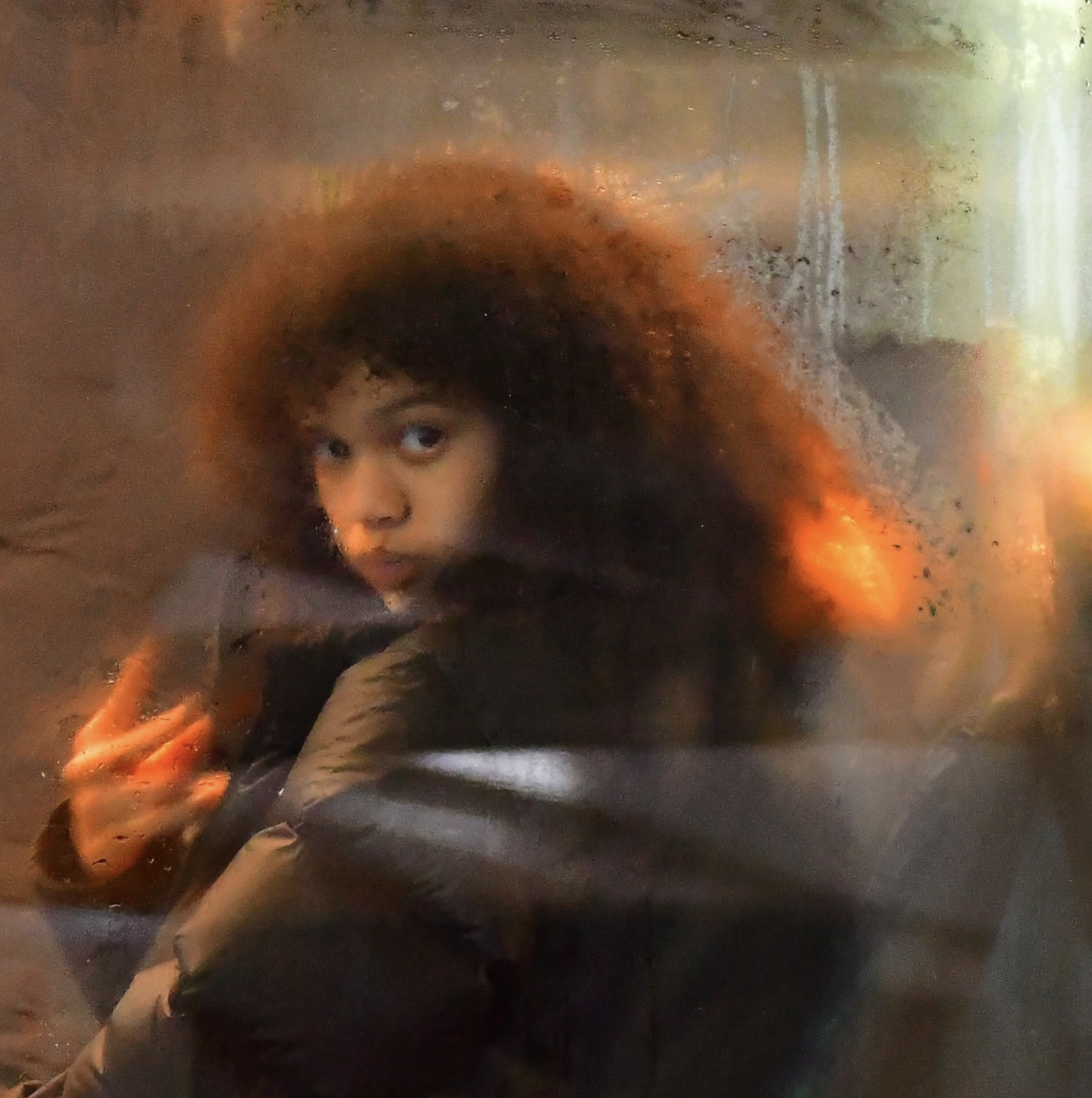
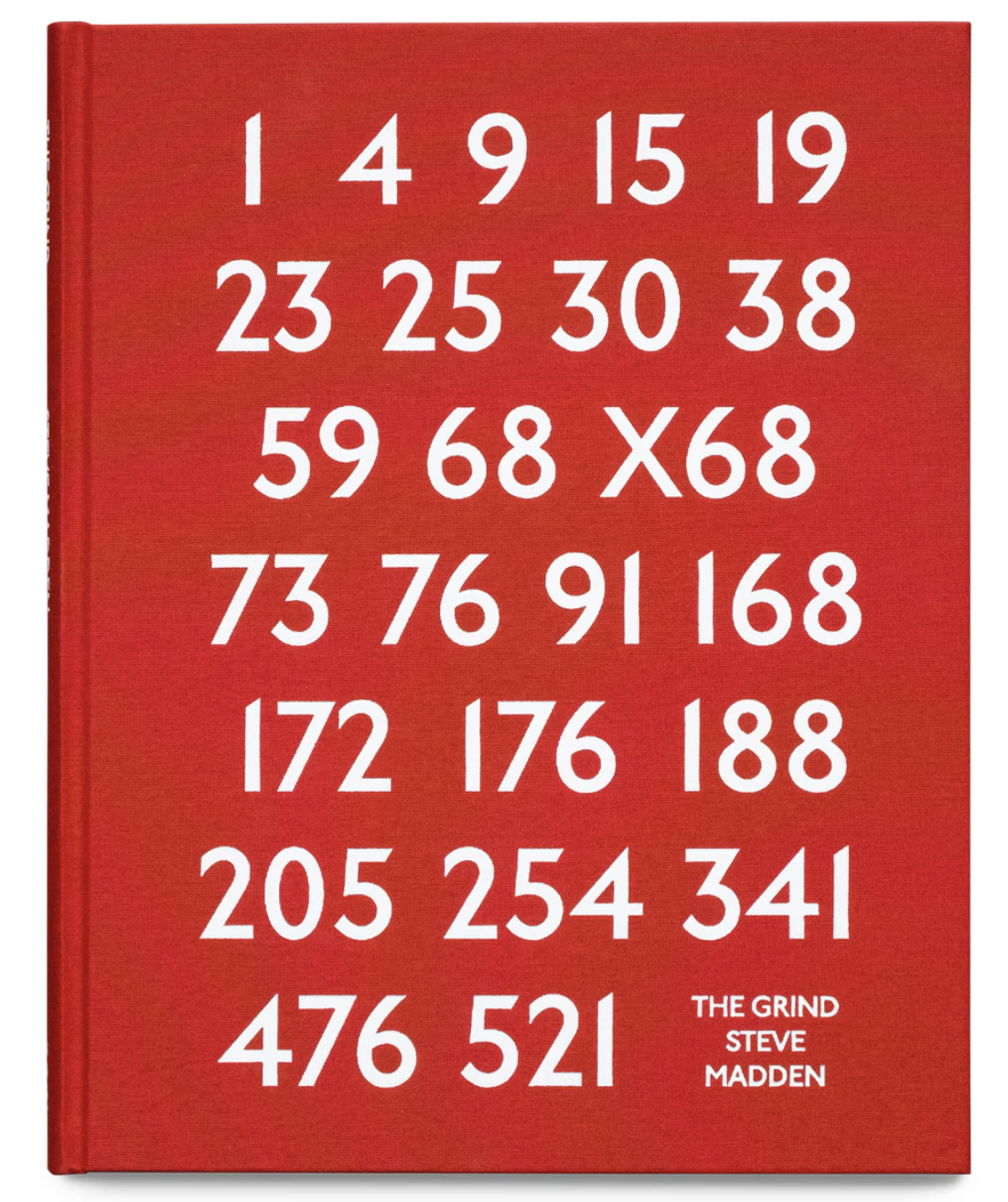
London carries millions of bus journeys each day, yet these photographs do not attempt to capture that scale. Instead, they remain small and specific. The cover itself lists route numbers rather than images — 1, 4, 9, 15, 19, 23, 25, 30, 38, 59, 68, X68, 73, 76, 91, 168, 172, 176, 188, 205, 254, 341, 476, 521 — grounding the work in the infrastructure of the city rather than in spectacle. The places Madden returns to — Finsbury Park, Hounslow, Islington, Kingston, the Strand, Stratford, Waterloo, Whitechapel — are not landmarks. They are part of the daily weave of London. The project sits inside that repetition rather than trying to summarise it.
What struck me first was not theory, but dampness. The way the glass refuses clarity. The commuters are there, clearly present, yet never fully available. The condensation interrupts the exchange between viewer and subject. You can see someone sitting behind the window, but not enough to be certain who they are.
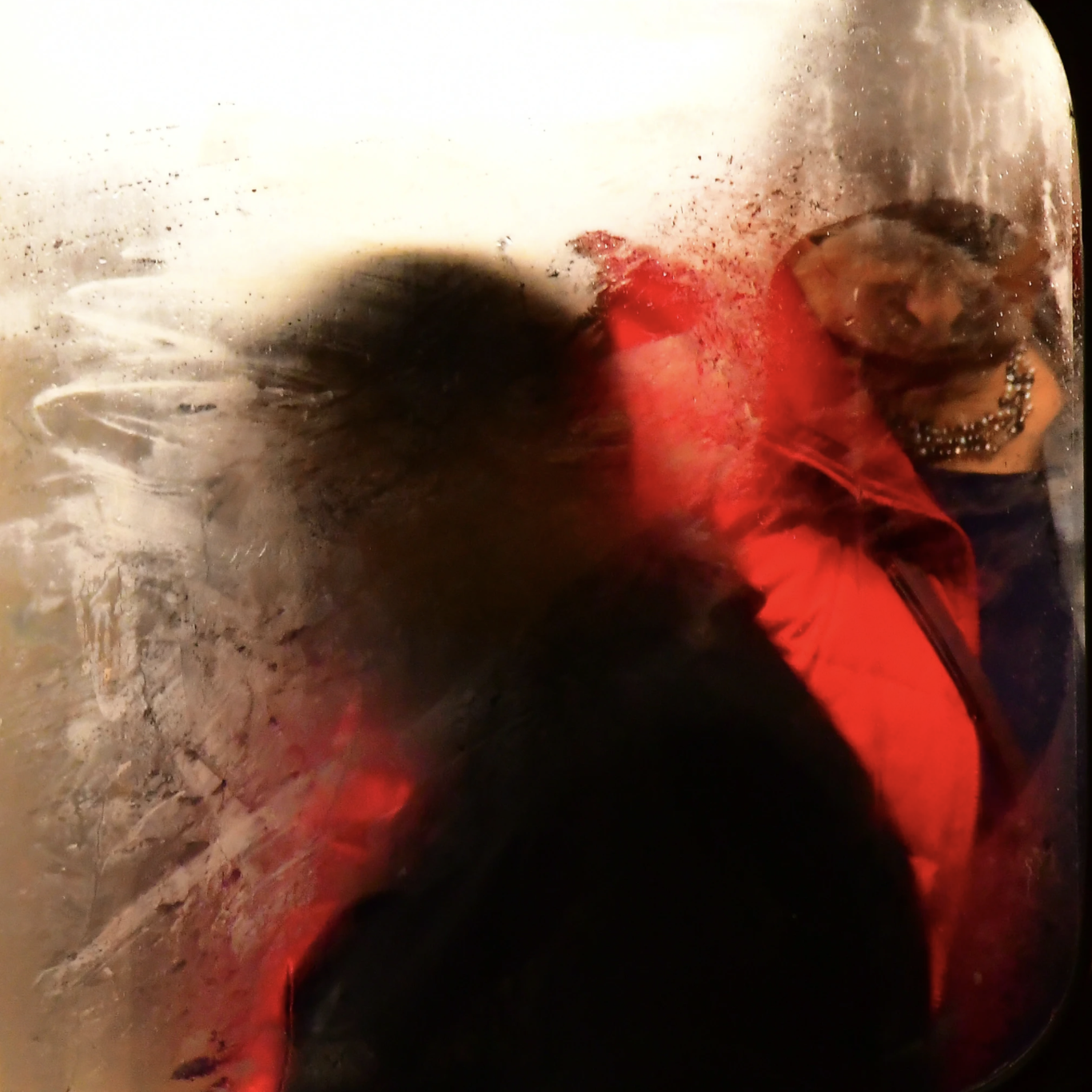
That instability holds the image in place. It never quite settles. The longer I look, the more it reminds me of how memory behaves — not as a concept, but in practice. When I try to picture someone, it is rarely a complete face that comes first. It is a detail. A posture. A sleeve. Sometimes just a colour that surfaces before the rest of the image gathers around it.
Most of what you see in these photographs is grey. The window flattens everything into the same muted surface. After a while, you stop searching for faces. Then colour appears — a red coat near the edge, a sleeve pushing forward through the blur, a brief flash of blue. It does not resolve the image. The blur remains. But it anchors the body in place. You know someone is there, even if the features never quite come into focus.
Because these are evening journeys, the atmosphere carries a particular weight. Morning commuting has a different energy — people assembled, alert. Here, the day seems to have worn people down slightly. Shoulders lean forward. Heads tilt. The fluorescent lighting, which might otherwise feel harsh, softens once filtered through misted glass. The bus continues moving through the city, but inside, there is a brief pause. A few minutes between destinations.
My own academic research has made me attentive to that kind of suspended presence. I have spent years reflecting on grief and spectatorship — about what it means to look at someone who cannot fully return that look. Grief makes it clear that a person can feel vividly present and still remain out of reach. A photograph confirms that someone once stood in front of the lens, but it does not close the distance. In The Grind, the commuters occupy something similar. They are visible enough, yet the glass maintains a separation. The distance is not symbolic. It is simply how the image has been made.
There is also a quiet unease that can accompany street photography. A stranger is framed, and the image travels beyond their control. In Madden’s work, the condensation shifts that dynamic slightly. The viewer cannot arrive at full possession. The image resists certainty. Something remains unsettled.
The use of rain-streaked or misted glass inevitably recalls the work of Saul Leiter, whose mid-century photographs of New York also allowed windows and reflections to dominate the frame. Like Leiter, Madden is comfortable with obstruction. He does not try to clear the surface. However, where Leiter’s work often leans toward painterly lyricism, Madden’s emphasis feels more infrastructural. The repetition of bus routes, the specificity of London’s transport network, and the emphasis on routine place the work firmly within the everyday machinery of the city.
Madden notes that newer buses no longer mist up quite as much. Air-conditioning has altered the interior climate. It sounds like a minor detail, but visually it changes everything. The fogged windows, heavy winter coats, and glow against dark streets depend on particular conditions. Without presenting itself as archival, the project ends up preserving a version of winter commuting that may already be shifting.
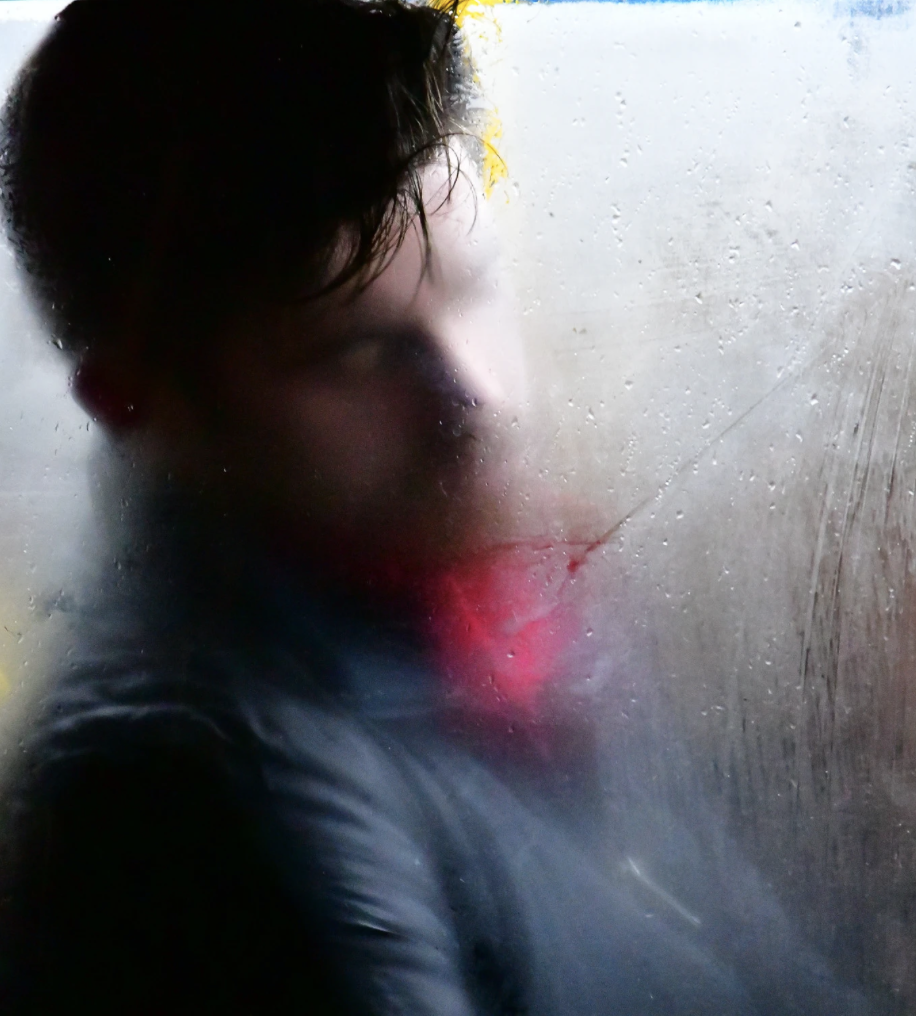
It is striking how still these images feel, given that they centre on movement. The bus is travelling, yet the figures inside seem suspended between departures and arrivals. Nothing dramatic unfolds. People sit or stand. They look through reflections. They withdraw into themselves. The ordinariness is part of what gives the work its weight.
The book does not force meaning onto these commuters. It does not elevate them into symbols. It allows them to remain partially unknown. That restraint feels consistent with urban life more broadly. Cities bring people into close physical proximity without necessarily bringing their lives together. You share buses, pavements, and queues. You are physically close most of the time. But that does not guarantee a connection.
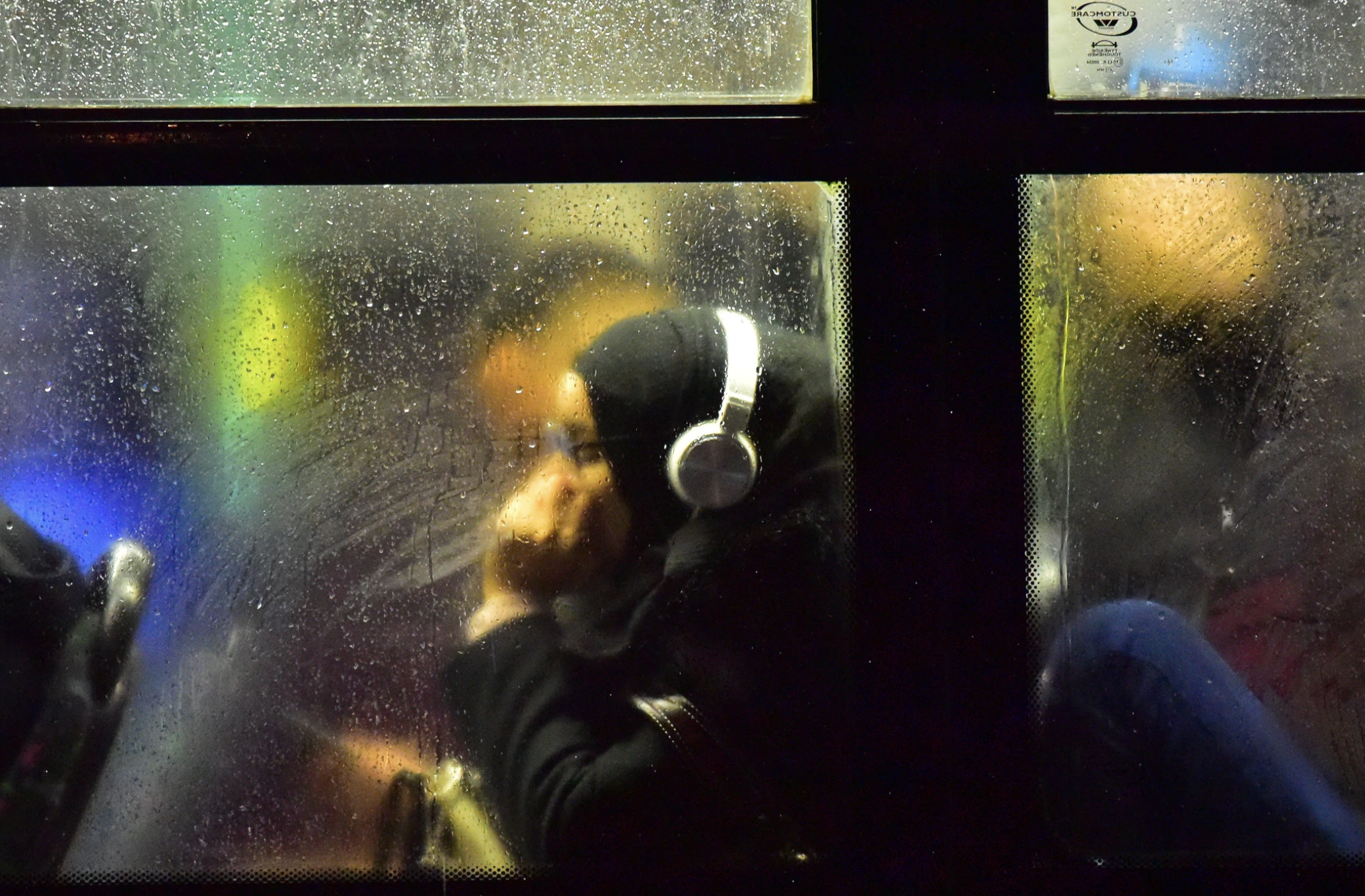
Spending time with The Grind gradually altered how I noticed buses. Not in a dramatic way. I began to pay attention to the glow on wet evenings, to reflections layered across faces, to colour surfacing briefly and fading again. I became more aware of how many lives move alongside mine without intersecting. The mist in these photographs does not feel decorative. It feels accurate. There is always something between us — glass, weather, fatigue, memory. Madden leaves that barrier intact.
And that restraint continues to stay with me.
To purchase this book, please click here
About Steve Madden
– Steve Madden
Please support us
TheAppWhisperer has always had a dual mission: to promote the most talented artists of the day and to support ambitious, interested viewers worldwide. As the years pass, TheAppWhisperer has gained readers and viewers and has found new venues for that exchange.
All this work thrives with the support of our community. Your support helps protect our independence, and we can keep delivering open, global promotion of artists. Every contribution, however big or small, is valuable for our future.

Joanne Carter
Joanne Carter, creator of the world’s most popular mobile photography and art website— TheAppWhisperer.com— TheAppWhisperer platform has been a pivotal cyberspace for mobile artists of all abilities to learn about, to explore, to celebrate and to share mobile artworks. Joanne’s compassion, inclusivity, and humility are hallmarks in all that she does, and is particularly evident in the platform she has built. In her words, “We all have the potential to remove ourselves from the centre of any circle and to expand a sphere of compassion outward; to include everyone interested in mobile art, ensuring every artist is within reach”, she has said. Promotion of mobile artists and the art form as a primary medium in today’s art world, has become her life’s focus. She has presented lectures bolstering mobile artists and their art from as far away as the Museum of Art in Seoul, South Korea to closer to her home in the UK at Focus on Imaging. Her experience as a jurist for mobile art competitions includes: Portugal, Canada, US, S Korea, UK and Italy. And her travels pioneering the breadth of mobile art includes key events in: Frankfurt, Naples, Amalfi Coast, Paris, Brazil, London. Pioneering the world’s first mobile art online gallery - TheAppWhispererPrintSales.com has extended her reach even further, shipping from London, UK to clients in the US, Europe and The Far East to a global group of collectors looking for exclusive art to hang in their homes and offices. The online gallery specialises in prints for discerning collectors of unique, previously unseen signed limited edition art. Her journey towards becoming The App Whisperer, includes (but is not limited to) working for a paparazzi photo agency for several years and as a deputy editor for a photo print magazine. Her own freelance photographic journalistic work is also widely acclaimed. She has been published extensively both within the UK and the US in national and international titles. These include The Times, The Sunday Times, The Guardian, Popular Photography & Imaging, dpreview, NikonPro, Which? and more recently with the BBC as a Contributor, Columnist at Vogue Italia and Contributing Editor at LensCulture. Her professional photography has also been widely exhibited throughout Europe, including Italy, Portugal and the UK. She is currently writing several books, all related to mobile art and is always open to requests for new commissions for either writing or photography projects or a combination of both. Please contact her at: joanne@theappwhisperer.com