
KickStarter – Daguerreotype & Ambrotype Inspired Mirror & Glass iPrints – iPhoneArt.com
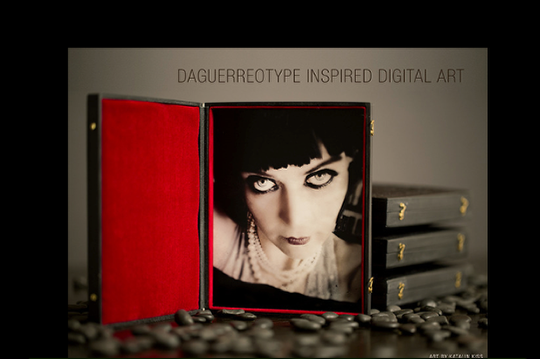
Our friends and colleagues at iPhoneArt.com have launched a KickStarter campaign in order to raise enough money to create high end print products. They have been developing new printing techniques for digital art and photography for several years. Their focus on mobile arts has enabled them to design two new products that will be accessible to all.
They have a target of $30,000 and have some way to go, they’re currently on $3,037 with 27 days to go and as with most Kickstarter projects, it will not be funded if the target is not reached.
Supporting Video

Joanne Carter
Joanne Carter is a British photography journalist, editor, curator, and the founder of *TheAppWhisperer.com*, one of the world’s leading platforms dedicated to mobile photography and art. Since its launch in 2009, TheAppWhisperer has become an international hub for artists of all levels to discover, learn, exhibit, and engage with contemporary photographic practice.Built on principles of inclusivity, accessibility, and artistic excellence, Joanne has spent almost two decades championing mobile photography as a serious artistic medium. Through interviews, critical essays, exhibitions, competitions, and education, she has helped shape and document the evolution of mobile art on a global scale.Her work has taken her internationally, lecturing on photography and mobile art at institutions and events including the Museum of Art in Seoul, South Korea, alongside appearances in the UK and Europe. She has served as a juror for international photography and mobile art awards across Portugal, Canada, the United States, South Korea, Italy, and the UK.Joanne is also the founder of *TheAppWhispererPrintSales.com*, one of the first online galleries dedicated exclusively to collectible mobile art, connecting artists with collectors across Europe, the United States, and Asia.Before founding TheAppWhisperer, Joanne worked extensively in print journalism and photographic publishing, including roles at a paparazzi photo agency and as deputy editor of a leading photography magazine. Her freelance journalism, criticism, and commentary have been published widely in both the UK and the US, with bylines in *The Times*, *The Sunday Times*, *The Guardian*, *Popular Photography*, *NikonPro*, *DPReview*, *Which?*, *Vogue Italia*, *LensCulture*, the *BBC*, and more recently, the *Financial Times*, where her published letters on photography continue to contribute to wider conversations around the medium.Alongside her editorial and curatorial work, Joanne’s own photographic practice has been exhibited internationally across the UK, Europe, South Korea, and the United States. Her work increasingly explores themes of grief, loss, death, memory, and the body.Her current research interests centre on grief, death, and poverty, with forthcoming postgraduate study leading towards doctoral research in these areas.Joanne is currently developing new long-form writing and photographic projects and is available for commissions, editorial projects, speaking engagements, and collaborations.Contact: joannetheappwhisperer@gmail.com)
3 Comments
Carlos
Creative and interesting. Shall have a look!
Mike
The framing/mounting options are nice. The wooden feet for the dimensional glass could be a little less clunky IMHO. Love the Bamboo and the floater stand off wall mount though!
Please note that I believe the imaging process to be inkjet dye sublimation. I worked extensively with his process several years ago imaging ceramic tile commercially. This process has been around for a decade. The image is sharp and color is reasonably true to the original but it will fade if exposed to direct sunlight or strong florescent.
Mike
Good news! I had the opportunity to speak with the developer via email about his process. He claims that dye sub is only one of several approaches they’re taking, several of the others employ a UV process which should produce a product less prone to fading.
Keep in mind that everything fades in time, even a traditional dark room print can only withstand the ravages of direct light for 80-100 years. Inkjet dye sublimation was notoriously worse however exhibiting image degradation in as short a period as 18 months.