iPhone Duo vs Motorola Razr Fold: iOS or Android – Which Makes More Sense for Photographers?
The arrival of Apple’s iPhone Duo makes 2026 an important year for foldable smartphones, although Apple is entering a category that other manufacturers have already spent several years developing. Motorola is particularly interesting because the Razr name has been associated with folding phones for decades, and its new Motorola Razr Fold moves beyond the familiar flip format into the same book-style territory Apple is now exploring.
There will be plenty of comparisons based on processors, display sizes and operating systems, but those aren’t really the questions that interest us most at TheAppWhisperer. A folding smartphone only becomes genuinely interesting photographically if the form itself changes what we can do with the camera, how we compose an image, how we interact with the person being photographed, and what happens when we begin reviewing and editing our work.
Seen from that perspective, the iPhone Duo and Motorola Razr Fold are considerably more interesting than another iOS-versus-Android contest. They represent two different approaches to turning the smartphone into a larger and potentially more adaptable photographic tool.
iPhone Duo vs Motorola Razr Fold: key specifications
| Specification | Apple iPhone Duo | Motorola Razr Fold |
|---|---|---|
| Operating system | iOS 27.1 | Android 16 |
| Internal display | 7.6-inch Super Retina XDR | 8.09-inch LTPO pOLED |
| External display | 5.4-inch Super Retina XDR | 6.56-inch LTPO pOLED |
| Processor | Apple A20 Pro | Qualcomm Snapdragon 8 Gen 5 |
| RAM | 12GB reported; not officially disclosed by Apple | 16GB |
| Storage | 256GB, 512GB, 1TB or 2TB | 512GB UK model |
| Main camera | 48MP Fusion Main | 50MP wide with OIS |
| Ultra-wide | 48MP Fusion Ultra Wide | 50MP ultra-wide/macro |
| Telephoto | No dedicated telephoto; up to 2x optical-quality zoom from Fusion system | 50MP periscope telephoto with OIS |
| Front cameras | 12MP Centre Stage plus under-display FaceTime camera | 20MP external and 32MP internal |
| Battery | Dual-battery system; up to 44 hours of video playback using outer display | 6,000mAh silicon-carbon |
| Charging | Up to 50% in around 20 minutes with fast wired charging | Up to 80W wired |
| Water/dust resistance | IP68 | IP48/IP49 |
| UK price | From £1,999 | £1,799.99 launch RRP |
| Availability | Pre-order 16 October; available 23 October 2026 | Available now |
Two cameras that happen to fold
The basic idea is similar. Both devices provide an external display for conventional smartphone use and open to reveal a much larger internal screen. That larger canvas immediately has obvious photographic possibilities, particularly for examining fine detail, checking focus, comparing images, editing and working with applications whose interfaces have always felt compromised on a conventional phone display.
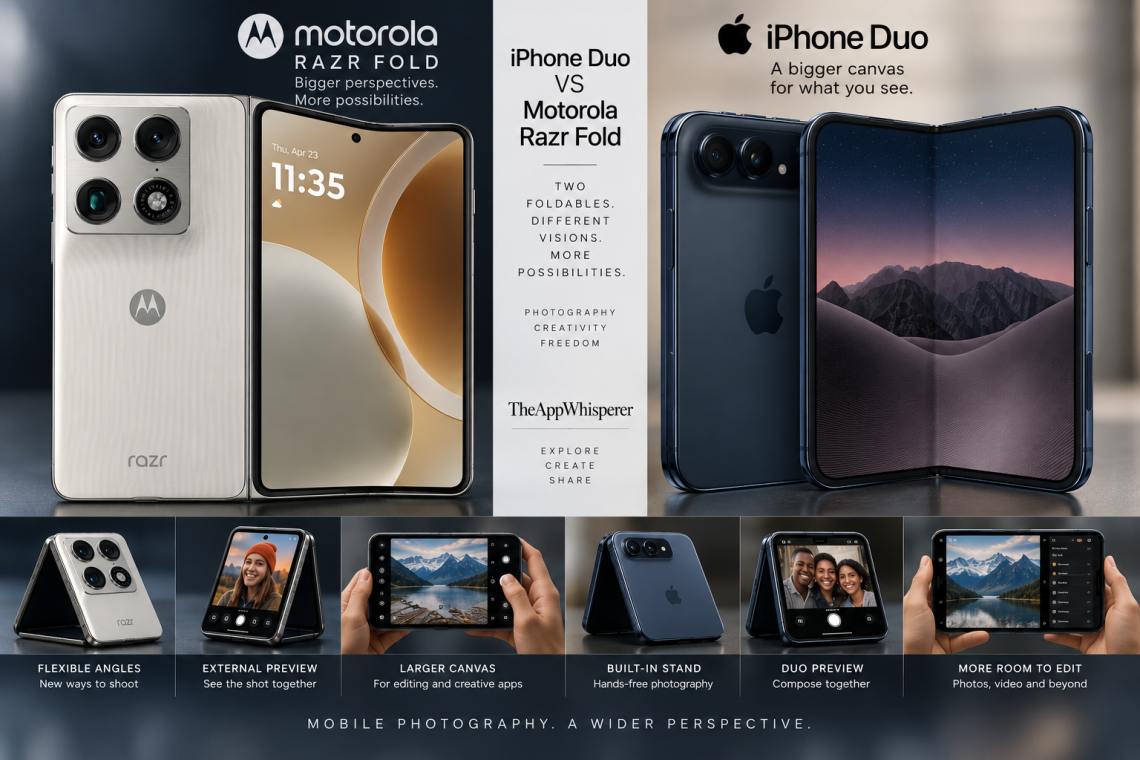
Motorola gives us more physical screen space. The Razr Fold opens to an 8.09-inch internal display, accompanied by a 6.56-inch outer screen, while Apple’s Duo has a 7.6-inch internal display and a considerably smaller 5.4-inch external one.

Those measurements tell us surprisingly little about which will actually be better for photographic work. What matters is how photographs look on those displays, how accurately colour is rendered, whether brightness and contrast remain consistent across the screen, how distracting the crease becomes when examining an image and whether editing applications make intelligent use of the additional space.
Apple has applied a nano-texture finish to the internal Duo display to reduce glare and reflections, which is particularly interesting because reflections remain one of the persistent frustrations of editing or reviewing photographs outdoors. Both of Apple’s displays also support ProMotion and reach up to 3,000 nits of peak outdoor brightness. Motorola’s larger panel, meanwhile, potentially provides a more comfortable editing environment, especially if application developers take advantage of it rather than simply stretching an existing phone interface across a bigger screen.
This is one of the areas we would want to examine properly in the App Lab because a larger display does not automatically make a better photographic display.
Motorola gives photographers more lenses
If we judge these phones purely by their rear camera hardware, Motorola makes the more immediately convincing case.
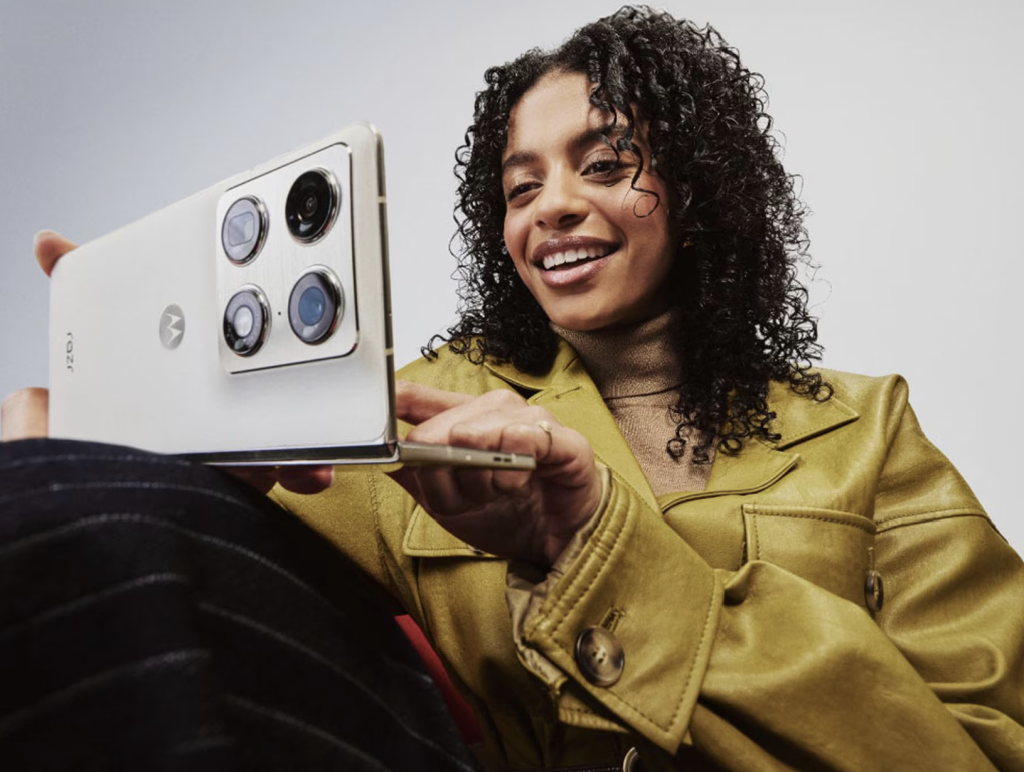
The Razr Fold combines three 50MP cameras, comprising a main camera, an ultra-wide that also supports macro photography and a dedicated periscope telephoto with optical image stabilisation. That creates a much broader native focal-length range and, importantly, gives photographers an actual telephoto camera rather than relying entirely on cropping and computational processing.
Apple’s Duo uses a 48MP Dual Fusion camera system comprising a 48MP Fusion Main and 48MP Fusion Ultra Wide. Apple provides 0.5x, 1x and 2x shooting options, with the high-resolution main sensor being used to deliver what Apple describes as up to 2x optical-quality zoom. There is no dedicated telephoto camera.
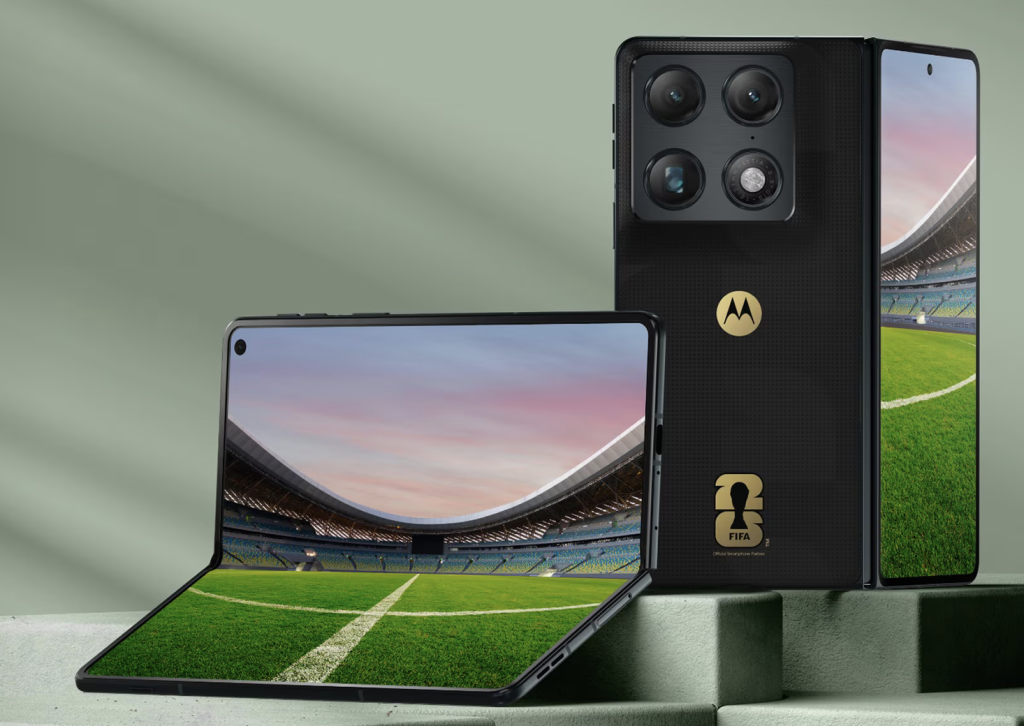
That distinction matters far more photographically than the difference between 48 and 50 megapixels. A longer lens changes where we can stand and how we can frame. It can compress perspective, isolate details in a landscape, alter the relationship between photographer and subject in portraiture, and allow a street photographer to work without physically moving into a scene.
On that basis, Motorola has given photographers a more versatile set of photographic tools. The absence of a dedicated telephoto on a £1,999 iPhone is significant, particularly when Apple’s own iPhone 18 Pro models include a 48MP Fusion Telephoto camera. The Duo will therefore need to make its case through image quality, computational processing and the possibilities created by its folding design.
The hinge could be more important than another camera
One of the most interesting aspects of either device may not be a sensor or lens at all, but the hinge and what it allows us to do with the camera.
Partially folding a smartphone changes the physical relationship between the camera and photographer because the device can support itself. Set it on a wall, table or another stable surface, and it effectively gains its own miniature stand, opening possibilities for self-portraits, group photographs, time-lapse work and video without immediately reaching for another accessory.
The second display introduces another possibility. When the rear cameras are being used, the external screen can show the person in front of the camera what the photographer is seeing. Portrait photography consequently becomes slightly more collaborative because the subject can understand the framing and their position within it while the photograph is being made.
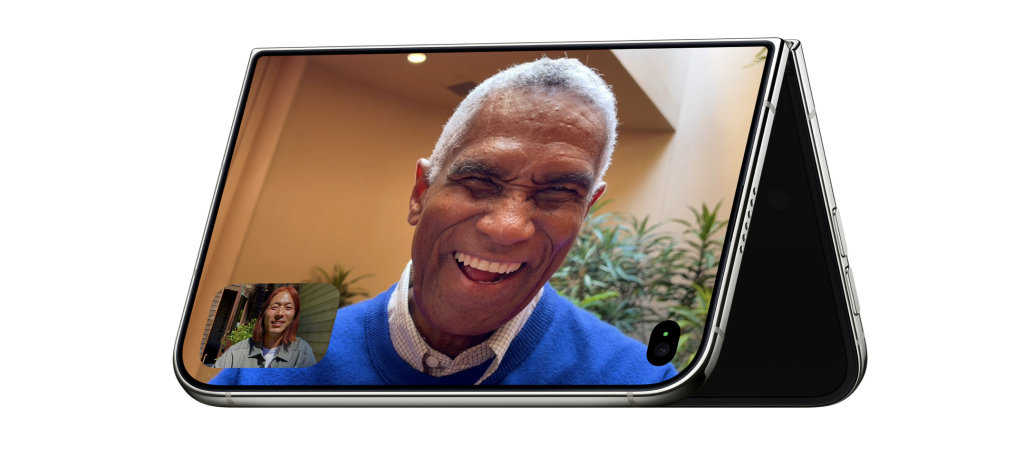
There are situations where that could be distracting, and there are photographers who would deliberately switch it off. In participatory or collaborative photographic practice, however, giving the person being photographed greater visibility of the image-making process could be genuinely useful.
Apple has developed several features specifically around this idea. Duo Preview provides a live preview on the outer display, while Smart Take can recognise when everyone is ready and make the photograph automatically, allowing the photographer to become part of the group rather than race against a timer. Kid Cue uses animations on the outer screen to attract a child’s attention towards the camera.
Motorola similarly takes advantage of its external display and partially folded positions, alongside photographic modes including Pro, Long Exposure, Night Vision and Macro.
This is where the fold starts to justify itself. Rather than simply making a large smartphone fit into a pocket, the physical structure begins to influence how photographs can be made.
What happens after pressing the shutter matters just as much
Camera comparisons still devote enormous attention to capture, but contemporary mobile photography does not end when the shutter is released. The smartphone has become the camera, darkroom, archive and publishing device, which makes the software environment surrounding these two foldables particularly important.
Apple has a significant advantage here because the iPhone already sits at the centre of a mature photographic ecosystem. RAW capture and processing, third-party camera applications, Lightroom and other editing tools, metadata management, cloud storage, AirDrop and continuity with iPad and Mac have developed over many generations of hardware.
The Duo does not need to invent that ecosystem. What it needs to demonstrate is that folding improves it. If applications simply expand to occupy a 7.6-inch display, the Duo becomes an iPhone with more screen. If developers can reposition controls, separate an image from its editing interface or make different elements available on different portions of the display, folding begins to alter the workflow itself.

Android offers a different kind of freedom. Motorola’s larger screen, Android 16 and more flexible approach to multitasking potentially allow the Razr Fold to behave more like an independent pocket workstation, particularly when several applications are being used together. Android’s approach to file management will also appeal to photographers who prefer greater direct control over where their images are stored and how they move between applications and devices.
The real contest, therefore, is not iOS against Android in the abstract. It is Apple’s integrated photographic ecosystem against Motorola’s combination of hardware versatility, screen space and Android flexibility.
The larger screen could change mobile editing
One of the longstanding contradictions of smartphone photography is that increasingly sophisticated images are often edited on relatively small displays. An eight-inch folding screen begins to change that equation.
There is enough space for an image to remain reasonably large while editing controls are visible, which should reduce the constant opening, closing and rearranging of interface elements familiar to anyone who has undertaken more involved edits on a phone.
It also creates interesting possibilities for comparing photographs, making selections from a shoot and working with reference images. Split-screen applications could potentially place an image editor alongside Files, Photos, notes or another visual source without making either application unusably small.

This is where Motorola’s larger internal display could become a genuine advantage, although software optimisation will determine whether that potential is realised. Apple, conversely, has enormous influence over both its operating system and developer frameworks, which allows it to make the Duo’s unusual display configuration feel less like an adaptation and more like something applications were designed for.
We will be particularly interested in how specialist photography apps respond. Manual camera applications, RAW editors, image-management tools and metadata utilities will tell us considerably more about the usefulness of these devices than watching video on their unfolded displays.
The question of image quality
Specifications inevitably dominate launch coverage, but megapixel counts alone tell us remarkably little about the photographs these devices will produce.
Sensor size, optics, stabilisation, computational processing, sharpening, noise reduction, HDR behaviour and colour rendering all contribute to the finished image. Increasingly, we also need to consider how much intervention takes place before the photographer even sees the file.
Apple has spent years refining its computational imaging pipeline, and consistency between lenses has traditionally been one of the strengths of the iPhone camera system. The challenge with the Duo will be whether Apple can maintain that quality while working within the physical restrictions of a thin, folding body.

Motorola’s camera specification is more ambitious, particularly with the inclusion of its periscope telephoto, but consistency across three cameras will be equally important. We want a photograph made with the ultra-wide, main and telephoto cameras to feel as though it belongs to the same imaging system rather than three cameras producing noticeably different colour, contrast and processing.
RAW performance will be especially revealing because it allows us to look beyond some of the decisions made automatically by each manufacturer’s computational pipeline. For photographers who want greater control over the final image, the quality and flexibility of those files may ultimately matter more than the immediately impressive photographs produced by automatic modes.
Video changes with the physical form too
The folding format could be equally useful for video. A phone capable of supporting itself at different angles immediately becomes easier to position for interviews, pieces to camera, time-lapse sequences and static shots without requiring a tripod for every situation.
The iPhone Duo records Dolby Vision video at up to 4K 120fps and benefits from Apple’s established strengths in stabilisation, computational video and integration with its wider editing environment. The ability to stand the Duo on its own also changes the practical experience of recording, particularly for solo creators.

Motorola counters with high-resolution video capabilities of its own, and, again, that larger internal display could be valuable when reviewing footage or working with editing applications.
The important tests will not revolve around which phone has the largest number printed beside its maximum video resolution. Exposure transitions, stabilisation, rolling shutter, heat management, sustained recording, microphone performance, colour consistency and battery consumption will tell us far more about whether either device can be relied upon for serious mobile filmmaking.
Battery life matters more when the phone becomes a workstation
Large displays consume power, photography consumes power and image editing consumes power, so battery performance becomes particularly important when these devices are being promoted as something more capable than a conventional smartphone.
Motorola equips the Razr Fold with a substantial 6,000mAh silicon-carbon battery and supports wired charging at up to 80W. On paper, that gives it a strong foundation for a full day involving photography, navigation, editing and general smartphone use.
Apple uses a dual-battery architecture in the Duo, reflecting the unusual internal design required by the folding format. Apple claims up to 31 hours of video playback using the inner display and up to 44 hours using the outer display, with fast wired charging capable of reaching approximately 50 per cent in around 20 minutes.
Those figures are useful, but our interest is in what happens during an actual photographic day. Shooting, using high screen brightness outdoors, moving between camera and editing apps, transferring files and recording video create a very different workload from ordinary mixed smartphone use.
A foldable that requires careful battery management halfway through a day’s photography becomes considerably less attractive, however impressive its display may be.
Can a foldable survive being used as a camera?
There is another practical consideration that tends to disappear beneath the excitement surrounding new form factors: photographers are not always gentle with their equipment.
Phones are taken into the rain, placed on walls and rocks, used on beaches, carried through cities and repeatedly removed from pockets and bags. Camera equipment inevitably accumulates dust, fingerprints and the occasional knock, and a foldable introduces a hinge and flexible internal display into that environment.
Apple has given the Duo an IP68 rating, a Grade 5 titanium frame and hinge cover, Ceramic Shield on the front and back, and a scratch-resistant coating on the inner display. Motorola has its own protection measures, but long-term durability cannot really be established from a launch specification.
The ability to stand these phones partially folded is photographically useful, but it also encourages us to place them on surfaces where a conventional phone might never be positioned. The robustness of the hinge and the protection afforded to the cameras and displays therefore, matter considerably.
For devices costing around the same as a capable interchangeable-lens camera body, photographers have every right to expect them to withstand real use.
iOS or Android becomes a workflow decision
For anyone already embedded in Apple’s ecosystem, the iPhone Duo has an obvious attraction because it should slot into an existing workflow with very little disruption. Images can move between iPhone, iPad and Mac, while photographers already using iCloud Photos, AirDrop and specialist iOS applications do not have to reconstruct the way they work simply because the hardware now folds.
Motorola’s proposition may be more attractive to photographers who want the phone itself to operate independently. Android’s file handling, multitasking and customisation provide a different kind of flexibility, and the Razr Fold’s larger internal display could make those advantages more apparent than they are on a conventional smartphone.

Neither philosophy is inherently better. The more useful question is where the phone sits within an individual photographer’s practice. If it is one component in a larger Apple-based workflow, the Duo has a natural advantage. If it is expected to perform more of the workflow itself, Motorola’s hardware and Android’s flexibility become increasingly persuasive.
Price changes the expectations
At £1,999 for the 256GB iPhone Duo and £1,799.99 as the Razr Fold’s UK launch price, these are exceptionally expensive smartphones. Apple’s pricing climbs further with storage, reaching £2,199 for 512GB, £2,599 for 1TB and an extraordinary £3,199 for the 2TB Duo.
At this end of the market, being innovative is not enough. The cameras need to be excellent, the displays need to be dependable, the hinge needs to survive repeated use, and the larger internal screen needs to contribute something meaningful beyond novelty.
It is also impossible to consider the price without looking at what the same money buys elsewhere. A photographer spending close to £2,000 could buy an excellent mirrorless camera, a premium conventional smartphone, an iPad or contribute significantly towards a new lens. A foldable, therefore, has to justify itself by combining functions in a way that those separate devices cannot.
That does not mean it needs to replace a dedicated camera. Mobile photography has never needed to prove its legitimacy by pretending smartphones and interchangeable-lens cameras are the same thing. The more interesting question is whether the foldable creates photographic opportunities that would otherwise be less convenient, less immediate or simply unavailable.
So which one makes more sense for photographers?
Based on hardware alone, the Motorola Razr Fold currently makes the stronger photographic argument. The combination of main, ultra-wide and dedicated periscope telephoto cameras gives it greater focal-length flexibility, while its larger internal display, substantial battery and Android multitasking provide the foundations for a very capable mobile creative device.
The iPhone Duo is more difficult to judge from its specification sheet because much of its potential lies in integration. Apple has taken the mature photographic environment surrounding the iPhone and changed the physical form of the device, which could become far more significant once specialist developers begin designing applications specifically for it.
That is why we would hesitate to declare either device the photographic winner simply by counting cameras or comparing processor specifications. We want to see what happens when they are used as cameras rather than smartphones being photographed for reviews.
We want to know whether the crease disappears from consideration when concentrating on an edit, whether RAW files retain enough information for substantial adjustment, whether colour remains dependable across both displays, how the cameras behave in difficult light, how quickly battery life falls during prolonged photographic use and whether the hinge genuinely creates new ways of working.
We also want to see what happens with third-party applications because that may ultimately determine whether either device becomes an important photographic tool or simply an interesting piece of hardware.
TheAppWhisperer verdict
The iPhone Duo and Motorola Razr Fold arrive at a point when smartphone photography no longer needs to prove that a phone can produce an excellent photograph. We established that a long time ago. The more interesting challenge now is finding ways of changing the experience of making, editing and sharing photographs, and the foldable format has the potential to do exactly that.
Motorola currently offers the most complete camera specification. A dedicated telephoto camera is a meaningful advantage, particularly for photographers who want focal-length flexibility without relying heavily on computational cropping, while the larger internal display gives the Razr Fold considerable potential as an editing and image-management device.
Apple’s proposition is different. The iPhone Duo brings the fold into an already sophisticated photographic environment encompassing capture, computational processing, RAW, editing, storage, metadata, third-party applications and integration with other Apple devices. If developers make intelligent use of the additional display and Apple continues opening its camera hardware to specialist applications, that ecosystem could ultimately prove more important than having another lens on the back.
What interests us most is the change in physical form. For almost two decades, smartphone photography has developed inside essentially the same rectangular slab. Cameras improved, displays became larger and computational imaging transformed what those tiny lenses could achieve, but the fundamental relationship between photographer and device barely changed.
The fold changes that relationship because it allows the screen to face the subject, lets the camera support itself, creates a much larger space for editing and introduces the possibility of interfaces that change according to how the device is being held or positioned. Whether manufacturers and app developers make full use of that potential remains to be seen, but this is where the iPhone Duo and Motorola Razr Fold become genuinely interesting.
The question is no longer simply whether iOS or Android makes the better foldable. For photographers, the much more important question is whether folding the smartphone can change the way we make photographs, and that is exactly what we intend to find out in TheAppWhisperer App Lab.
Please support us
TheAppWhisperer has always had a dual mission: to promote the most talented mobile artists of the day and to support ambitious, interested viewers worldwide. As the years pass, TheAppWhisperer has gained readers and viewers and has found new venues for that exchange.
All this work thrives with the support of our community. Your support helps protect our independence, and we can keep delivering open, global promotion of mobile artists. Every contribution, however big or small, is valuable for our future.

Joanne Carter
Joanne Carter is a British photographer, photography journalist, editor and curator and the founder and editorial director of TheAppWhisperer.com, an independent international photography publication established in 2009.Her journalism, criticism and commentary have appeared in The Times, The Sunday Times, The Guardian, Financial Times, BBC, Vogue Italia, LensCulture, Popular Photography, Android Magazine, NikonPro, DPReview, Which Digital Camera and Which Camera. She has lectured internationally on photography and mobile art, served as a juror for international photography awards, and exhibited her own photographic work across the UK, Europe, South Korea and the United States.Alongside her editorial work, Joanne's photographic and postgraduate research explores death, grief, memory, representation and social inequality through contemporary photography, participatory practice and visual research methods, with the longer-term aim of developing this work through doctoral research.Through TheAppWhisperer, she continues to publish independent photography journalism spanning contemporary photographic practice, mobile imaging, photographic apps, computational photography and emerging imaging technologies.Joanne is available for editorial commissions, photography projects, judging, curatorial work, speaking engagements, consultancy and selected collaborations.