Assignment – ‘Melancholy’ – Result and Third Essay with Peter Wilkin – @ for our forthcoming book – Away with Words
With two chapters behind us, our third chapter begins to take shape for our forthcoming book ‘Away with Words’, this will be published early next year.
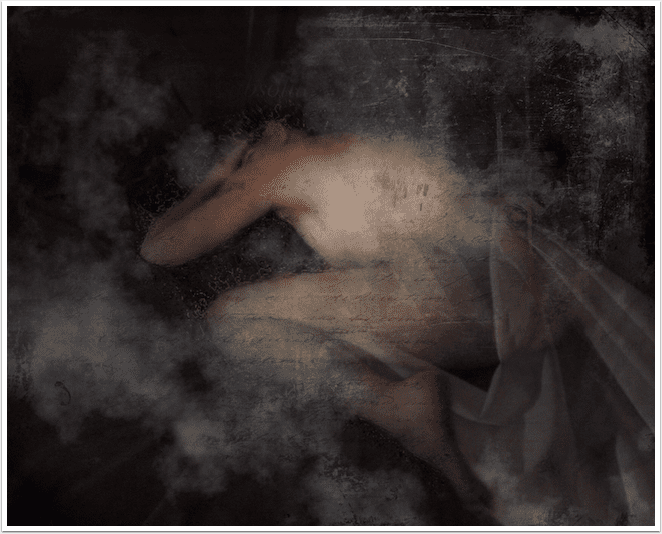
Our ‘assignment’ for this chapter was ‘Melancholy’ and we have selected Peter Wilkin’s image from the selection we were sent, as we feel it epitomises this subject, for our third of twelve 1000 word essays, personally written by myself.
This non fiction work merges discursive scholarship with what may be construed as personal flights of fancy. That is not to say it will disappoint, moreover I have given myself a far and wide range to delve into photography, literature, art, theory, design and music as I tease out my own offbeat associations and at the same time astutely tune into each mobile photographers key tropes and artfully deconstruct their imagery. I thus begin:
What are we looking at?
We are looking at a colour image of a woman laying naked in the foetal position. A position, that can resemble a state of distress or withdrawal. Her left arm is bent at the elbow and her hand is touching her forehead. Her hairless underarm is exposed, her breast is not visible at this intersection but we deduce that it is pressing into a soft cushion upon the floor. Her left leg is drawn up and her knee is in symmetry with her left elbow. The top of her left foot is flat to the floor and bent at the ankle joint to facilitate this. Her right arm, and right leg are not visible but we enthuse they lay beneath the main trunk of her body. Her bottom is covered whimsically with cloth, draped and applied using an art app. In addition, illusory clouds surround the woman, they are particularly heavily placed to the bottom left of the image. The background of the image is dark, allowing for the clouds and cloth, which are displayed in a lighter colour to visualise. Unintelligible words are opaquely visible upon the image. The image has been shot in an interior setting.
How can the image be interpreted?
Let’s speculate that mobile art is a method of human communication, as a dialogue moored in concrete social relations, in lieu as a mystified, lofty, and ahistorical domain of exclusively affective expression and awareness. Is there a difference to be found in written words and in imagery? In this image, words adjoin the imagery, although they are unintelligible.
The artist has made good use of geometric shapes, several triangles in this instance, to pose and organise the model. There is a psychology behind the use of geometric patterns in art and photography and how the human mind perceives each shape, suggestive of conformity. Each shape represents a different meaning, triangles are known to represent tension and that is fitting for this image, as it contains several.
Is this image sexual in nature? I do not visualise or experience this work in a sexual context. Simple* nudity – yes, but not sexual posing. There is definitely a sensual quality to the work, it is charged with atmosphere and mood, both as a result of the positioning of the model as well as the lighting, shading and brush strokes.
The sanctuary of her whole face is missing, we cannot see her lips and can only view one closed visible eye. It is almost as if the artist has chosen to remove any deliberate information from her face. The body language, suggests either the artist himself or the model is protective of her main core, her breasts, her sexuality.
The viewer feels somewhat forced to look at her body, her breasts uncomfortably flattened against their resting surface. There’s a vulnerability in looking at the armpit triangular apex with shading beneath, between the arm and leg. Her left hand is supporting or holding her head. Suggestive that her head is paining her, we do not know whether this is emotional or physical pain. A sense of ambiguity emanates from the subject herself. She appears lost in contemplation, deep in thought, deep in distress or possibly asleep. We feel that we want to lift her, embrace her, clothe her, love her. We do not know if she is conscious or unconscious. This picture has been entered for our melancholy assignment so we are to deduce that she is experiencing a profound sense of loss or distress. It is unclear to speculate whether it represents, the end of a relationship, the death of a loved one, the diagnosis of a terminal illness, bankruptcy or any of these life disasters. The frustratingly impenetrable text sits in full view above the image, perhaps this is a symbol of a broken relationship, a love letter or a letter of self destruction…
‘I sense a revelation of loneliness, that omnipresent, unanswerable feeling of despair, just as every love story, is a potential grief story. Its resonance comes from all that it does not say, as well as what it does. From the depth of love we infer from the desert of grief‘, from the book ‘The sense of another ending’ ©Julian Barnes, 2013.
Could this image be a metaphor for a dream? Is the artist reliving their own anxieties through this imagery? Dreams offer the power to turn the lights on and off, in real life, is this artist retreating? Should we open or close our eyes to its more prurient explorations of voyeurism, which in turn somewhat serve to distract rather than focus our attention.
Through technique and medium Wilkin seems to create imagery that is almost more real than reality. Wilkin’s images transcend the medium of mobile photography and with this image he is exploring the connection between isolation and creativity.
Conclusion
Wilkin has orchestrated an image, a story that somehow avoids punishing the viewer as much as the model. It demands patience, to interpret and it conveys the profound isolation of mental distress and the absolute futility of searching for someone, something, to blame. Fighting the omnipresent melancholy in small ways, rather than large, this image is devolved into the arias of melodrama; If only depression were always this pretty.
*Despite describing this work as ‘simple nudity’, I mean this as ‘tongue in cheek’, there is actually nothing simple about it, in terms of nudity.

Joanne Carter
Joanne Carter is a British photographer, photography journalist, editor and curator and the founder and editorial director of TheAppWhisperer.com, an independent international photography publication established in 2009.Her journalism, criticism and commentary have appeared in The Times, The Sunday Times, The Guardian, Financial Times, BBC, Vogue Italia, LensCulture, Popular Photography, Android Magazine, NikonPro, DPReview, Which Digital Camera and Which Camera. She has lectured internationally on photography and mobile art, served as a juror for international photography awards, and exhibited her own photographic work across the UK, Europe, South Korea and the United States.Alongside her editorial work, Joanne's photographic and postgraduate research explores death, grief, memory, representation and social inequality through contemporary photography, participatory practice and visual research methods, with the longer-term aim of developing this work through doctoral research.Through TheAppWhisperer, she continues to publish independent photography journalism spanning contemporary photographic practice, mobile imaging, photographic apps, computational photography and emerging imaging technologies.Joanne is available for editorial commissions, photography projects, judging, curatorial work, speaking engagements, consultancy and selected collaborations.

One Comment
Carol Wiebe
This moved me—both the essay, and the image that prompted it.
A haiku was suggested in a sentence I found particularly moving, and evocative.
The sanctuary
Of her face is hidden yet
Holiness resides